 Destinations
 Data sources
 AI insights
 About us
 Careers
 Security
 Customer reviews
 Contact us
 Affiliate program
 Solution partners
 Template gallery
 Looker Studio templates
 Power BI templates
 Excel templates
 Google Sheets templates
 Tableau templates
 Facebook Ads templates
 Google Ads templates
 Data fields & Metrics
 AI prompt library & Guides
 Product documentation
 API documentation
 Case studies
 Blog
Blog Data models
 Windsor vs Supermetrics
 Windsor vs Funnel.io
 Windsor vs Fivetran
 Windsor vs Rivery
 Windsor vs Portermetrics
 Windsor vs Coupler.io
 Last updated: 3 September 2026




This tutorial shows how to connect JSON and CSV data from an API (Application Programming Interface) to Power BI using Windsor.ai.
What is Power BI and what are its features
Microsoft Power BI is a suite of business intelligence tools: software services, apps, and data connectors.
JSON
JSON stands for JavaScript Object Notation, a lightweight, text-based, open-standard data format.
A comma-separated values (CSV) file
A CSV file is a delimited text file that uses a comma to separate values. Each line is a data record, and each record consists of one or more fields separated by commas. A CSV file typically stores tabular data (numbers and text) as plain text, with each line having the same number of fields.
How to connect JSON/CSV data from an API to Power BI
1. Select and authenticate the data source you want to connect through Windsor.ai.
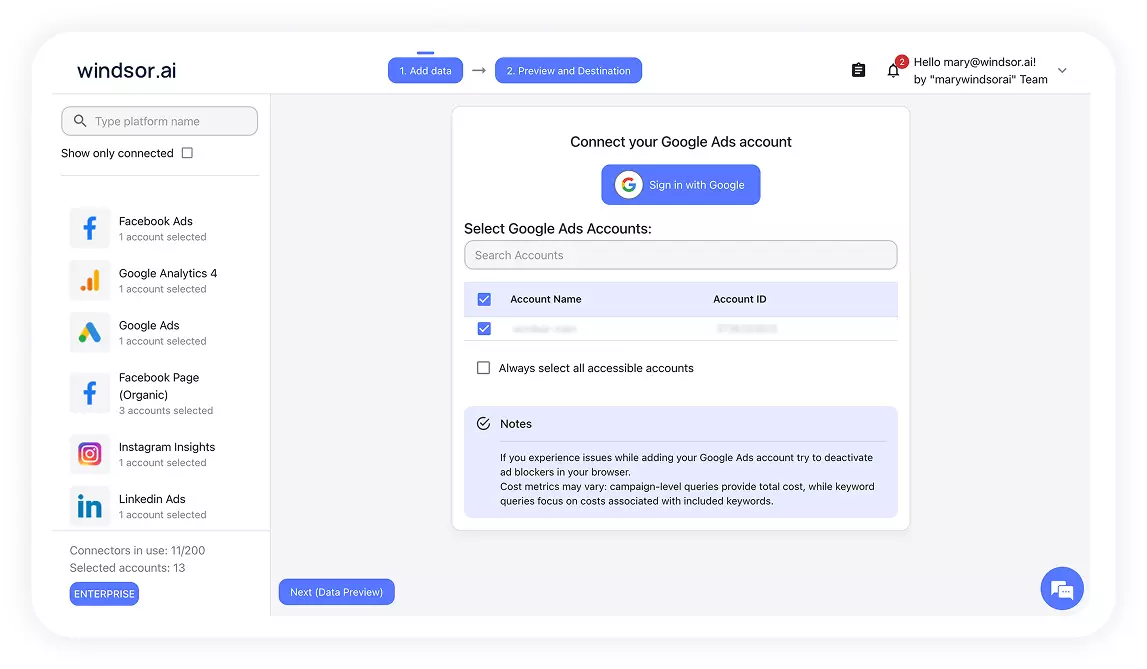
2. Go to Select Destination and choose the file format you need.
Importing JSON data into Power BI
2.1. Click the JSON logo, as shown below.

2.2. In Power BI Desktop, click Get Data, then choose Web.

2.3. Paste the link in the box that appears.
Importing CSV data into Power BI
3.1. Download the CSV file, as shown below.

3.2. In Power BI Desktop, click Get Data, then choose CSV.

3.3. Select the downloaded file from your computer.
💡 Power BI is not the only destination for this data. The same API URL can feed an AI assistant through Windsor MCP, so you can ask about the numbers in plain language instead of building a report first.
Wrapping up: How to connect JSON/CSV data from an API to Power BI
We support 9,000+ fields across 350+ connectors. The whole list is here.
To pull connector data into a data frame, create your own Windsor.ai account (free forever plan), connect your data sources, and build your API URL. Here’s a sample:
https://connectors.windsor.ai/all?api_key=[your API key]&date_preset=last_7d&fields=source,medium,campaign,clicks,impressions,spend,date
This returns a JSON containing the fields source, medium, campaign, clicks, impressions, spend, and date for the past 7 days.


