 Destinations
 Data sources
 AI insights
 About us
 Careers
 Security
 Customer reviews
 Contact us
 Affiliate program
 Solution partners
 Template gallery
 Looker Studio templates
 Power BI templates
 Excel templates
 Google Sheets templates
 Tableau templates
 Facebook Ads templates
 Google Ads templates
 Data fields & Metrics
 AI prompt library & Guides
 Product documentation
 API documentation
 Case studies
 Blog
Blog Data models
 Windsor vs Supermetrics
 Windsor vs Funnel.io
 Windsor vs Fivetran
 Windsor vs Rivery
 Windsor vs Portermetrics
 Windsor vs Coupler.io
Connect GitHub to Claude
Automatically sync your GitHub data to Claude using the Windsor.ai connector.
Send your GitHub data to Claude to instantly understand your code, track changes, and make smarter product decisions.
Forget CSVs. Stop copy/paste. Connect data in minutes. No code required.
 Sign up with Google
 Free forever plan
No credit card needed
Free forever plan
No credit card needed









Make the most out of your data with GitHub to Claude integration
Use Windsor MCP to skip technical hurdles and quickly stream GitHub data into Claude for advanced AI analysis. Explore some of the use cases below:

Issue prioritization
Claude reviews the text of all open issues, cross-referencing them with labels and timestamps to suggest a ‘Sprint Priority’ list. It flags issues that mention critical bugs or high-impact user friction for immediate action.

AI-powered release notes
By fetching recent commit messages and pull request descriptions, Claude can draft human-readable ‘What’s New’ updates. It translates technical jargon into benefit-driven language suitable for customers and stakeholders.

Dependency vulnerability guard
Claude scans your package.json or requirements.txt via the Windsor stream to identify outdated or insecure libraries. It provides a summary of risks and suggests the safest stable versions to upgrade to.
Using Windsor.ai to connect data from GitHub to Claude
Integrating GitHub with Claude usually requires manual exports, copying issues, or managing complex API scripts. Windsor MCP removes this friction with a dedicated GitHub-to-Claude connector that automatically sends your repository data directly into your AI workspace.
Connect in minutes and start generating actionable insights instantly.















How to connect GitHub to Claude with Windsor.ai
Explore our video tutorial and a step-by-step guide to integrate your data from any source into Claude with the Windsor.ai connector.
Select your data source
Choose GitHub as your data source and grant access to Windsor.ai.

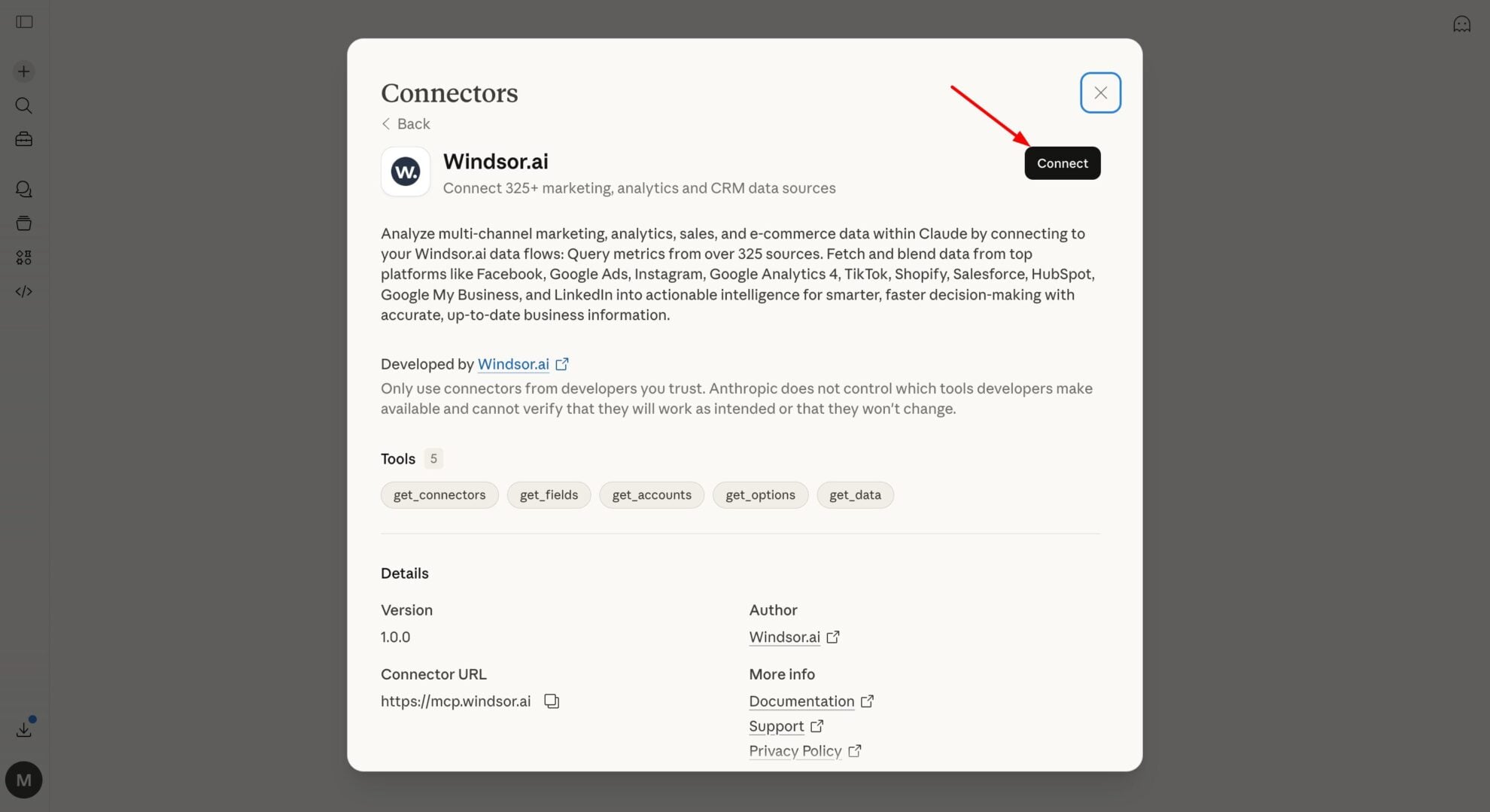
Install the Windsor.ai connector in Claude
In Claude, open Customize, then Connectors, search for Windsor and click Add. Sign in to your Windsor.ai account when prompted, and the connector appears in your Connectors list. You can also open the Windsor.ai listing in the Claude directory and click Connect.
Query your data in Claude
Start a new chat and ask Claude questions about your connected data: summarize KPIs, create client reporting dashboards, or run advanced analyses.

FAQs
What can I do with GitHub data in Claude?
Once your GitHub data is in Claude, you can:
- Run technical SEO checks on your code. Scan your frontend for issues like missing meta tags, weak heading structure, or performance problems, and fix them before they impact traffic.
- Improve README files. Turn messy or outdated docs into clear, structured READMEs that are easier for users and teammates to follow.
- Clearly summarize pull requests. Skip long PRs. Get a clear summary of what changed, why it matters, and any risks in seconds.
- Track project progress. Analyze commit history to spot trends, active areas, and possible bottlenecks without digging through logs.
- Turn product updates into marketing content. Automatically convert new features into release notes, website copy, emails, or social posts.
How do I connect GitHub to Claude using Windsor MCP?
The setup is a simple 3-step process:
- Connect your GitHub account in the Windsor.ai onboard dashboard.
- In Claude, go to Settings > Connectors and add the Windsor.ai connector.
- Authorize the connection, and start querying your GitHub data in Claude.
How secure is my GitHub data in Claude?
To ensure maximum security, the Windsor.ai connector uses read-only access. Claude can analyze, summarize, and report on your GitHub data, but it cannot modify your code, delete branches, or merge pull requests.
Can I analyze multiple GitHub repositories in a single Claude chat?
Yes. By accessing your frontend code, Claude can check things like meta tags, structured data (Schema), robots.txt settings, and scripts that may slow down your site. This helps you find and fix issues that could affect your search rankings and performance.
Can Claude analyze my project’s commit history?
Yes. Claude can review your commit history to summarize recent changes, generate ‘What’s New’ updates, and help you understand how your project is evolving.
What prompts can I use when analyzing GitHub data in Claude?
Use more specific, advanced prompts to extract deeper insights from your GitHub data. For example:
-
Find parts of the code that are used by many other files and may be doing too much. Highlight areas with high coupling and suggest how to split the logic into smaller, more modular services.
-
Analyze the changes in this feature branch and identify potential risks before release. Highlight areas where small changes could have a wider impact (e.g. shared components, core logic, or dependencies). Suggest what should be tested more carefully and flag anything that could break existing functionality.
-
Review API calls and database queries. Identify anything inefficient, like repeated data fetching or heavy loops, and suggest faster alternatives that will scale better as data grows.
-
Look at who is working on different parts of the code. Find areas that rely on just one developer and could become a risk. Suggest where knowledge should be shared across the team.
How much does it cost to integrate GitHub into Claude using Windsor.ai?
Windsor.ai’s pricing for Claude data integration varies depending on the number of connected accounts and data sources. We offer absolutely transparent pricing plans for diversified business needs and budgets.
How long does it take to connect GitHub to Claude?
With Windsor.ai’s easy-to-use connector, the integration process takes just a few minutes. No technical expertise is needed; syncing GitHub to Claude is simple, straightforward, and completely code-free.
Do you have helpful links to get started with integrating GitHub and Claude using Windsor.ai?
Yes, we have helpful resources to help you get started. You can explore our official documentation and tutorials for seamless GitHub to Claude integration with Windsor.ai:
Tired of manual GitHub data exports? Try Windsor.ai today to automate your reporting


