 Destinations
 Data sources
 AI insights
 About us
 Careers
 Security
 Customer reviews
 Contact us
 Affiliate program
 Solution partners
 Template gallery
 Looker Studio templates
 Power BI templates
 Excel templates
 Google Sheets templates
 Tableau templates
 Facebook Ads templates
 Google Ads templates
 Data fields & Metrics
 AI prompt library & Guides
 Product documentation
 API documentation
 Case studies
 Blog
Blog Data models
 Windsor vs Supermetrics
 Windsor vs Funnel.io
 Windsor vs Fivetran
 Windsor vs Rivery
 Windsor vs Portermetrics
 Windsor vs Coupler.io
Connect Typeform to ChatGPT
Automatically sync your Typeform forms, responses, and workspace data to ChatGPT using the Windsor.ai connector.
Chat with your Typeform data in plain language to see where respondents drop off, catch webhooks that went stale, and segment responses by hidden fields, without exporting a single CSV.
Forget CSVs. Stop copy/paste. Connect in minutes. No code required.
 Sign up with Google
 Free forever plan
No credit card needed
Free forever plan
No credit card needed










Get instant form insights from your Typeform data in ChatGPT
Windsor MCP streams your Typeform forms, responses, themes, webhooks, and workspaces directly into ChatGPT, so you can go from a question to an answer without exporting anything. A few ways teams use it:

Spot where respondents abandon your form
Cross-reference each response’s landing time against its submission time to see how many visitors open a form but never finish it.

Catch webhooks that silently went stale
Break down enabled and disabled webhooks by form to catch integrations that stopped firing after a question was edited.

Track how fast new forms go live
Compare a form’s created date against its published and last-updated dates to see how quickly forms move from draft to live across your workspaces.

Segment responses by acquisition source
Pull the hidden fields passed through your form links to group completed responses by campaign, source, or customer segment.

Audit theme and branding consistency
Check which forms still use the default Typeform theme versus a custom one, and flag brand assets that haven’t been touched in a while.
Using Windsor.ai to connect data from Typeform to ChatGPT
Piping Typeform data into ChatGPT usually means manual exports, response cleanup, or costly form-analytics tools, especially when cross-referencing timestamps to spot where respondents abandon a form. Windsor.ai removes that friction with an MCP connector that automatically collects, structures, and streams your Typeform data directly into ChatGPT.
Connect in minutes and start asking natural-language questions about drop-off, webhook health, and response segmentation.
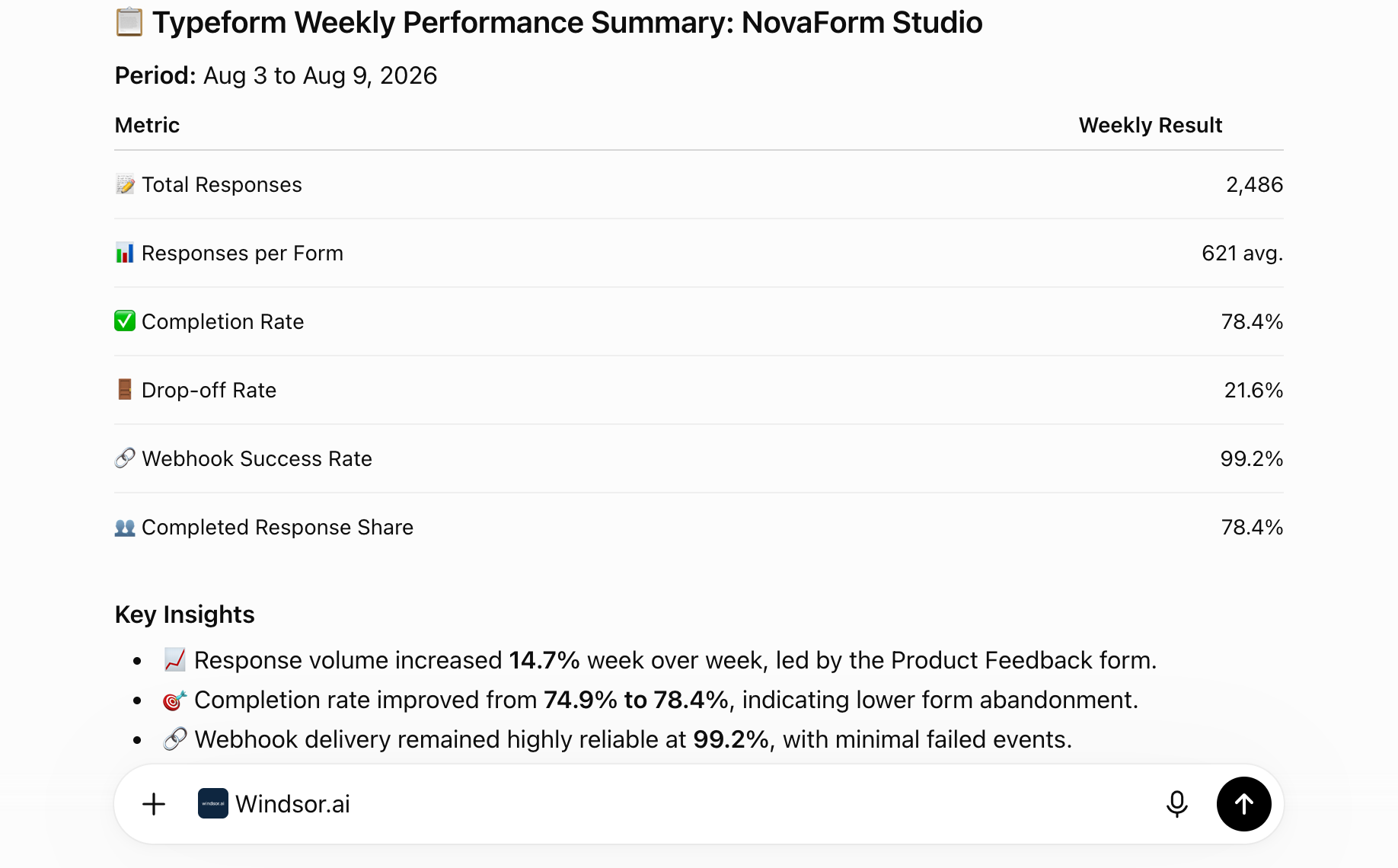














How to connect Typeform to ChatGPT with Windsor.ai
Follow the step-by-step guide to integrate your Typeform data into ChatGPT with the Windsor.ai connector.
Connect Typeform in the Windsor.ai dashboard
In your Windsor.ai dashboard, choose Typeform as your data source and grant access to Windsor.ai.

Install the Windsor.ai connector
Log in to your ChatGPT account and open this Windsor.ai connector page.
Click Connect, then authorize access.

Query your Typeform data in ChatGPT
Open a new chat and start asking questions about your connected Typeform data using natural language.
Make sure that the Windsor.ai connector is enabled (click the + sign → More → Windsor.ai).
FAQs
What Typeform data can I analyze in ChatGPT?
Windsor.ai gives ChatGPT access to all 66 Typeform fields, organized by category:
- Forms and structure (14 fields): form title, type, created date, published date, last-updated date, logic, settings, welcome and thank-you screens.
- Responses (12 fields): response ID, landed-at time, submitted-at time, response type, answers, hidden fields, calculated scores, variables.
- Themes and branding (12 fields): theme name, font, colors, background, rounded corners, visibility, created and updated dates.
- Webhooks (8 fields): webhook URL, enabled status, tag, form ID, created and updated dates, SSL verification.
- Images (8 fields): file name, source URL, width, height, media type, average color.
- Workspaces (7 fields) and universal metadata (5 fields): workspace name, account ID, shared status, plus the data source and fetch-time fields Windsor adds to every connector.
Can ChatGPT tell me which form is losing the most respondents mid-survey?
Yes. Windsor streams each response’s landed-at and submitted-at timestamps, so ChatGPT can see exactly how many sessions landed on a form but never reached submission, and group that by form.
Can ChatGPT compare response volume across workspaces?
Yes. Every form and response carries its workspace context, so ChatGPT can total responses per workspace and flag which workspace’s forms are driving the most, or the least, activity.
Can ChatGPT identify forms with outdated welcome or thank-you screens?
Yes. Each form stores its welcome and thank-you screen configuration alongside its last-updated date, so ChatGPT can flag long-running forms whose screens haven’t changed in a while.
What prompts can I use to analyze Typeform data in ChatGPT?
-
Compare response_type across forms to see which ones have the highest share of partial versus completed submissions.
-
For forms with a calculated scoring field, is average time-to-submit higher than for forms without one?
-
Which workspace has the most forms that were published but never had a single response?
-
Cross-reference webhook creation dates with form last-updated dates to flag webhooks that predate their form's most recent edit.
How much does it cost to integrate Typeform into ChatGPT using Windsor.ai?
Windsor.ai is free to start, no credit card required. Paid plans start at $19/month and scale by the number of sources and accounts. See the pricing page.
Can I combine Typeform data with other channels in ChatGPT?
Yes. Windsor.ai supports 350+ data sources, so you can connect Typeform alongside your CRM or email platform, such as HubSpot or Klaviyo, to see how form responses turn into pipeline or campaign activity.
Do you have helpful links to get started with integrating Typeform and ChatGPT using Windsor.ai?
Yes, we have helpful resources to help you get started. You can explore our official documentation for seamless Typeform to ChatGPT integration with Windsor.ai:
Tired of manual Typeform data exports? Try Windsor.ai today to automate your reporting


