Destinations
 Data sources
 AI insights
 About us
 Careers
 Security
 Customer reviews
 Contact us
 Affiliate program
 Solution partners
 Template gallery
 Looker Studio templates
 Power BI templates
 Excel templates
 Google Sheets templates
 Tableau templates
 Facebook Ads templates
 Google Ads templates
 Data fields & Metrics
 AI prompt library & Guides
 Product documentation
 API documentation
 Case studies
 Blog
Blog Data models
 Windsor vs Supermetrics
 Windsor vs Funnel.io
 Windsor vs Fivetran
 Windsor vs Rivery
 Windsor vs Portermetrics
 Windsor vs Coupler.io
 Last updated: 1 September 2026




Working on Google Sheets, at times, we need to import data from one sheet to another. The simplest way to do it is to copy and paste. It works when you are dealing with a handful of rows and columns and the data is static. However, it isn’t the best way if you are working with a ton of data that needs to be regularly updated.
In this article, we discuss how you can easily import data without much hassle.
4 ways to import data from one Google Sheet to another
1. From a different sheet within the same document
If it’s just one cell you want to get data from, use the formula [=SheetName!CellName] in the destination cell.
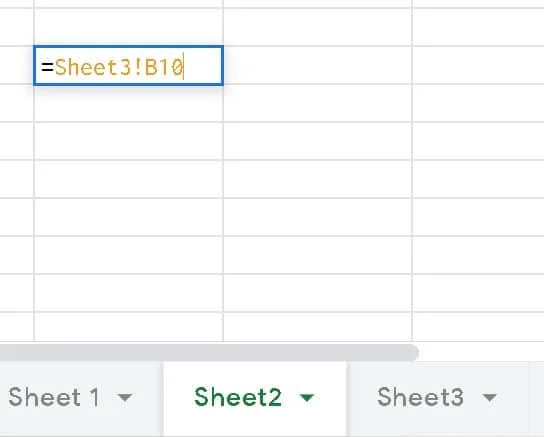
This method links both cells. So when the value in the original cell changes, it’s automatically updated in the destination cell.
2. Import data from a sheet in another document
If you looking to import data from a sheet in a different document use the formula [=IMPORTRANGE]
Select a cell on your destination sheet, such that it is the first cell on top-left. Ensure that the cells around it, where you wish to import data, are empty.
Enter [=IMPORTRANGE(“SheetURL”,”SheetName!CellRange”)] in the destination cell.

Press “Enter”.
The URL for the data source sheet is important. The sheet name and cell range are optional.
Allow access to your sheet.
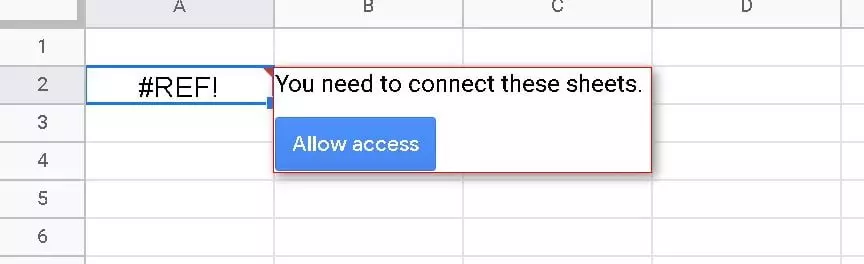
Using this method, the two sheets get linked. So, the destination sheet will update automatically if there are changes on the source sheet.
3. Copy an entire sheet into another document
The methods above link data so it stays in sync. If you just want a one-off copy of a whole tab, Google Sheets has a built-in option.
Right-click the tab at the bottom of the spreadsheet, hover over Copy to, and choose Existing spreadsheet. Search for the destination file or paste its URL, then click Select. The tab appears in the other document, named “Copy of” followed by the original sheet name.
Important: this creates a static copy, not a live link. Nothing updates afterwards. If you want the destination to follow changes in the source, use IMPORTRANGE from method 2 instead.
4. Using Windsor.ai to stream data into a Google Sheet on a schedule
Methods 1 and 2 link sheets you already own. If the data you want lives in a different tool entirely, like an ad platform, a CRM, or another spreadsheet you don’t control, Windsor.ai can stream it into your Google Sheet automatically on a schedule.
Here’s how to set it up:
- Go to onboard.windsor.ai and register, or log in if you already have an account.
- Connect the data source you want to bring into your sheet (a marketing platform, CRM, or another spreadsheet), then select Google Sheets as your destination.
- Click Add Destination Task.
- A new tab opens to authorize your Google account. Select the account connected to your Google Sheets and grant Windsor.ai the requested access.
- Fill in the destination task details: a Task Name, the Document (the existing spreadsheet you want to stream data into, or create one), and the Sheet Name (an existing tab or a new one). Optionally set Backfill for historical data (paid plans) and a Schedule for how often it updates (Standard plans and above), and pick Columns to Match so each sync updates the right row instead of creating duplicates.
- Click Test connection, then Save.
You’ll see the task running in the Data Destinations section, with a green “upload” status showing “ok” once it’s syncing correctly.
💡 Once your data is consolidated in one sheet, you can also connect that sheet to an AI assistant and analyze it in plain language: Google Sheets to Claude and Google Sheets to ChatGPT.
Once set up, your Google Sheet keeps updating on its own. Windsor.ai has a free forever plan, so go ahead and get started.