Destinations
 Data sources
 AI insights
 About us
 Careers
 Security
 Customer reviews
 Contact us
 Affiliate program
 Solution partners
 Template gallery
 Looker Studio templates
 Power BI templates
 Excel templates
 Google Sheets templates
 Tableau templates
 Facebook Ads templates
 Google Ads templates
 Data fields & Metrics
 AI prompt library & Guides
 Product documentation
 API documentation
 Case studies
 Blog
Blog Data models
 Windsor vs Supermetrics
 Windsor vs Funnel.io
 Windsor vs Fivetran
 Windsor vs Rivery
 Windsor vs Portermetrics
 Windsor vs Coupler.io
 Last updated: 11 August 2026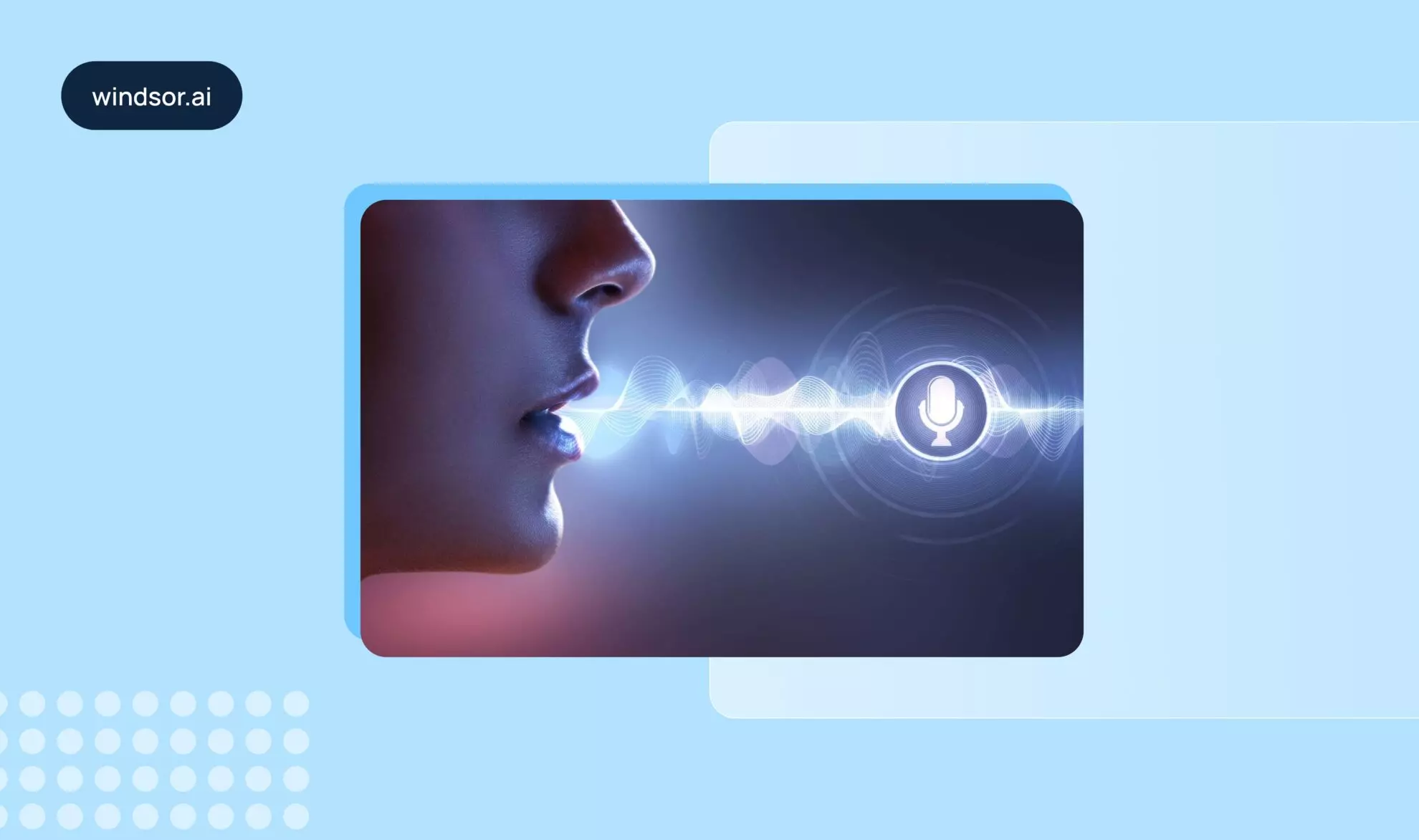




Generating human-like voices using prompts has gained immense traction in recent years. With a staggering market size valuation of $3.29 billion in 2025, AI voice cloning is no longer an undervalued concept. Just like other AI-powered technologies, it also relies on deep learning algorithms.
Owing to this, efficient data management lays the cornerstone for voice cloning. After all, the quality of the information directly impacts the accuracy of the cloned voice. Companies, nowadays, rely on industry best practices to ensure ethical data usage throughout.
Security is another reason why this has become so imperative. That being said, we have curated a detailed guide to explain how voice cloning relies on effective data management strategies behind the scenes.
Understanding voice cloning
Powered by artificial intelligence, this practice generates a highly accurate digital replica of a human voice. It capitalizes on machine learning algorithms to understand peculiar voice features. These include the tonal quality, pitch, accent, and rhythm. The result generated is completely new speech data that sounds exactly like the speaker.
Key technology principles
Multiple tech-based practices are used to create a voice cloning model. Here’s how:
- Neural networks and deep learning: These enable the AI models to assess the specifications of a sample audio input. That’s how they can synthesize a human-like voice with higher accuracy.
- Real-time inference: Most models can generate the speech immediately by utilizing vast training datasets.
- Text-to-speech: It can convert any text sample into speech in the cloned voice. Just like that, you can also clone your voice and check how it sounds.
- Speaker embedding: The AI models are designed to capture the unique voiceprint of every sample. That’s why no two cloned voices are the same.
- Voice synthesis: The software programs can integrate emotions, pauses, and intonations to create a perfect replica with higher precision.
Real-time use cases of voice cloning
- Assistive devices can be integrated with voice cloning algorithms. These will allow people with degenerative speech disorders to preserve their natural speech.
- Personalized voices can improve user engagement in IVR systems and AI app chatbots.
- Production studios can leverage this technology to recreate the voices of actors. It will help in post-production tasks, dubbing, and bringing legendary characters back to life.
- Gaming developers often use speech cloning models to create an immersive audio experience. Character dialogues become more realistic, thereby improving engagement.
- Educational instructors can generate multilingual audio content with ease. Synthetic voice technology will help them provide personalized training to their students.
- Sales teams, including SDRs and BDRs, are increasingly leveraging voice cloning to personalize outreach at scale, creating human-sounding follow-ups, voicemails, or voicemail drops that maintain a personal touch without requiring manual effort. When combined with thoughtful email design, these efforts create a cohesive, multi-channel outreach strategy that enhances engagement and brand consistency.
Importance of data management in voice cloning
As every speech cloning model draws power from vast datasets, managing these information groups is crucial. Otherwise, the concerns about ethical replication and data privacy can never be mitigated.
To help you understand further, here are a few reasons why data management is so crucial for voice cloning:
- Well-labeled samples with clean speech will help generate realistic, expressive, and completely natural clones.
- Data management will help preserve the unique voiceprints of the speaker, like emotion, tone, and accent.
- Professionals can track user permissions and consents, ensuring no unethical speech cloning activities.
- Data management practices in voice synthesis will also ensure complete compliance with stringent industry regulations. These include HIPAA, GDPR, and India’s DPDP Bill.
Best practices in data management for speech cloning
-
Speech segmentation into contextual units
Dividing the input datasets into dynamic contexts will help the AI models understand the changes in speech. The software can easily learn how emotions change with different speech contexts. Hence, this will enhance the naturalness of the cloned speeches greatly. You can effectively collect such diverse datasets to create automated, no-code pipelines.
-
Preservation of prosodic features
Prosody includes the features that make every voiceprint unique. Rhythm, stress, pitch, and intonation are a few to name. Preserving these, along with the audio samples, will help generate emotion-loaded cloned voices. However, integrating the prosodic features with the deep learning models can be overwhelming.
-
Capturing multilingual variants
One of the most imperative data management strategies will be to collect speech samples in different languages from the same speaker. It will help train the AI software models to generate multilingual outputs without sacrificing the voice’s footprint.
-
Maintaining the consent metadata layer
Compliance and ethical voice synthesis have become huge concerns. That’s why companies now capitalize on a consent metadata layer for every audio sample. It can include information like scope, duration, date, and revocation rights. Using it will bring numerous benefits to the table.
For starters, it will help companies adhere to compliance standards and put more emphasis on ethical sourcing. Also, it enables automatic deletion or filtering according to the updated consent information.
-
Storing demographic bias flags
Voice samples can be flagged using demographic attributes. These can include region, gender, age, and dialect. It will become easier for developers to create unbiased and unified synthetic voice technology. Monitoring demographic representation will also become easier. To top it off, one can incorporate inclusivity principles in the voice cloning model.
-
Validation using synthetic audio regression testing
One of the most effective data management strategies for speech cloning is regression testing. Here, professionals use fixed text prompts to test the synthesized voice outputs for consistency. It further helps detect quality degradation, voice drift, and model regressions with time.
-
Implementation of ethical watermarking
Another practice that will help professionals prevent misuse is the inclusion of hidden watermarks. Labeling the speech outputs as AI-synthesized will further support content verification. Hence, listeners can easily distinguish between the real and cloned speeches without any hassle.
The future of speech cloning and data management
Speech cloning is becoming increasingly advanced, enabling computers to recreate a person’s voice from just a few audio clips. This can be life-changing for people who’ve lost their ability to speak, and is helpful in creating more natural interactions with technology. Here are some points that could be helpful for the future use of voice cloning.
- Advanced AI models will be able to capture specific nuances in human speech. These can include emotion, laughter, and even breathing pauses.
- On-demand voice cloning will enable users to generate personalized speech samples in no time.
- The voice synthesis models are likely to have built-in compliance engines for better regulatory usage.
- Blockchain-enabled models can allow individuals to hold optimal ownership of their voiceprint and identities.
Conclusion
As artificial intelligence is gaining traction, voice cloning has become an integral part. Empowered by deep learning models and neural networks, it allows the creation of exact replicas of human speech. However, companies need to implement proven data management techniques to prevent misuse, increase accuracy, and improve output quality.