 Destinations
 Data sources
 AI insights
 About us
 Careers
 Security
 Customer reviews
 Contact us
 Affiliate program
 Solution partners
 Template gallery
 Looker Studio templates
 Power BI templates
 Excel templates
 Google Sheets templates
 Tableau templates
 Facebook Ads templates
 Google Ads templates
 Data fields & Metrics
 AI prompt library & Guides
 Product documentation
 API documentation
 Case studies
 Blog
 Data models
 Windsor vs Supermetrics
 Windsor vs Funnel.io
 Windsor vs Fivetran
 Windsor vs Rivery
 Windsor vs Portermetrics
 Windsor vs Coupler.io
Connect Salesforce to Cursor
Connect your Salesforce data to Cursor with the Windsor.ai connector, so the dashboards and scripts Cursor builds use your real opportunity, lead, account and campaign data.
Ask Cursor for a pipeline canvas, a stale deal alert script or a lead source report built on your own Opportunity Amount, Opportunity Stage, Opportunity Close Date and Lead Source fields.
Forget CSVs. Stop copy/paste. Connect in minutes. No code required.
 Sign up with Google
 Free forever plan









Build pipeline reports on live Salesforce data in your Cursor project
Cursor works inside your project, so what it builds from your Salesforce data stays with you as files, scripts and canvases you can rerun. Key use cases:

See the pipeline by stage
Cursor can build a canvas of Opportunity Amount by Opportunity Stage and Opportunity Close Date month, weighted by Opportunity Probability (%).

Catch deals past their close date
Ask for a script that lists open opportunities with an Opportunity Close Date in the past, grouped by Opportunity Owner ID, to run before each pipeline review.

Find the lead sources that convert
Lead Source with Lead Converted and won Opportunity Amount by Opportunity Lead Source shows which sources bring revenue.

Report campaign return
Cursor can compare Campaign Actual Cost in Campaign with Campaign Value Won Opportunities in Campaign for each Campaign Name in a report you keep.
Using Windsor.ai to connect data from Salesforce to Cursor
Without Windsor.ai, Cursor builds on placeholder numbers or on CSV exports you paste into the project. Windsor MCP gives Cursor live Salesforce data with the real field names, so the dashboards and scripts it writes match your account.
Connect in minutes, then ask Cursor to build something with your Salesforce data.
Available actions
Update Object Update field values on a Salesforce record of any object type (Opportunity, Lead, Contact, Account, Case, custom objects, ...). Only the provided fields are changed. Use field API names (e.g. StageName, Amount, My_Field__c) and pass null as a value to clear a field.
Update field values on a Salesforce record of any object type (Opportunity, Lead, Contact, Account, Case, custom objects, ...). Only the provided fields are changed. Use field API names (e.g. StageName, Amount, My_Field__c) and pass null as a value to clear a field.
Create Object Create a new Salesforce record of any object type (Opportunity, Lead, Contact, Account, Case, custom objects, ...). Use field API names (e.g. LastName, Company, Amount, My_Field__c); the required fields depend on the object type. Returns the id of the new record, which update_object and delete_object can then use.
Create a new Salesforce record of any object type (Opportunity, Lead, Contact, Account, Case, custom objects, ...). Use field API names (e.g. LastName, Company, Amount, My_Field__c); the required fields depend on the object type. Returns the id of the new record, which update_object and delete_object can then use.
Delete Object Permanently delete a Salesforce record of any object type (Opportunity, Lead, Contact, Account, Case, custom objects, ...) by id. Salesforce moves the record to the Recycle Bin for 15 days, from where a user can restore it in the Salesforce UI but not through Windsor. Tell the user this is permanent before you ask them to confirm.
Permanently delete a Salesforce record of any object type (Opportunity, Lead, Contact, Account, Case, custom objects, ...) by id. Salesforce moves the record to the Recycle Bin for 15 days, from where a user can restore it in the Salesforce UI but not through Windsor. Tell the user this is permanent before you ask them to confirm.


How to connect Salesforce to Cursor with Windsor.ai
Explore a step-by-step guide to add Windsor MCP to Cursor and start building on your Salesforce data.
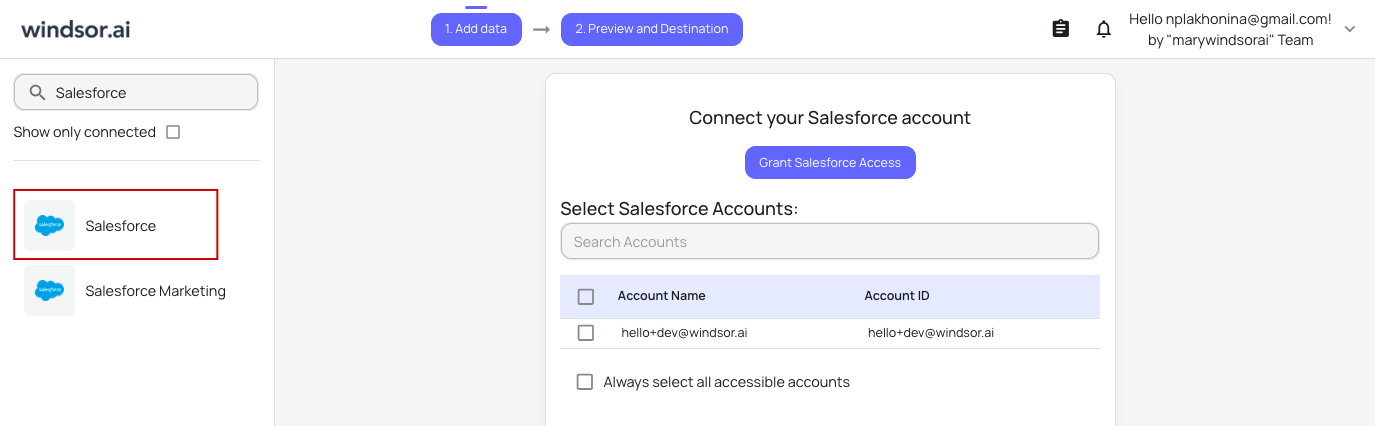
Connect Salesforce in the Windsor.ai dashboard
Choose Salesforce as your data source and sign in to grant Windsor.ai access to your account.
Add Windsor MCP in Cursor
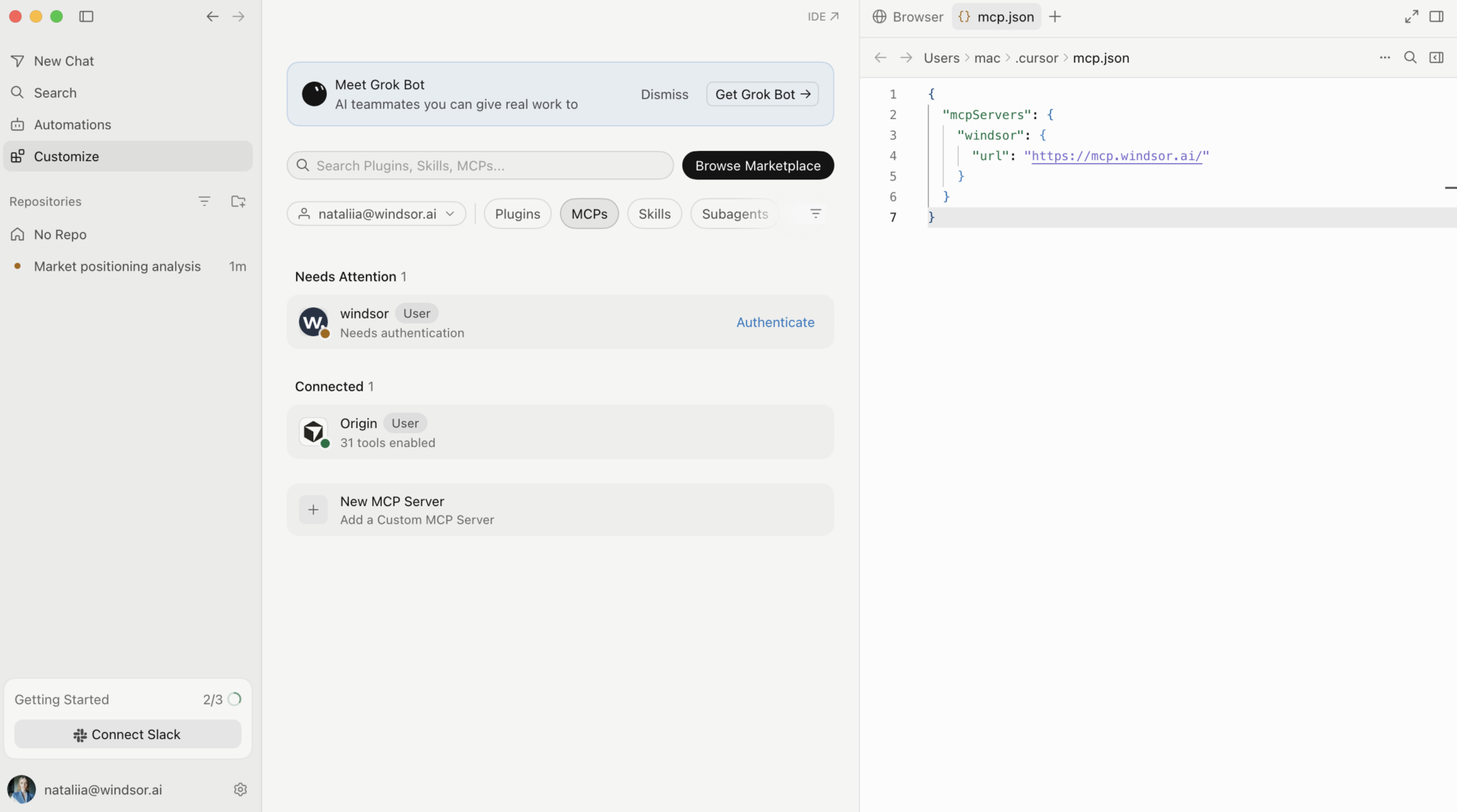
Open Settings in Cursor Desktop and go to Tools & Integrations → New MCP Server. When mcp.json opens, add Windsor:
{
  "mcpServers": {
    "windsor": {
      "url": "https://mcp.windsor.ai/"
    }
  }
}
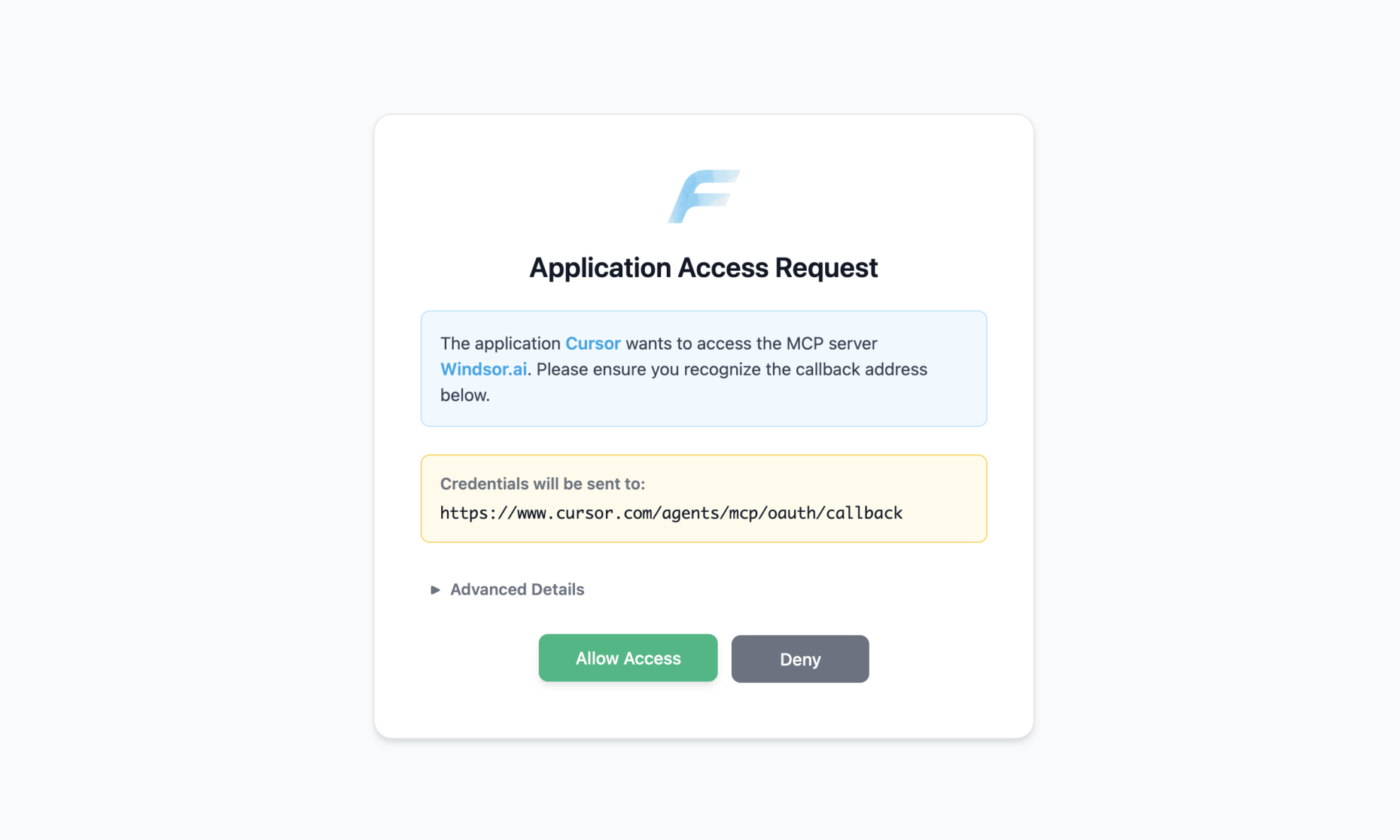
Authenticate with Windsor.ai
Save mcp.json. Windsor appears in your MCP list and asks you to authenticate. Click Authenticate and sign in to Windsor.ai in the browser.
Ask Cursor to build on your Salesforce data
Open a chat in your project and ask about your Salesforce data.
FAQs
What Salesforce data can Cursor use?
Windsor.ai gives Cursor access to 347 Salesforce fields. These are some of the groups; the Salesforce field reference lists all of them:
- Opportunities: Opportunity Name, Opportunity Amount, Opportunity Stage, Opportunity Probability (%), Opportunity Close Date, Opportunity Type, Opportunity Lead Source, Opportunity Won, Opportunity Owner ID.
- Leads: Lead Source, Lead Status, Lead Company, Lead Industry, Lead Created Date, Lead Converted, Lead Converted Date.
- Accounts: Account Name, Account Industry, Account Type.
- Campaigns: Campaign Name, Campaign Type, Campaign Actual Cost in Campaign, Campaign Leads in Campaign, Campaign Converted Leads in Campaign, Campaign Value Won Opportunities in Campaign.
What prompts can I use to build with Salesforce data in Cursor?
Cursor works best when you ask it to build something with a clear output. Each of these names the fields to use and the file or canvas you want back:
-
Pull Opportunity Name, Opportunity Amount, Opportunity Stage, Opportunity Probability (%) and Opportunity Close Date for open opportunities. Build a canvas with total and probability-weighted amount by stage and by close month for the next two quarters, and list the 10 largest deals under it.
-
Pull open opportunities with Opportunity Name, Opportunity Owner ID, Opportunity Stage, Opportunity Amount and Opportunity Close Date. Write a Python script that lists every deal whose close date has passed, groups them by owner with the total amount, and writes stale_deals.md for the pipeline review.
-
Pull Lead Source, Lead Created Date, Lead Converted and Lead Converted Date for leads created in the last two quarters. Build a chart of lead count and conversion rate by source, and add the median days from creation to conversion for each source.
-
Pull Campaign Name, Campaign Type, Campaign Actual Cost in Campaign, Campaign Leads in Campaign, Campaign Converted Leads in Campaign and Campaign Value Won Opportunities in Campaign. Write a script that calculates cost per lead and won value per unit of cost for each campaign and saves campaigns.csv sorted by return.
-
Pull won opportunities this year with Opportunity Amount, Opportunity Type, Account Name and Account Industry. Write a report as won_deals.md with won amount by industry and by opportunity type, and the 10 largest accounts. Keep the script so I can rerun it each month.
Can Cursor turn Salesforce data into dashboards I can share?
Yes. Cursor can render a dashboard, analysis or report as a canvas next to the chat, and it saves the canvas so you can reopen and rerun it later with fresh data. On paid Cursor plans you can publish a canvas to a read-only share link that members of your Cursor team can open. See the Cursor canvas documentation for the current plan requirements.
Can I combine Salesforce data with other sources in Cursor?
Yes. Windsor.ai supports 350+ data sources, so you can connect Salesforce alongside tools such as LinkedIn Ads, Google Ads or HubSpot and ask Cursor to work with them together. For example, ask Cursor to put Salesforce won Opportunity Amount by Opportunity Lead Source next to LinkedIn Ads Spend and Google Ads Cost, and write a script that reports won revenue per unit of ad spend for each channel.
How do I add Windsor MCP to Cursor?
Open Settings in Cursor Desktop, go to Tools & Integrations → New MCP Server, and add Windsor to mcp.json:
{
  "mcpServers": {
    "windsor": {
      "url": "https://mcp.windsor.ai/"
    }
  }
}
Save the file, click Authenticate next to Windsor in your MCP list, and sign in to Windsor.ai in the browser.
Do I need to code to connect Salesforce to Cursor?
No. The connection takes no code: connect Salesforce in Windsor.ai, add Windsor to Cursor’s MCP settings, and sign in. After that you describe what you want in plain language, and Cursor writes and runs the code. You can read and edit everything it produces.
How much does it cost to integrate Salesforce with Cursor using Windsor.ai?
The free forever plan covers 1 data source, so connecting Salesforce on its own costs nothing and needs no credit card. Combining Salesforce with other sources, such as LinkedIn Ads or Google Ads, needs a paid plan: $19/month for 3 sources or $99/month for 7. Cursor is billed separately by Cursor. See the pricing page.
Do you have helpful links to get started with Salesforce and Cursor?
Yes. These are the resources to start with for the Salesforce to Cursor integration:
Tired of manual Salesforce data exports? Try Windsor.ai today to build on live data


