 Destinations
 Data sources
 AI insights
 About us
 Careers
 Security
 Customer reviews
 Contact us
 Affiliate program
 Solution partners
 Template gallery
 Looker Studio templates
 Power BI templates
 Excel templates
 Google Sheets templates
 Tableau templates
 Facebook Ads templates
 Google Ads templates
 Data fields & Metrics
 AI prompt library & Guides
 Product documentation
 API documentation
 Case studies
 Blog
Blog Data models
 Windsor vs Supermetrics
 Windsor vs Funnel.io
 Windsor vs Fivetran
 Windsor vs Rivery
 Windsor vs Portermetrics
 Windsor vs Coupler.io
 Last updated: 8 September 2026




To connect Google Merchant Center to Claude, link your account at onboard.windsor.ai/app/google_merchant and add the Windsor.ai connector from the Claude directory (in Claude, open Customize, then Connectors, search Windsor, and click Add). From there, start a new chat and ask about your product feed.
Here’s the problem it solves: It’s Monday morning. You open Google Merchant Center and need to understand which products are losing visibility, which ones are overpriced versus benchmark, and which catalog segments are hurting Shopping performance.
The data is there, including product attributes, benchmark prices, suggested prices, impressions, clicks, and conversions, but the interface makes it hard to turn that information into clear decisions.
Connecting Google Merchant Center to Claude via Windsor MCP changes that. Instead of manually clicking through filters and cross-referencing tabs, you ask a question and get a clear AI-powered answer, with context, prioritization, and suggested next steps.
🚀 Connect your first Google Merchant Center account to Claude: https://onboard.windsor.ai/app/google_merchant.
In seconds, Claude can help identify products with zero impressions, large price gaps, weak click potential, or strong repricing opportunities, and generate structured reports like the one on the screen below to guide action.

Here’s how to set up this integration.
Connecting Google Merchant Center to Claude via Windsor MCP in 3 steps
The Google Merchant Center to Claude integration using Windsor MCP is completely no-code and is usually covered in less than a minute.
📖 Full step-by-step connection guide: https://windsor.ai/documentation/windsor-mcp/how-to-integrate-data-into-claude/.
What you’ll need:
- A Windsor.ai account: free or paid plan
- Google Merchant Center admin access
- A Claude.ai account
Step 1: Authorize Windsor to access your Merchant Center
- Log in to onboard.windsor.ai.
- Select Google Merchant Center as your data source.
- Sign in with the Google account that has access to your Merchant Center.
- Select the account(s) that you’d like to sync to Claude.

Windsor directly connects via Google’s Content API for Shopping, pulling product data, feed status, price benchmarks, and performance metrics into a structured, query-ready format. Multi-account setups (e.g., an MCA with sub-accounts) are also supported.
Step 2: Add Windsor.ai as a connector in Claude
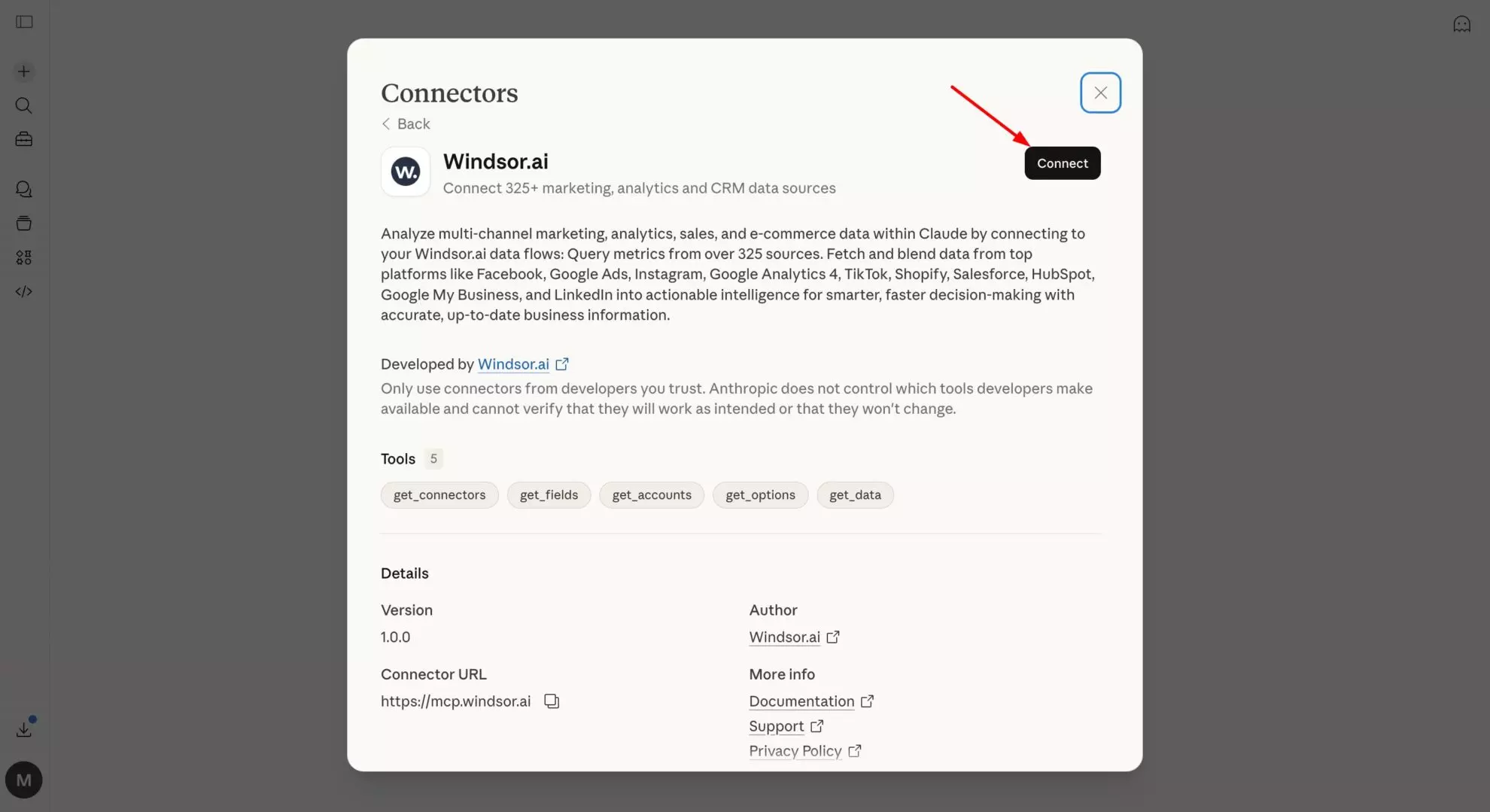
In Claude, open Customize, then Connectors, search for Windsor and click Add. Sign in to your Windsor.ai account when prompted. You can also open the Windsor.ai listing in the Claude directory and click Connect.
Step 3: Start querying your Google Merchant data in Claude
That’s it. You can now ask questions of any depth and complexity in natural language, such as:
- “Which products have been active in my feed but received zero impressions in the last 7 days?”
- “Which products in the {category name} category have the lowest CTR or conversion rate?”
- “Which products are driving the highest revenue and ROAS in my Shopping campaigns?”
💡 Pro tip: You can also ask Claude to cross-reference Merchant Center data with your Google Ads performance. Connect both data sources in Windsor and ask: “Which of my best-selling products were previously advertised through Shopping campaigns?”
Real scenarios where Google Merchant Center to Claude integration saves hours (prompt ideas)
These aren’t generic prompt templates. These are the real situations Google Merchant Center users actually face, and what you can ask Claude to handle them.
1. Products that are live but getting zero visibility
One of the most common issues in Merchant Center is discovering that products exist in your catalog but never appear in Shopping results. These products may have weak pricing, low click potential, or simply be buried in large catalogs.
Instead of manually filtering product reports, ask Claude to surface them instantly.
Prompt:
Show me products that were active in my Merchant Center catalog but received zero impressions in the last 7 days.
You can also narrow the analysis:
Which products in the {category name} category had zero impressions in the last 30 days?
Claude can return a prioritized list of products along with attributes like:
- product title
- category
- price
- click potential
- benchmark price comparison
This helps quickly identify items that need pricing adjustments, feed improvements, or promotion.
2. Products priced above the market benchmark
Pricing competitiveness has a major impact on Shopping performance.
Merchant Center provides benchmark prices and price gap metrics, but identifying which products are overpriced across a large catalog can take significant manual work.
Claude can analyze this immediately.
Prompt:
Which products have the largest price gap compared to the benchmark price?
Or more targeted:
Show me products where my price is more than 20% higher than the benchmark price.
Claude can highlight:
- products most likely losing auctions
- categories where pricing is uncompetitive
- potential revenue impact
3. Products with the highest optimization potential
Merchant Center provides signals such as click potential and suggested prices to help merchants understand where pricing improvements could increase performance.
Instead of reviewing these fields manually, Claude can surface the best opportunities.
Prompt:
Which products have the highest click potential but relatively low impressions?
Or a more action-oriented:
Show me products where applying the suggested price could increase clicks the most.
This helps identify quick wins where small price changes could unlock significant additional traffic.
4. Catalog segments driving the most traffic and conversions
Understanding which categories or brands drive the most performance usually requires multiple reports.
Claude can summarize this instantly.
Prompt:
Which product categories generated the most clicks and conversions in the last 30 days?
Or a more specific:
Which brands drive the highest conversion rate in my Merchant Center catalog?
Claude can generate a structured breakdown showing:
- top categories
- top brands
- conversion performance
- growth trends
5. Products losing visibility over time
Another common issue is when products gradually lose impressions due to pricing changes, competition, or market demand shifts.
Claude can detect these patterns.
Prompt:
Which products lost the most impressions in the last 30 days compared to the previous 30 days?
Or another idea:
Which product categories are experiencing the biggest drop in impressions?
This helps merchants quickly understand where performance is declining and why.
6. Products with strong traffic but poor conversions
Some products attract clicks but fail to convert. These cases often indicate issues with pricing, product pages, or competitiveness.
Claude can surface these instantly.
Prompt:
Show me products with more than 500 clicks but low conversion rates.
Or a narrower question:
Which products receive high impressions but have below-average CTR?
This highlights where improvements could have the biggest impact.
What Google Merchant Center data Windsor sends to Claude
When you connect Google Merchant Center to Claude through Windsor MCP, Claude gains access to a structured set of product catalog, pricing, and performance data.
Here are the key Google Merchant data fields supported by Windsor, grouped by what they help you do:
Product identity & catalog structure
Core fields that identify products and allow Claude to group and segment catalog data.
-
Product ID (
product_id): unique identifier for each product -
Title & description (
product_title,product_description) -
Brand, GTIN, MPN (
product_brand,product_gtin,product_mpn) -
Item group ID (
product_item_group_id): groups product variants -
Product type taxonomy (
product_type_l1–l5): merchant-defined categories -
Google product category (
product_google_category) -
Google category levels (
product_category_l1–l5) -
Custom labels (0–4) (
product_custom_label_0–4): merchant-defined segmentation tags
Feed & catalog attributes
Fields describing the product feed and catalog structure.
-
Availability (
product_availability): in stock, out of stock, preorder -
Feed label (
product_feed_label): identifies the feed source -
Data source (
product_data_source) -
Creation time (
product_creation_time) -
Last update date (
product_last_update_date) -
Expiration date (
product_expiration_date)
Pricing & competitiveness
Signals used to evaluate pricing competitiveness across Shopping.
-
Price (
product_price) -
Sale price (
product_sale_price) -
Price currency (
product_price_currency_code) -
Benchmark price (
product_benchmark_price): market reference price -
Price gap (
product_price_gap): difference from benchmark -
Suggested price (
product_suggested_price): Google’s optimization suggestion -
Click potential (
product_click_potential) -
Click potential rank (
product_click_potential_rank)
Shopping performance metrics
Product-level performance signals.
-
Impressions (
product_impressions) -
Clicks (
product_clicks) -
CTR (
product_ctr) -
Conversions (
product_conversions) -
Conversion rate (
product_conversion_rate) -
Performance date (
product_performance_date)
Pricing optimization signals
Predictive metrics showing potential impact of pricing adjustments.
-
Click uplift (
product_click_uplift) -
Conversion uplift (
product_conversion_uplift) -
Impression uplift (
product_impression_uplift) -
Effectiveness score (
product_effectiveness)
🤖 Windsor streams all these fields, so Claude can answer questions that span pricing competitiveness, product visibility, and conversion performance in one query, something Merchant Center’s UI cannot do natively.
Why Merchant Center data is particularly painful to work with manually
Most data tools have one big export problem. Google Merchant Center has three.
-
The data is fragmented. Product attributes, pricing benchmarks, and performance metrics live in different reports and views. To answer a question like “Which products are overpriced relative to benchmark and still getting the most impressions?” you often have to compare multiple screens and manually reconcile the results.
-
Manual workflows do not scale. That might be manageable for 50 products. It is not manageable for 10,000. Once you need to compare brands, categories, custom labels, benchmark prices, and conversion performance across a large catalog, the process quickly becomes slow, repetitive, and error-prone.
-
Merchant Center shows data, but it does not explain it. The interface can tell you a product’s price gap, click potential, or impression count. It will not tell you which products are your biggest repricing opportunities, which categories are losing visibility, or where a small pricing change could have the biggest impact. That layer of prioritization and reasoning is exactly what’s missing.
⚙️ Windsor MCP eliminates all three problems: it joins the data at the source, keeps it live, and delivers it to Claude in a format where the reasoning layer can actually do its job.
Google Merchant Center to Claude: The Windsor MCP way vs. The manual way
|
Windsor MCP + Claude |
Manual export + Claude |
Merchant Center UI only |
|
|
Data freshness |
Live API, always current |
Stale from export moment |
Live, but no export to AI |
|
Cross-report joins |
Yes (products + performance + pricing) |
Manual VLOOKUP required |
Not available |
|
Disapproval diagnosis |
Grouped, prioritized, actionable |
Raw status list only |
Filtered UI, no AI reasoning |
|
Price competitiveness |
Queryable alongside product data |
Separate export required |
Separate tab, no joining |
|
Multi-account (MCA) |
Supported |
Tedious one-by-one |
Supported in UI |
|
Setup time |
Under 60 seconds |
10–30 min per session |
No setup, but no AI insights |
|
Repeatable analysis |
One-time setup |
Re-export every time |
Manual every time |
Conclusion
Google Merchant Center is one of the most data-rich platforms in e-commerce, and one of the most frustrating to actually extract insight from. The gap between “something is wrong” and “here’s exactly what to fix and why” is where most teams lose time every week.
Windsor MCP closes that gap. Your product feed, your price benchmarks, and your Shopping performance become a single, queryable data source that Claude can reason across in real time. The questions that used to take a day to answer take <60 seconds.
🚀 Stop digging through Merchant Center reports. Ask questions instead. Start for free and connect Google Merchant Center to Claude in a minute: https://onboard.windsor.ai/app/google_merchant.
FAQs
What's the fastest way to get Google Merchant Center data into Claude?
Windsor MCP. It takes under 60 seconds to set up at onboard.windsor.ai, and the connection is permanent. Every time you ask Claude a question, it fetches live data from Merchant Center. There’s no manual export step, ever.
Can I combine Merchant Center data with my Google Ads data in Claude?
Yes, and this is a particularly powerful combination. Connect both Google Merchant Center and Google Ads (or other channels) to Windsor, then ask Claude questions that span them all. Experiment with cross-system questions that normally require two separate exports and a spreadsheet.
Does this work with Google Merchant Center sub-accounts (MCA)?
Yes. Windsor supports multi-client account setups. You can connect an MCA and pull data across sub-accounts, then ask Claude to analyze performance or feed health at the sub-account level or rolled up across your entire portfolio.
How many products can Windsor handle?
Windsor is built for large-scale catalogs. There’s no hard limit on product count; accounts with tens of thousands of SKUs are well within normal operating range. For very large catalogs, Windsor’s filtering and aggregation at the API level keep Claude’s context window efficient, so you’re not paying to process irrelevant data.
Does Windsor support multiple countries and currencies?
Yes. Windsor pulls data per target country and currency as configured in your Merchant Center feeds. You can ask Claude to analyze feed health or pricing by market, or compare performance across countries if you’re running a multi-market Shopping setup.
Will Claude be able to see my product titles, descriptions, and images?
Claude will have access to product titles, descriptions, and image URLs that are included in your feed data. It can analyze title quality, flag missing descriptions, and reference image URLs, but it cannot visually render images. If you need a visual review of product images, you’d need to open those URLs directly.
How is using Windsor different from Google's own Merchant Center reporting?
Merchant Center’s built-in reporting is designed to show you what’s happening in your account. It does that well. What it doesn’t do is let you ask follow-up questions, join data across different report types, or combine your product feed data with data from other platforms. Windsor MCP for Claude adds the reasoning and cross-source layer that Merchant Center’s UI doesn’t have, so you move from observing data to actually interrogating it.


