 Destinations
 Data sources
 AI insights
 About us
 Careers
 Security
 Customer reviews
 Contact us
 Affiliate program
 Solution partners
 Template gallery
 Looker Studio templates
 Power BI templates
 Excel templates
 Google Sheets templates
 Tableau templates
 Facebook Ads templates
 Google Ads templates
 Data fields & Metrics
 AI prompt library & Guides
 Product documentation
 API documentation
 Case studies
 Blog
Blog Data models
 Windsor vs Supermetrics
 Windsor vs Funnel.io
 Windsor vs Fivetran
 Windsor vs Rivery
 Windsor vs Portermetrics
 Windsor vs Coupler.io
Google Ads MCP for AI Insights
Send your Google Ads data to leading LLMs with Windsor MCP.
Connect Google Ads to ChatGPT, Claude, Copilot, Perplexity, and more to generate AI-driven insights, optimize bidding and targeting, and take action directly from the chat.
Forget CSVs. Stop copy/paste. Connect data in 2 minutes. No code required.
 Sign up with Google
 Free forever plan








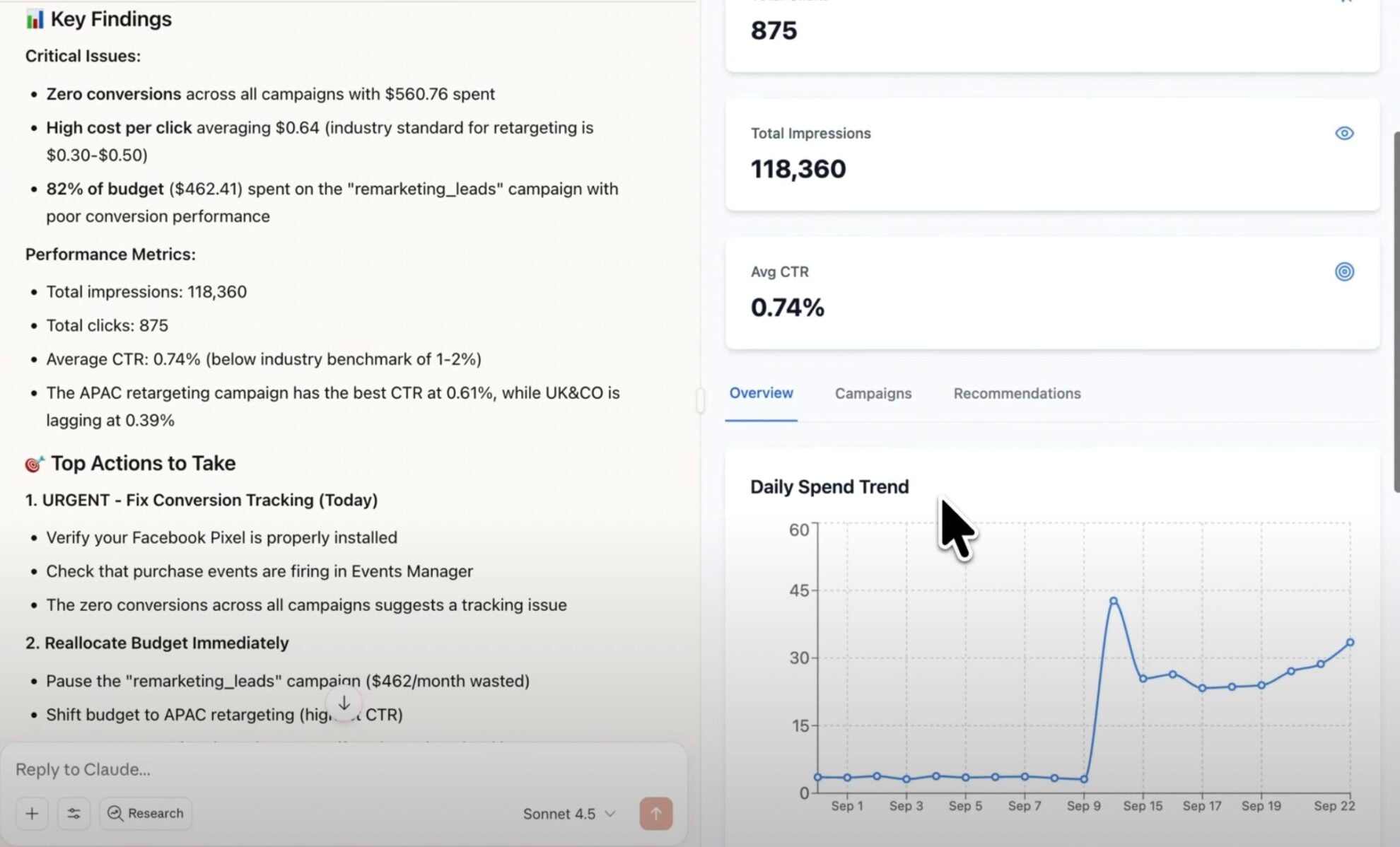
Turn raw Google Ads data into AI insights and actions with Windsor MCP
Seamlessly connect Google Ads to AI chats with Windsor MCP to centralize and analyze your ad performance metrics, unlocking the following benefits:

Get instant answers in LLMs
Send your Google Ads data into your favorite LLMs in seconds, with no engineering or setup headaches. Get AI-generated summaries, visual breakdowns, and optimization recommendations without writing SQL or building dashboards.

Generate insights via natural language
Use short prompts about top performers, ROAS, or ad spend. Windsor MCP turns raw metrics into clear takeaways and next steps, no dashboards required.

Optimize ad spend
Compare PMax vs. Search at a glance, spot weak assets, and cut wasted spend without digging through reports. Ask “Which campaign should get more budget?” or “Which ads should we pause?” to sharpen your strategy.

Unify data across channels
Combine Google Ads with 350+ other sources to gain a complete view of your marketing and business performance. Spot trends, surface opportunities, and make confident, data-backed decisions beyond clicks and cost.

Execute changes from the chat
Pause the ad group burning budget on a high CPA, bump the budget on your best campaign, or push a batch of negative keywords, right from your AI chat. No Google Ads UI, no context switch.
Using Windsor.ai MCP to connect data from Google Ads to LLMs
Sending Google Ads data into AI tools usually requires manual exports, CSV cleanups, or expensive tools. Windsor MCP simplifies this process by collecting, normalizing, and streaming your Google Ads data to the LLM platform of your choice.
Connect your advertising data in minutes, ready for natural-language analysis.
Available actions
Push Negative Keywords Add negative keywords to a Google Ads campaign or ad group. Set level to 'campaign' (with campaign_id) to block the terms across the whole campaign, or 'ad_group' (with ad_group_id) to block them only in that ad group. Each keyword has a match type (BROAD, PHRASE or EXACT, defaulting to BROAD). Keywords are pushed in one request; any that Google rejects (for example a duplicate, or a negative that already exists on the target) are skipped and reported, and the remaining valid keywords are still added. To read back the pushed negative keywords, query get_data with the campaign_criterion_keyword_text, campaign_criterion_keyword_match_type and campaign_criterion_negative fields (campaign level) or the ad_group_criterion_keyword_text, ad_group_criterion_keyword_match_type and ad_group_criterion_negative fields (ad group level).
Add negative keywords to a Google Ads campaign or ad group. Set level to 'campaign' (with campaign_id) to block the terms across the whole campaign, or 'ad_group' (with ad_group_id) to block them only in that ad group. Each keyword has a match type (BROAD, PHRASE or EXACT, defaulting to BROAD). Keywords are pushed in one request; any that Google rejects (for example a duplicate, or a negative that already exists on the target) are skipped and reported, and the remaining valid keywords are still added. To read back the pushed negative keywords, query get_data with the campaign_criterion_keyword_text, campaign_criterion_keyword_match_type and campaign_criterion_negative fields (campaign level) or the ad_group_criterion_keyword_text, ad_group_criterion_keyword_match_type and ad_group_criterion_negative fields (ad group level).
Push Keywords Add positive keywords to a Google Ads ad group (positive keywords live on the ad group, not the campaign). Each keyword has a match type (BROAD, PHRASE or EXACT, defaulting to BROAD) and an optional max CPC bid in micros. Status ('enabled' or 'paused') defaults to 'enabled' for the whole batch and can be overridden per keyword. Keywords are pushed in one request; any that Google rejects (for example a duplicate that already exists in the ad group) are skipped and reported, and the remaining valid keywords are still added.
Add positive keywords to a Google Ads ad group (positive keywords live on the ad group, not the campaign). Each keyword has a match type (BROAD, PHRASE or EXACT, defaulting to BROAD) and an optional max CPC bid in micros. Status ('enabled' or 'paused') defaults to 'enabled' for the whole batch and can be overridden per keyword. Keywords are pushed in one request; any that Google rejects (for example a duplicate that already exists in the ad group) are skipped and reported, and the remaining valid keywords are still added.
Create Responsive Search Ad Create a responsive search ad inside an existing Search ad group. Provide 3-15 headlines (max 30 characters each) and 2-4 descriptions (max 90 characters each); Google mixes them into ad combinations. final_url is the landing page. The optional path1 and path2 are display-URL segments (max 15 characters each; path2 requires path1). The ad is created paused by default so it does not start serving immediately.
Create a responsive search ad inside an existing Search ad group. Provide 3-15 headlines (max 30 characters each) and 2-4 descriptions (max 90 characters each); Google mixes them into ad combinations. final_url is the landing page. The optional path1 and path2 are display-URL segments (max 15 characters each; path2 requires path1). The ad is created paused by default so it does not start serving immediately.
Create Ad Group Create a new ad group inside an existing Search or Display campaign. The ad group type is derived from the campaign's channel type. The optional cpc_bid_micros sets the default max CPC bid in micros of the account currency (1,000,000 micros = 1 unit). The ad group is created paused by default.
Create a new ad group inside an existing Search or Display campaign. The ad group type is derived from the campaign's channel type. The optional cpc_bid_micros sets the default max CPC bid in micros of the account currency (1,000,000 micros = 1 unit). The ad group is created paused by default.
Create Campaign Create a new Search or Display Google Ads campaign together with its daily budget in a single atomic request. The budget amount is in micros of the account currency (1,000,000 micros = 1 unit, e.g. 50_000_000 means 50.00). The campaign is created paused by default so it does not start serving immediately. It is declared as not containing EU political advertising unless contains_eu_political_advertising is set to true. The maximize_conversions bidding strategy requires conversion tracking to be enabled on the account. Add ad groups to it with the create_ad_group action.
Create a new Search or Display Google Ads campaign together with its daily budget in a single atomic request. The budget amount is in micros of the account currency (1,000,000 micros = 1 unit, e.g. 50_000_000 means 50.00). The campaign is created paused by default so it does not start serving immediately. It is declared as not containing EU political advertising unless contains_eu_political_advertising is set to true. The maximize_conversions bidding strategy requires conversion tracking to be enabled on the account. Add ad groups to it with the create_ad_group action.
Set Campaign Budget Set the daily or total (lifetime) budget of a Google Ads campaign. The amount is in micros of the account currency (1,000,000 micros = 1 unit, e.g. 50_000_000 means 50.00). A lifetime budget only applies to campaigns with a fixed end date. If the budget is also used by other campaigns, the change is rejected unless apply_to_shared_budget is set to true, because it would affect every campaign that shares that budget.
Set the daily or total (lifetime) budget of a Google Ads campaign. The amount is in micros of the account currency (1,000,000 micros = 1 unit, e.g. 50_000_000 means 50.00). A lifetime budget only applies to campaigns with a fixed end date. If the budget is also used by other campaigns, the change is rejected unless apply_to_shared_budget is set to true, because it would affect every campaign that shares that budget.
Create Ad Asset Create a Google Ads ad extension asset and link it to a campaign or ad group in one atomic request. Supported asset_type values: 'sitelink' (extra links under the ad; needs link_text and final_url, with optional description_1 and description_2), 'callout' (short non-clickable highlight; needs callout_text), 'structured_snippet' (a header plus 3-10 values; needs header and values) and 'call' (a phone number; needs phone_number and country_code). Set level to 'campaign' (with campaign_id) to apply the extension across the whole campaign, or 'ad_group' (with ad_group_id) to apply it to one ad group only. Each call creates one asset; call the action again for each additional extension. New call and sitelink assets go through Google's policy review before they start showing.
Create a Google Ads ad extension asset and link it to a campaign or ad group in one atomic request. Supported asset_type values: 'sitelink' (extra links under the ad; needs link_text and final_url, with optional description_1 and description_2), 'callout' (short non-clickable highlight; needs callout_text), 'structured_snippet' (a header plus 3-10 values; needs header and values) and 'call' (a phone number; needs phone_number and country_code). Set level to 'campaign' (with campaign_id) to apply the extension across the whole campaign, or 'ad_group' (with ad_group_id) to apply it to one ad group only. Each call creates one asset; call the action again for each additional extension. New call and sitelink assets go through Google's policy review before they start showing.
Enable Campaign Enable a paused Google Ads campaign. Reversible via pause_campaign.
Enable a paused Google Ads campaign. Reversible via pause_campaign.
Pause Campaign Pause an active Google Ads campaign. Reversible via enable_campaign.
Pause an active Google Ads campaign. Reversible via enable_campaign.
Enable Ad Enable a paused ad within an ad group. Identify the ad by its ad group id and ad id; the create ad actions return these joined as '<ad_group_id>~<ad_id>'. Reversible via pause_ad.
Enable a paused ad within an ad group. Identify the ad by its ad group id and ad id; the create ad actions return these joined as '<ad_group_id>~<ad_id>'. Reversible via pause_ad.
Pause Ad Pause an active ad within an ad group. Identify the ad by its ad group id and ad id; the create ad actions return these joined as '<ad_group_id>~<ad_id>'. Reversible via enable_ad.
Pause an active ad within an ad group. Identify the ad by its ad group id and ad id; the create ad actions return these joined as '<ad_group_id>~<ad_id>'. Reversible via enable_ad.
Update Keywords Update existing positive keywords in a Google Ads ad group, identified by ad group criterion id (from the get_data 'keyword_criterion_id' field). Each update can change the keyword's status ('enabled' or 'paused') and/or its max CPC bid in micros; a keyword's text and match type cannot be changed (remove and re-add to change those). Updates are applied in one request; any that Google rejects (for example an unknown criterion id) are skipped and reported, and the remaining valid updates are still applied.
Update existing positive keywords in a Google Ads ad group, identified by ad group criterion id (from the get_data 'keyword_criterion_id' field). Each update can change the keyword's status ('enabled' or 'paused') and/or its max CPC bid in micros; a keyword's text and match type cannot be changed (remove and re-add to change those). Updates are applied in one request; any that Google rejects (for example an unknown criterion id) are skipped and reported, and the remaining valid updates are still applied.
Enable Ad Group Enable a paused Google Ads ad group. Reversible via pause_ad_group.
Enable a paused Google Ads ad group. Reversible via pause_ad_group.
Set Campaign Bidding Strategy Switch a Google Ads campaign to a different standard (campaign-level) bidding strategy. Supported strategies: manual_cpc, target_cpa, target_roas, maximize_conversions, maximize_conversion_value, maximize_clicks, target_spend. maximize_clicks and target_spend are aliases for the same strategy (the former is the Google Ads UI label, the latter the API and get_data field naming). target_cpa_micros is required for target_cpa and maximize_conversions (1,000,000 micros = 1 unit of the account currency). target_roas is required for target_roas and maximize_conversion_value (expressed as a ratio, e.g. 4.0 means 400% return on ad spend). cpc_bid_ceiling_micros is required for maximize_clicks and target_spend; it is not accepted for other strategies because the API only allows a campaign-level ceiling on Target Spend (other strategies require a portfolio bidding strategy). manual_cpc takes no additional parameters.
Switch a Google Ads campaign to a different standard (campaign-level) bidding strategy. Supported strategies: manual_cpc, target_cpa, target_roas, maximize_conversions, maximize_conversion_value, maximize_clicks, target_spend. maximize_clicks and target_spend are aliases for the same strategy (the former is the Google Ads UI label, the latter the API and get_data field naming). target_cpa_micros is required for target_cpa and maximize_conversions (1,000,000 micros = 1 unit of the account currency). target_roas is required for target_roas and maximize_conversion_value (expressed as a ratio, e.g. 4.0 means 400% return on ad spend). cpc_bid_ceiling_micros is required for maximize_clicks and target_spend; it is not accepted for other strategies because the API only allows a campaign-level ceiling on Target Spend (other strategies require a portfolio bidding strategy). manual_cpc takes no additional parameters.
Set CPC Bid Ceiling Set the maximum CPC bid the strategy is allowed to place on a Google Ads campaign. The amount is in micros of the account currency (1,000,000 micros = 1 unit, e.g. 2_500_000 means 2.50). Only applies to campaigns using Target Spend / Maximize Clicks bidding. Other strategies (Target CPA, Target ROAS, Maximize Conversions, Maximize Conversion Value) treat ceiling as portfolio-only per the Google Ads API, so those cannot be adjusted via this action.
Set the maximum CPC bid the strategy is allowed to place on a Google Ads campaign. The amount is in micros of the account currency (1,000,000 micros = 1 unit, e.g. 2_500_000 means 2.50). Only applies to campaigns using Target Spend / Maximize Clicks bidding. Other strategies (Target CPA, Target ROAS, Maximize Conversions, Maximize Conversion Value) treat ceiling as portfolio-only per the Google Ads API, so those cannot be adjusted via this action.
Remove Keywords Remove positive keywords from a Google Ads ad group, identified by ad group criterion id (from the get_data 'keyword_criterion_id' field). Removals are applied in one request; any that Google rejects (for example an unknown criterion id) are skipped and reported, and the remaining valid removals still apply.
Remove positive keywords from a Google Ads ad group, identified by ad group criterion id (from the get_data 'keyword_criterion_id' field). Removals are applied in one request; any that Google rejects (for example an unknown criterion id) are skipped and reported, and the remaining valid removals still apply.
Pause Ad Group Pause an active Google Ads ad group. Reversible via enable_ad_group.
Pause an active Google Ads ad group. Reversible via enable_ad_group.
Set Campaign Language Targeting Set the languages a Google Ads campaign targets, so its ads only reach users Google associates with one of them. Each language is given as its Google Ads language code, spelled exactly as the languages parameter enumerates it (e.g. en, de, es, zh_CN). Regional variants such as en_US and en_GB are not among them and cannot be targeted, only the base en. Google's table of these codes with the language each one names is at https://developers.google.com/google-ads/api/data/codes-formats#languages. This replaces the whole language targeting — every language to target must be listed in one call, because the languages not listed are removed. Languages already targeted are left in place, so their criterion ids do not change. A campaign with no language criteria targets all languages; pass an empty list to clear the targeting and return it to that state. Language targeting cannot be negative: there is no way to exclude a single language, only to list the ones to target. Google rejects the change for campaign types that do not support language criteria (e.g. Smart campaigns).
Set the languages a Google Ads campaign targets, so its ads only reach users Google associates with one of them. Each language is given as its Google Ads language code, spelled exactly as the languages parameter enumerates it (e.g. en, de, es, zh_CN). Regional variants such as en_US and en_GB are not among them and cannot be targeted, only the base en. Google's table of these codes with the language each one names is at https://developers.google.com/google-ads/api/data/codes-formats#languages. This replaces the whole language targeting — every language to target must be listed in one call, because the languages not listed are removed. Languages already targeted are left in place, so their criterion ids do not change. A campaign with no language criteria targets all languages; pass an empty list to clear the targeting and return it to that state. Language targeting cannot be negative: there is no way to exclude a single language, only to list the ones to target. Google rejects the change for campaign types that do not support language criteria (e.g. Smart campaigns).
Remove Negative Keywords Remove negative keywords from a Google Ads campaign or ad group, identified by criterion id. Set level to 'campaign' (with campaign_id) or 'ad_group' (with ad_group_id) to match where the negative keywords are attached. Removals are applied in one request; any that Google rejects (for example an unknown criterion id) are skipped and reported, and the remaining valid removals still apply. Reversible via push_negative_keywords by re-adding the keyword text and match type.
Remove negative keywords from a Google Ads campaign or ad group, identified by criterion id. Set level to 'campaign' (with campaign_id) or 'ad_group' (with ad_group_id) to match where the negative keywords are attached. Removals are applied in one request; any that Google rejects (for example an unknown criterion id) are skipped and reported, and the remaining valid removals still apply. Reversible via push_negative_keywords by re-adding the keyword text and match type.
Set Max CPC Bid Set the default Max CPC bid on a Google Ads ad group. The amount is in micros of the account currency (1,000,000 micros = 1 unit, e.g. 2_500_000 means 2.50). Manual CPC bids live on the ad group, not the campaign, so the parent campaign must use the Manual CPC bidding strategy; switch it first via set_campaign_bidding_strategy if it uses Smart Bidding.
Set the default Max CPC bid on a Google Ads ad group. The amount is in micros of the account currency (1,000,000 micros = 1 unit, e.g. 2_500_000 means 2.50). Manual CPC bids live on the ad group, not the campaign, so the parent campaign must use the Manual CPC bidding strategy; switch it first via set_campaign_bidding_strategy if it uses Smart Bidding.
Set Ad Schedule Set the ad schedule (dayparting) of a Google Ads campaign: the days and times of day its ads are allowed to serve, each with an optional bid adjustment. This replaces the campaign's whole schedule — every window it should serve in must be listed in one call, because the windows not listed are removed. Times are in the campaign's account time zone. Hours are 24-hour, minutes are limited to 0, 15, 30 and 45, and each window is exclusive of its end time, so 09:00-17:00 serves up to but not including 17:00; use end_hour 24 for the end of the day. Windows for the same day must not overlap, and a day takes at most six of them. A campaign with no ad schedule serves at all times; pass an empty schedule list to clear the schedule and return it to that state. To read the current schedule, query get_data with the campaign_criterion_ad_schedule_day_of_week, campaign_criterion_ad_schedule_start_hour, campaign_criterion_ad_schedule_start_minute, campaign_criterion_ad_schedule_end_hour and campaign_criterion_ad_schedule_end_minute fields.
Set the ad schedule (dayparting) of a Google Ads campaign: the days and times of day its ads are allowed to serve, each with an optional bid adjustment. This replaces the campaign's whole schedule — every window it should serve in must be listed in one call, because the windows not listed are removed. Times are in the campaign's account time zone. Hours are 24-hour, minutes are limited to 0, 15, 30 and 45, and each window is exclusive of its end time, so 09:00-17:00 serves up to but not including 17:00; use end_hour 24 for the end of the day. Windows for the same day must not overlap, and a day takes at most six of them. A campaign with no ad schedule serves at all times; pass an empty schedule list to clear the schedule and return it to that state. To read the current schedule, query get_data with the campaign_criterion_ad_schedule_day_of_week, campaign_criterion_ad_schedule_start_hour, campaign_criterion_ad_schedule_start_minute, campaign_criterion_ad_schedule_end_hour and campaign_criterion_ad_schedule_end_minute fields.
Set Target CPA Set the target cost per acquisition on a Google Ads campaign already using Target CPA or Maximize Conversions bidding. The amount is in micros of the account currency (1,000,000 micros = 1 unit, e.g. 25_000_000 means 25.00). To switch a campaign to Target CPA bidding, use set_campaign_bidding_strategy with strategy='target_cpa' instead.
Set the target cost per acquisition on a Google Ads campaign already using Target CPA or Maximize Conversions bidding. The amount is in micros of the account currency (1,000,000 micros = 1 unit, e.g. 25_000_000 means 25.00). To switch a campaign to Target CPA bidding, use set_campaign_bidding_strategy with strategy='target_cpa' instead.
Rename Campaign Change the name of an existing Google Ads campaign. Only the name changes: budget, bidding, targeting, status, ad groups and ads are all left as they are, and historical reporting stays attached to the campaign because reports key on the campaign id. Campaign names must be unique within the account, so renaming to a name another campaign already uses is rejected. To rename an ad group instead, use the rename_ad_group action.
Change the name of an existing Google Ads campaign. Only the name changes: budget, bidding, targeting, status, ad groups and ads are all left as they are, and historical reporting stays attached to the campaign because reports key on the campaign id. Campaign names must be unique within the account, so renaming to a name another campaign already uses is rejected. To rename an ad group instead, use the rename_ad_group action.
Rename Ad Group Change the name of an existing Google Ads ad group. Only the name changes: bids, targeting, status, keywords and ads are all left as they are, and historical reporting stays attached to the ad group because reports key on the ad group id. Ad group names must be unique within their campaign, so renaming to a name another ad group in the same campaign already uses is rejected. To rename a campaign instead, use the rename_campaign action.
Change the name of an existing Google Ads ad group. Only the name changes: bids, targeting, status, keywords and ads are all left as they are, and historical reporting stays attached to the ad group because reports key on the ad group id. Ad group names must be unique within their campaign, so renaming to a name another ad group in the same campaign already uses is rejected. To rename a campaign instead, use the rename_campaign action.
Set Target ROAS Set the target return on ad spend on a Google Ads campaign already using Target ROAS or Maximize Conversion Value bidding. The value is a ratio of conversion value to spend, not a percentage (e.g. 4.0 means 400% ROAS). To switch a campaign to Target ROAS bidding, use set_campaign_bidding_strategy with strategy='target_roas' instead.
Set the target return on ad spend on a Google Ads campaign already using Target ROAS or Maximize Conversion Value bidding. The value is a ratio of conversion value to spend, not a percentage (e.g. 4.0 means 400% ROAS). To switch a campaign to Target ROAS bidding, use set_campaign_bidding_strategy with strategy='target_roas' instead.
Create Customer Match List Create an empty Google Ads Customer Match user list (CRM-based, with CONTACT_INFO as the upload key type — email, phone, or mailing address) that can then be populated with upload_customer_match_list. Returns the numeric user_list_id to pass to that action. membership_life_span_days controls how long an uploaded member remains in the list before Google auto-removes it: 1-540 for a fixed lifespan, or 10000 as Google's sentinel value for 'no expiration'. The account must be enrolled in Customer Match; if it is not, creation fails with a policy error and no list is created.
Create an empty Google Ads Customer Match user list (CRM-based, with CONTACT_INFO as the upload key type — email, phone, or mailing address) that can then be populated with upload_customer_match_list. Returns the numeric user_list_id to pass to that action. membership_life_span_days controls how long an uploaded member remains in the list before Google auto-removes it: 1-540 for a fixed lifespan, or 10000 as Google's sentinel value for 'no expiration'. The account must be enrolled in Customer Match; if it is not, creation fails with a policy error and no list is created.
Attach User List to Ad Group Attach a Customer Match user list to a Google Ads ad group so the ad group can target or exclude users in that list. Pass exclude=false (default) to add the list as a positive audience criterion, or exclude=true to add it as a negative criterion (never show ads to users in the list — commonly used to suppress existing customers). This action is idempotent: attaching a list that is already attached with the same exclude value is a no-op and returns the existing criterion. Attaching with a different exclude value than the current attachment returns an error — detach first, then re-attach. targeting_mode controls whether the list narrows delivery for the ad group ('targeting') or is only used for reporting and bidding ('observation'). Passing 'targeting' or 'observation' updates the ad group's AUDIENCE target_restriction; other target_restrictions (e.g. DEMOGRAPHIC) are preserved. Passing 'unchanged' (default) leaves targeting_setting untouched; note the setting is ad-group-wide, so changing it affects ALL audience criteria on the ad group, not just the list being attached. Negative (exclude=true) criteria always apply regardless of targeting_setting. Scope: this action is for AD-GROUP-level audiences only; campaign-level audience criteria and Performance Max audience signals use different APIs and are not supported here.
Attach a Customer Match user list to a Google Ads ad group so the ad group can target or exclude users in that list. Pass exclude=false (default) to add the list as a positive audience criterion, or exclude=true to add it as a negative criterion (never show ads to users in the list — commonly used to suppress existing customers). This action is idempotent: attaching a list that is already attached with the same exclude value is a no-op and returns the existing criterion. Attaching with a different exclude value than the current attachment returns an error — detach first, then re-attach. targeting_mode controls whether the list narrows delivery for the ad group ('targeting') or is only used for reporting and bidding ('observation'). Passing 'targeting' or 'observation' updates the ad group's AUDIENCE target_restriction; other target_restrictions (e.g. DEMOGRAPHIC) are preserved. Passing 'unchanged' (default) leaves targeting_setting untouched; note the setting is ad-group-wide, so changing it affects ALL audience criteria on the ad group, not just the list being attached. Negative (exclude=true) criteria always apply regardless of targeting_setting. Scope: this action is for AD-GROUP-level audiences only; campaign-level audience criteria and Performance Max audience signals use different APIs and are not supported here.
Upload Customer Match List Upload contact records (email, phone, or mailing address) to a Google Ads Customer Match user list for audience targeting. The user list must already exist in Google Ads; pass its numeric id as user_list_id. If you do not have one yet, call create_customer_match_list first to create an empty list and get its id. Uploads go through Google's Data Manager API (https://developers.google.com/data-manager/api/devguides/audiences/google-ads/customer-match), which requires the Google Ads account to have been authorised with the ``https://www.googleapis.com/auth/datamanager`` OAuth scope; the action returns a clear error if the scope is missing. This action is ASYNCHRONOUS: it returns immediately with a request_id once Google has accepted the request. Google then matches the records against signed-in users in the background — this typically takes a few minutes but can take up to 24 hours for large lists. The user list is NOT usable for targeting until matching completes. To check progress, call get_customer_match_upload_status with the returned request_id. Poll no more than once every 60 seconds. The job is done when status is SUCCESS, PARTIAL_SUCCESS, or FAILED; while it is PROCESSING keep polling. PII HANDLING: emails, phone numbers, and names are normalized and SHA-256 hashed by this action before being sent to Google — do NOT pre-hash them; pass raw values. operation_type=add appends records to the list; operation_type=remove removes matching records (use for compliance requests such as GDPR erasure). At most 10,000 records per call; split larger uploads into multiple calls.
Upload contact records (email, phone, or mailing address) to a Google Ads Customer Match user list for audience targeting. The user list must already exist in Google Ads; pass its numeric id as user_list_id. If you do not have one yet, call create_customer_match_list first to create an empty list and get its id. Uploads go through Google's Data Manager API (https://developers.google.com/data-manager/api/devguides/audiences/google-ads/customer-match), which requires the Google Ads account to have been authorised with the ``https://www.googleapis.com/auth/datamanager`` OAuth scope; the action returns a clear error if the scope is missing. This action is ASYNCHRONOUS: it returns immediately with a request_id once Google has accepted the request. Google then matches the records against signed-in users in the background — this typically takes a few minutes but can take up to 24 hours for large lists. The user list is NOT usable for targeting until matching completes. To check progress, call get_customer_match_upload_status with the returned request_id. Poll no more than once every 60 seconds. The job is done when status is SUCCESS, PARTIAL_SUCCESS, or FAILED; while it is PROCESSING keep polling. PII HANDLING: emails, phone numbers, and names are normalized and SHA-256 hashed by this action before being sent to Google — do NOT pre-hash them; pass raw values. operation_type=add appends records to the list; operation_type=remove removes matching records (use for compliance requests such as GDPR erasure). At most 10,000 records per call; split larger uploads into multiple calls.
Delete Customer Match List Permanently delete a Google Ads Customer Match user list. Detaches the list from any ad groups or campaigns currently using it as an audience or exclusion criterion and removes all uploaded members. Historical performance data for the list is retained in reports. Cannot be undone; to recover, create a new list and re-upload members. Use with care — deleting a list that is actively targeting a live campaign changes delivery immediately.
Permanently delete a Google Ads Customer Match user list. Detaches the list from any ad groups or campaigns currently using it as an audience or exclusion criterion and removes all uploaded members. Historical performance data for the list is retained in reports. Cannot be undone; to recover, create a new list and re-upload members. Use with care — deleting a list that is actively targeting a live campaign changes delivery immediately.
Detach User List from Ad Group Remove a Customer Match user list criterion (audience or exclusion) from a Google Ads ad group. Reverses attach_user_list_to_ad_group. Removes both positive (audience) and negative (exclusion) criteria — pass the same ad_group_id and user_list_id used when attaching. Removing a user list stops any targeting or reporting effect it had on future traffic; historical performance data remains in reports. If the list is not currently attached to the ad group, the action returns an error and no changes are made.
Remove a Customer Match user list criterion (audience or exclusion) from a Google Ads ad group. Reverses attach_user_list_to_ad_group. Removes both positive (audience) and negative (exclusion) criteria — pass the same ad_group_id and user_list_id used when attaching. Removing a user list stops any targeting or reporting effect it had on future traffic; historical performance data remains in reports. If the list is not currently attached to the ad group, the action returns an error and no changes are made.
Get Customer Match Upload Status Check the status of a Customer Match upload request started by upload_customer_match_list. Pass the request_id that action returned. Status is one of PROCESSING, SUCCESS, PARTIAL_SUCCESS, FAILED. PROCESSING means matching is still in progress — poll again in at least 60 seconds. Do NOT poll more frequently; quota is shared with data reads. If still PROCESSING after 24 hours, treat as stuck and contact support. SUCCESS means every uploaded record was accepted; the response includes the record count and match_rate_range, a coarse bucket indicating what fraction of uploaded records were matched to signed-in Google users. A low match rate usually reflects source data quality (invalid or non-Google-account emails/phones), not upload failure. For operation_type=remove requests, SUCCESS means the matching records were removed from the list. PARTIAL_SUCCESS means some records were accepted and others were rejected; the response includes the same counts plus the error message describing which records failed. The list still receives the accepted records. FAILED means the entire request failed with no records ingested; the response includes the reason. Failed requests cannot be resumed; start a new upload after fixing the issue.
Check the status of a Customer Match upload request started by upload_customer_match_list. Pass the request_id that action returned. Status is one of PROCESSING, SUCCESS, PARTIAL_SUCCESS, FAILED. PROCESSING means matching is still in progress — poll again in at least 60 seconds. Do NOT poll more frequently; quota is shared with data reads. If still PROCESSING after 24 hours, treat as stuck and contact support. SUCCESS means every uploaded record was accepted; the response includes the record count and match_rate_range, a coarse bucket indicating what fraction of uploaded records were matched to signed-in Google users. A low match rate usually reflects source data quality (invalid or non-Google-account emails/phones), not upload failure. For operation_type=remove requests, SUCCESS means the matching records were removed from the list. PARTIAL_SUCCESS means some records were accepted and others were rejected; the response includes the same counts plus the error message describing which records failed. The list still receives the accepted records. FAILED means the entire request failed with no records ingested; the response includes the reason. Failed requests cannot be resumed; start a new upload after fixing the issue.
Update Ad Group Partially update an existing Google Ads ad group. Provide only the fields to change; at least one besides ad_group_id is required and omitted fields are left untouched. status is 'enabled' or 'paused'; ad_rotation_mode is 'optimize' or 'rotate_forever'. cpc_bid_micros is the default max CPC bid in micros of the account currency (1,000,000 micros = 1 unit, e.g. 2_500_000 means 2.50) and only applies when the parent campaign uses Manual CPC; switch it first via set_campaign_bidding_strategy if it uses Smart Bidding. Budget, target CPA and CPM bids are not editable here. This is a value change with no built-in undo: to reverse it read the current values first (e.g. GAQL 'SELECT ad_group.name, ad_group.status, ad_group.cpc_bid_micros, ad_group.ad_rotation_mode FROM ad_group WHERE ad_group.id = <id>') then call update_ad_group again with the previous values. The single-purpose rename_ad_group, pause_ad_group/enable_ad_group and set_max_cpc actions still exist; prefer them for one change and use update_ad_group to change several fields at once.
Partially update an existing Google Ads ad group. Provide only the fields to change; at least one besides ad_group_id is required and omitted fields are left untouched. status is 'enabled' or 'paused'; ad_rotation_mode is 'optimize' or 'rotate_forever'. cpc_bid_micros is the default max CPC bid in micros of the account currency (1,000,000 micros = 1 unit, e.g. 2_500_000 means 2.50) and only applies when the parent campaign uses Manual CPC; switch it first via set_campaign_bidding_strategy if it uses Smart Bidding. Budget, target CPA and CPM bids are not editable here. This is a value change with no built-in undo: to reverse it read the current values first (e.g. GAQL 'SELECT ad_group.name, ad_group.status, ad_group.cpc_bid_micros, ad_group.ad_rotation_mode FROM ad_group WHERE ad_group.id = <id>') then call update_ad_group again with the previous values. The single-purpose rename_ad_group, pause_ad_group/enable_ad_group and set_max_cpc actions still exist; prefer them for one change and use update_ad_group to change several fields at once.
Rename Customer Match List Change the display name of a Google Ads Customer Match user list. Does not affect membership, campaign attachments, targeting behaviour, or the list's configuration — only the name shown in the Google Ads UI and reports. Names must be unique per account; Google returns an error if another list already uses the requested name.
Change the display name of a Google Ads Customer Match user list. Does not affect membership, campaign attachments, targeting behaviour, or the list's configuration — only the name shown in the Google Ads UI and reports. Names must be unique per account; Google returns an error if another list already uses the requested name.
Set Campaign Geo Targeting Set the geographic targeting of a Google Ads campaign: the countries, regions or cities its ads may serve in, plus optional radius (proximity) areas. Give the complete set of locations to target or exclude in one call; a location currently targeted but left out of the call is removed, and each location may be listed only once. Locations are identified by their numeric geo target constant id (e.g. 2840 for the United States); set a location's 'negative' flag to exclude it (for example target a country but exclude a state), and give targeted locations or proximities an optional bid_modifier between 0.1 and 10.0 (1.0 leaves bids unchanged; excluded locations may not have one). Re-running keeps the locations that stay in the set and updates their bid modifier, but a location cannot be switched between targeted and excluded in one call: omit it to remove it, then add it back the other way in a later call. A proximity area is a point (latitude, longitude) and a radius in miles or kilometers; proximity areas can only be targeted, not excluded, and are replaced as a whole on each call. Passing empty location and proximity lists clears the campaign's geo targeting so its ads can serve in all locations. To read the current geo targeting, query get_data with the criteria_type, campaign_criterion_location_geo_target_constant, campaign_criterion_negative, campaign_criterion_bid_modifier, campaign_criterion_proximity_geo_point_latitude_in_micro_degrees, campaign_criterion_proximity_geo_point_longitude_in_micro_degrees, campaign_criterion_proximity_radius and campaign_criterion_proximity_radius_units fields.
Set the geographic targeting of a Google Ads campaign: the countries, regions or cities its ads may serve in, plus optional radius (proximity) areas. Give the complete set of locations to target or exclude in one call; a location currently targeted but left out of the call is removed, and each location may be listed only once. Locations are identified by their numeric geo target constant id (e.g. 2840 for the United States); set a location's 'negative' flag to exclude it (for example target a country but exclude a state), and give targeted locations or proximities an optional bid_modifier between 0.1 and 10.0 (1.0 leaves bids unchanged; excluded locations may not have one). Re-running keeps the locations that stay in the set and updates their bid modifier, but a location cannot be switched between targeted and excluded in one call: omit it to remove it, then add it back the other way in a later call. A proximity area is a point (latitude, longitude) and a radius in miles or kilometers; proximity areas can only be targeted, not excluded, and are replaced as a whole on each call. Passing empty location and proximity lists clears the campaign's geo targeting so its ads can serve in all locations. To read the current geo targeting, query get_data with the criteria_type, campaign_criterion_location_geo_target_constant, campaign_criterion_negative, campaign_criterion_bid_modifier, campaign_criterion_proximity_geo_point_latitude_in_micro_degrees, campaign_criterion_proximity_geo_point_longitude_in_micro_degrees, campaign_criterion_proximity_radius and campaign_criterion_proximity_radius_units fields.














How to connect Google Ads MCP by Windsor.ai
Follow this quick setup guide to connect your Google Ads data to your preferred AI chat.
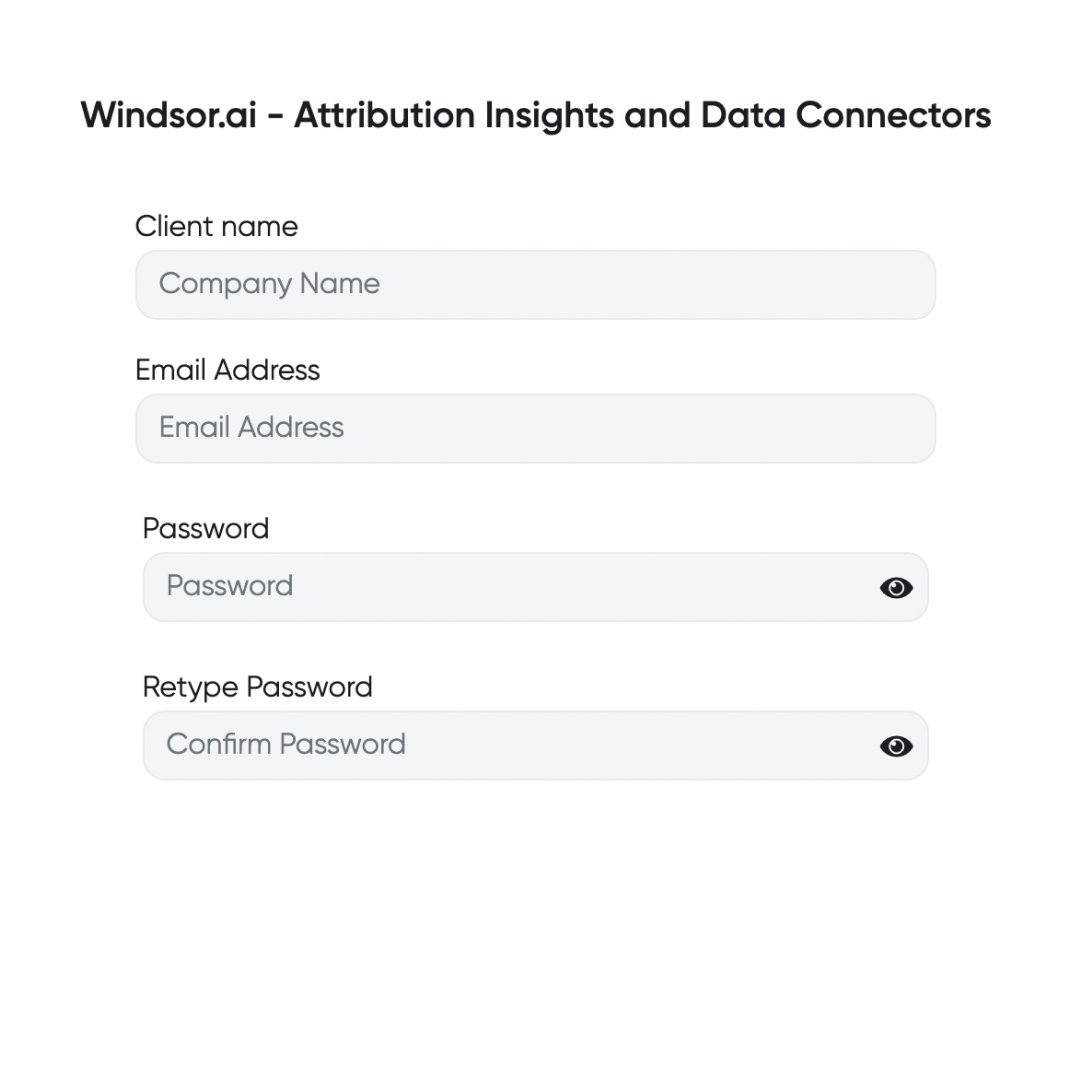
Register and log in to Windsor.ai
Create a new Windsor.ai account or log in if you already have one.
Select your data source
Choose Google Ads as your data source and grant access to Windsor.ai.

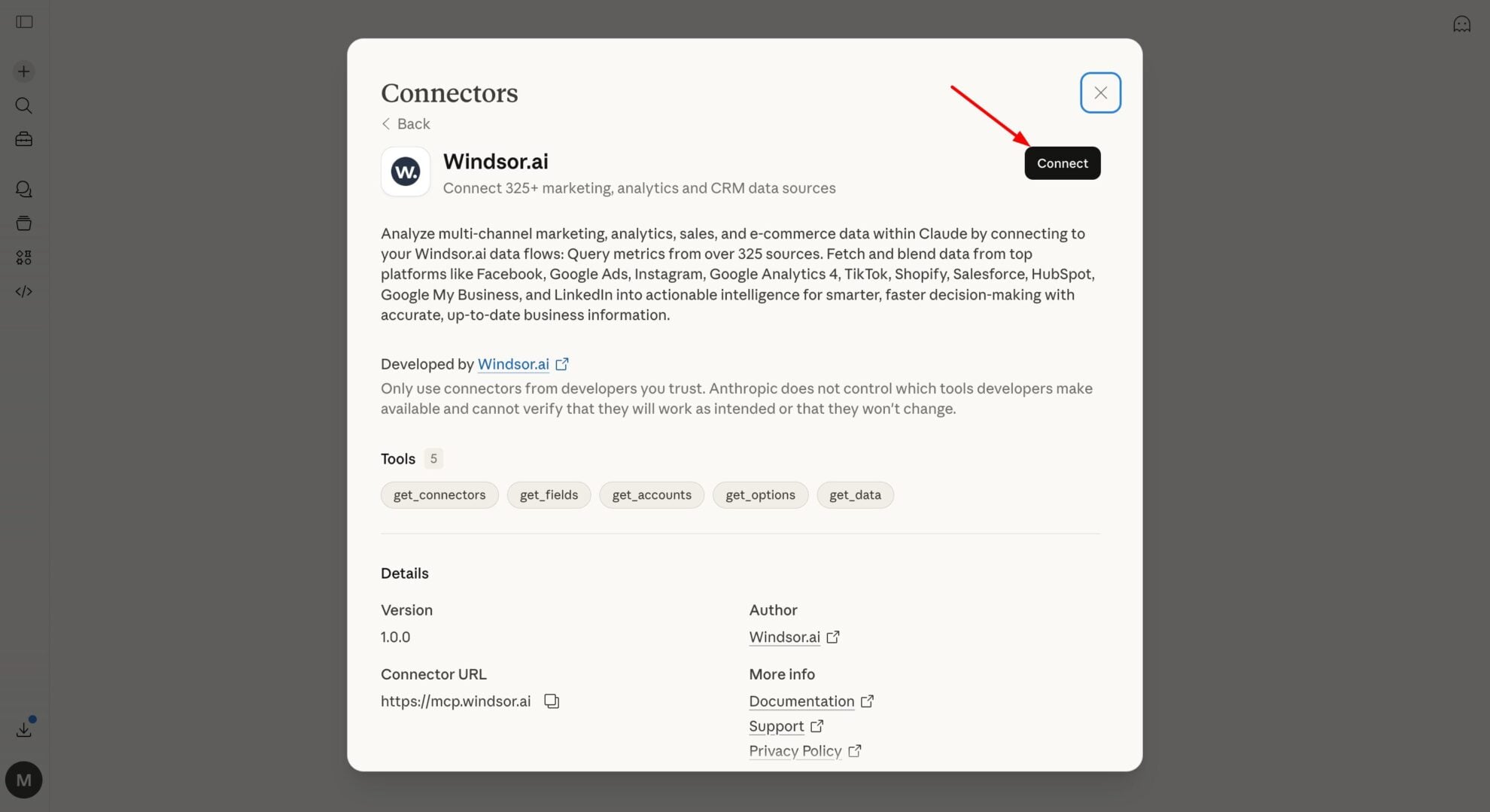
Connect Windsor MCP to your favorite LLM
If a native connector is available for your platform, connect in one click. Otherwise, visit this guide and follow the instructions for your platform of choice.
Start analyzing your data in the LLM
Now you’re ready to ask anything about your data. Your AI assistant can also pause campaigns, adjust budgets, and push negative keywords straight from the chat.
FAQs
What is Windsor MCP?
Windsor MCP (Model Context Protocol) is an AI-powered tool that connects your integrated Windsor.ai data with LLM platforms like Claude, ChatGPT, Copilot, Cursor, and others. It allows you to ask natural language questions about your data, get actionable insights, and execute changes.
What can I do with Windsor MCP?
Windsor MCP lets you interact with your business data directly in your favorite LLM tools. Instead of writing SQL queries, you can simply ask questions like “Which ad groups have the lowest CPA this week?” or “Which devices (mobile/desktop/tablet) convert best?”
MCP automatically collects and normalizes data from all sources connected to your Windsor account, generating instant summaries, deep insights, and optimization recommendations.
For Google Ads, you can also act on those insights directly from the same chat.
Can I manage Google Ads campaigns directly from AI chats?
Yes. Windsor MCP gives any MCP-compatible AI assistant, such as Claude, ChatGPT, or Microsoft Copilot, write access to Google Ads. You can:
- Create new campaigns, ad groups, and responsive search ads
- Pause or enable campaigns, ad groups, and ads
- Set campaign budgets
- Adjust bidding strategy, target CPA, and max CPC
- Set a CPC bid ceiling
- Push negative keywords
Which AI agents support write actions for Google Ads?
Write actions run through Windsor MCP, so any MCP-compatible AI client connected to it can use them, including Claude (Web, Desktop, and Code), ChatGPT, Microsoft Copilot, and Gemini Enterprise. In Gemini Enterprise, turn on Execute Action and Write actions during setup.
Is Windsor MCP free to use?
Yes. Windsor MCP is included in every Windsor.ai plan, including the free forever plan with no credit card. The free plan covers 1 connected data source; combining several sources needs a paid plan, from $19/month for 3 sources. See the pricing page.
What agents does it work with?
You can connect Windsor MCP to any AI agent compatible with MCP, including Claude Desktop, ChatGPT, Perplexity, Cursor, Gemini, etc. All get full read access and write actions, so you can pause, enable, or budget campaigns directly from the chat.
Tired of manual Google Ads data exports? Try Windsor.ai today to automate your reporting


