 Destinations
 Data sources
 AI insights
 About us
 Careers
 Security
 Customer reviews
 Contact us
 Affiliate program
 Solution partners
 Template gallery
 Looker Studio templates
 Power BI templates
 Excel templates
 Google Sheets templates
 Tableau templates
 Facebook Ads templates
 Google Ads templates
 Data fields & Metrics
 AI prompt library & Guides
 Product documentation
 API documentation
 Case studies
 Blog
 Data models
 Windsor vs Supermetrics
 Windsor vs Funnel.io
 Windsor vs Fivetran
 Windsor vs Rivery
 Windsor vs Portermetrics
 Windsor vs Coupler.io
Connect NetSuite to ChatGPT
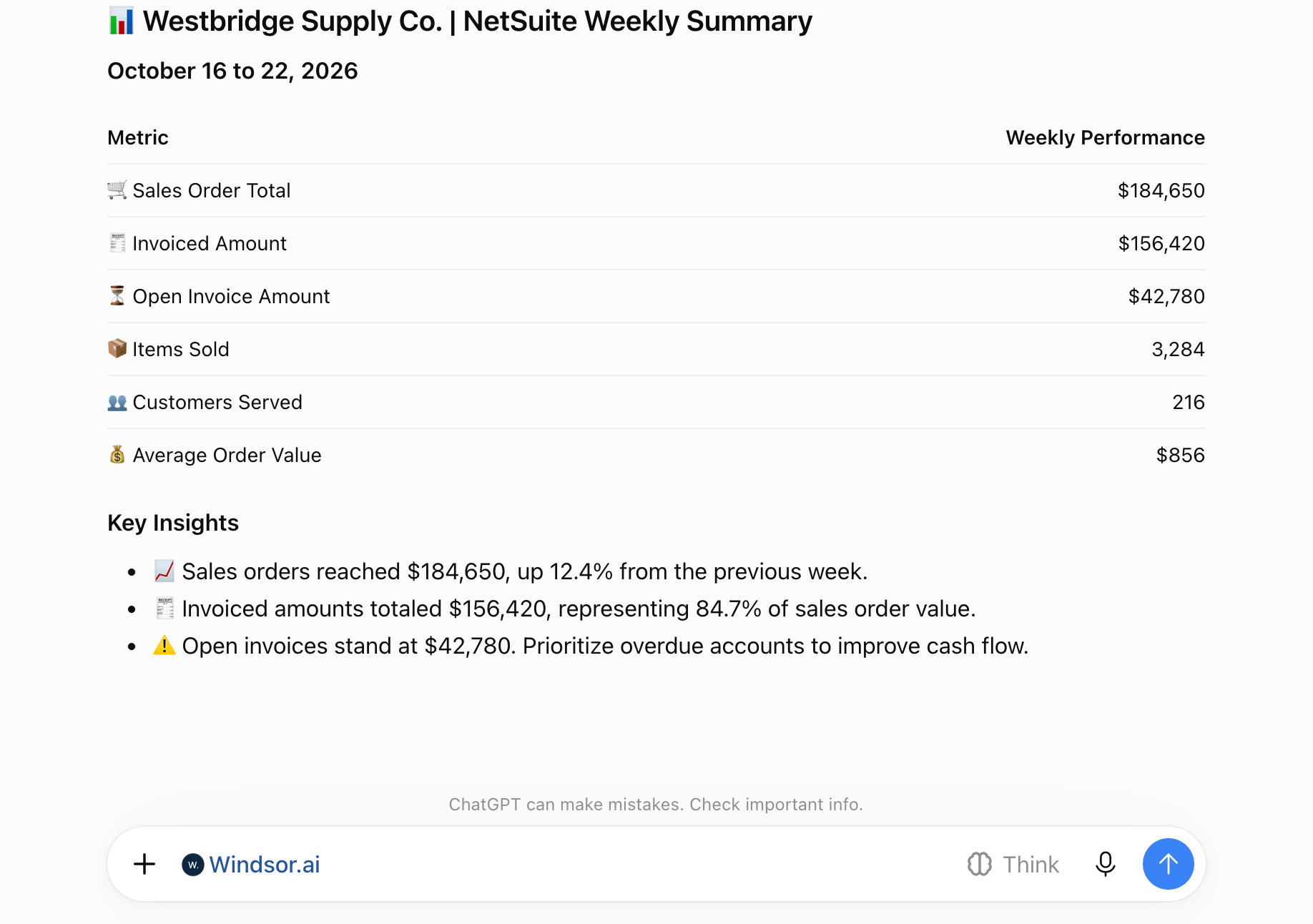
Connect your NetSuite data to ChatGPT with the Windsor.ai connector, and ask about your sales orders, invoices and customers in plain language.
Ask how sales orders moved by month, which invoices are past due, or which items sell most, built on the NetSuite record types you choose, such as salesorder, invoice and item.
Forget CSVs. Stop copy/paste. Connect in minutes. No code required.
 Sign up with Google
 Free forever plan
No credit card needed







Get your NetSuite data into ChatGPT
NetSuite is connected once in Windsor.ai, and these are the use cases the fields support:

Track sales orders
Sales order totals by month, customer and status show how orders move through the year.

Follow up on invoices
Invoices with their due dates and open amounts show what customers still owe.

See what sells
Items on sales orders show which products and services sell most, and at what price.

Check spend by vendor
Transactions by vendor show where the company spends money each quarter.
Using Windsor.ai to connect data from NetSuite to ChatGPT
Without Windsor.ai, ChatGPT answers about NetSuite data come from a file you exported and pasted in. Through the Windsor.ai connector, ChatGPT reads the live records with their real field names, so the answers match what is in NetSuite today.
Connect in minutes, then ask about your sales orders, invoices, customers and items.


How to connect NetSuite to ChatGPT with Windsor.ai
Explore a step-by-step guide to integrate your NetSuite data into ChatGPT with the Windsor.ai connector.
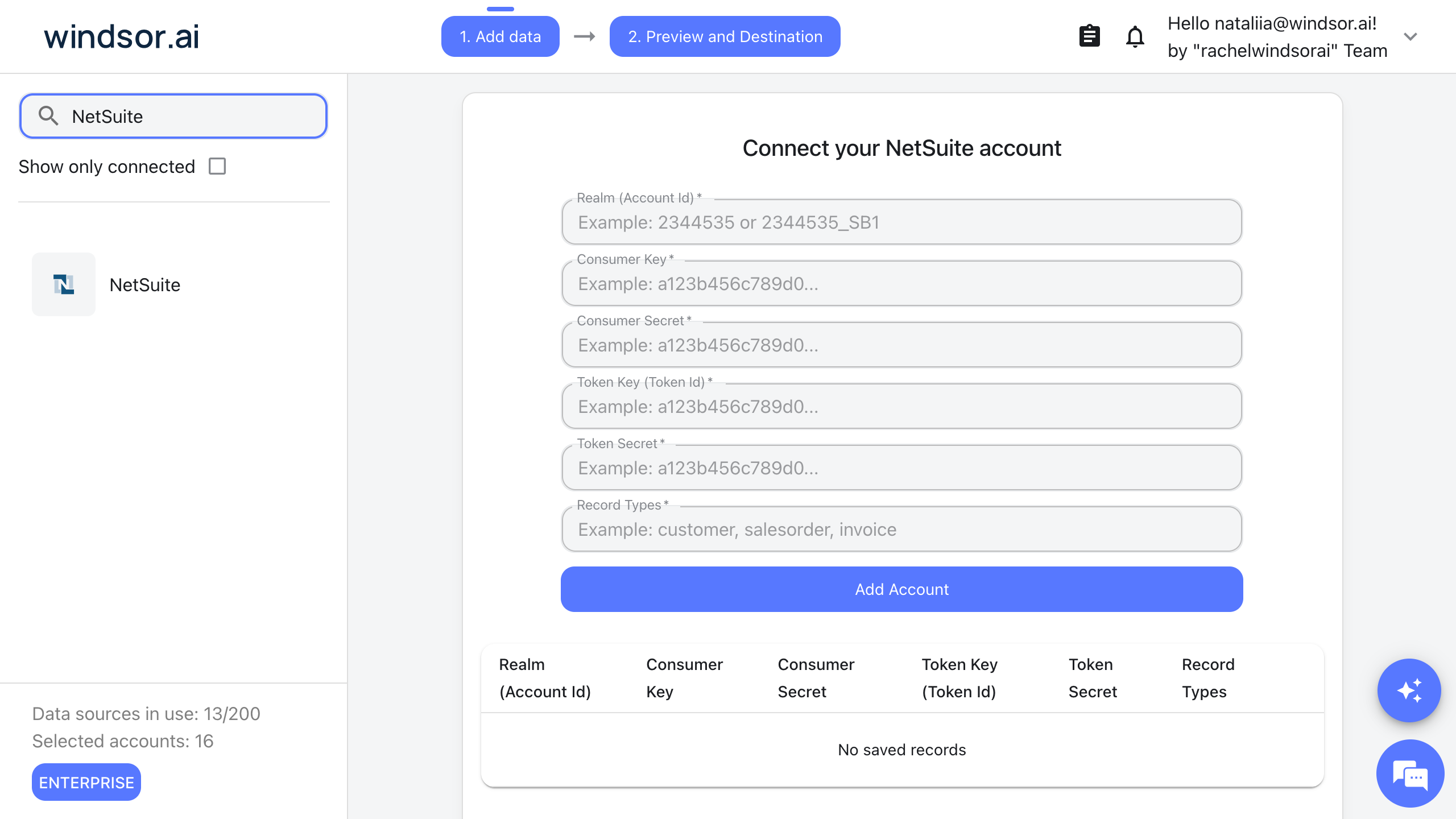
Connect NetSuite in the Windsor.ai dashboard
Choose NetSuite as your data source and enter your NetSuite account ID, Consumer Key, Consumer Secret, Token ID and Token Secret, then list the record types you want, for example customer, salesorder, invoice. A NetSuite administrator creates the integration, role and access token first; the NetSuite connector installation guide has every step.
Install the Windsor.ai connector
Log in to your ChatGPT account and open this Windsor.ai connector page.
Click Connect, then authorize access.

Query your NetSuite data in ChatGPT
Open a new chat and ask about your connected NetSuite data in plain language.
Make sure the Windsor.ai connector is enabled (click the + sign, then More, then Windsor.ai).
FAQs
What NetSuite data can ChatGPT use?
Windsor.ai reads the NetSuite record types you list when you connect, such as customer, salesorder, invoice, item, transaction, vendor and employee. Each record type comes with the fields NetSuite returns for it, as far as the integration role has permission to read them. Every row also carries the date fields Date, Week, Month and Year, so you can group results by period. The NetSuite connector installation guide lists the common record types and the role permissions they need.
What can I ask ChatGPT about my NetSuite data?
These prompts work on the salesorder, invoice, customer, item and vendor record types, so connect those when you set up NetSuite:
-
How many sales orders were created in the last 30 days, and what is their total amount?
-
Which 20 customers had the highest invoiced amount this quarter, and how much is still open?
-
List invoices past their due date with the customer and the open amount.
-
Which items sold the most units last month?
Can ChatGPT change my NetSuite data?
No. The NetSuite connector is read-only. ChatGPT can read your NetSuite records through Windsor.ai and cannot create, edit or delete anything in NetSuite.
Can I combine NetSuite data with other sources in ChatGPT?
Yes. Windsor.ai supports 350+ data sources, so you can connect NetSuite alongside tools such as Google Ads, GA4 or Shopify and ask about them together. For example, compare monthly Google Ads Cost by Campaign with NetSuite sales order totals for the same months.
Do I need to code to connect NetSuite to ChatGPT?
No. Connect NetSuite in Windsor.ai, add Windsor to ChatGPT, and sign in. After that you ask in plain language.
How much does it cost to integrate NetSuite with ChatGPT using Windsor.ai?
The free forever plan covers 1 data source, so connecting NetSuite on its own costs nothing and needs no credit card. Combining NetSuite with other sources needs a paid plan: $19/month for 3 sources or $99/month for 7. ChatGPT is billed separately by OpenAI. See the pricing page.
Do you have helpful links to get started with NetSuite and ChatGPT?
Yes. These are the resources to start with for the NetSuite to ChatGPT integration:
Tired of manual NetSuite data exports? Try Windsor.ai today to work on live data


