 Destinations
 Data sources
 AI insights
 About us
 Careers
 Security
 Customer reviews
 Contact us
 Affiliate program
 Solution partners
 Template gallery
 Looker Studio templates
 Power BI templates
 Excel templates
 Google Sheets templates
 Tableau templates
 Facebook Ads templates
 Google Ads templates
 Data fields & Metrics
 AI prompt library & Guides
 Product documentation
 API documentation
 Case studies
 Blog
Blog Data models
 Windsor vs Supermetrics
 Windsor vs Funnel.io
 Windsor vs Fivetran
 Windsor vs Rivery
 Windsor vs Portermetrics
 Windsor vs Coupler.io
 Last updated: 1 September 2026




You connect PageSpeed Insights to ChatGPT by installing Windsor.ai’s native ChatGPT app, adding the URL or URLs you want to monitor as a PageSpeed Insights data source, and asking ChatGPT about your Core Web Vitals in plain language once the connection is live.
The alternative is running the PageSpeed Insights web tool one URL at a time and copying scores into a spreadsheet by hand, which gives you a single snapshot with no history and no way to compare pages side by side. Windsor.ai’s native app pulls lab and real-user Core Web Vitals data into ChatGPT automatically, so you can track trends across every URL you monitor and blend that data with the other 350+ sources Windsor.ai connects to, all from one chat.
2 steps to connect PageSpeed Insights to ChatGPT
Takes under a minute, no code or manual CSV work required.
See the full walkthrough in the Windsor.ai documentation on integrating data into ChatGPT.
Prerequisites
- A Windsor.ai account (free or paid)
- At least one URL or site you want to monitor for Core Web Vitals and page-load performance
- A ChatGPT account
Step 1. Connect PageSpeed Insights to Windsor.ai
PageSpeed Insights doesn’t have a login or an account to authorize the way an ad platform does. It tests specific URLs, so connecting it to Windsor.ai means adding the site or pages you want tracked, not signing into an account.
- Create a free Windsor.ai account, or sign in, at onboard.windsor.ai/app/google_pagespeed
- Add PageSpeed Insights as a data source and specify the URL or URLs you want to track
- Add every page or domain you want to monitor. Windsor.ai will start pulling lab and real-user performance data for each one
Step 2. Connect the Windsor.ai app in ChatGPT
Once your URLs are added, install Windsor’s native app in ChatGPT.
- In ChatGPT, find and install the Windsor.ai app
- Allow access when prompted so ChatGPT can read your connected Windsor.ai data
- Once connected, Windsor.ai (including PageSpeed Insights) is available as a data source inside ChatGPT
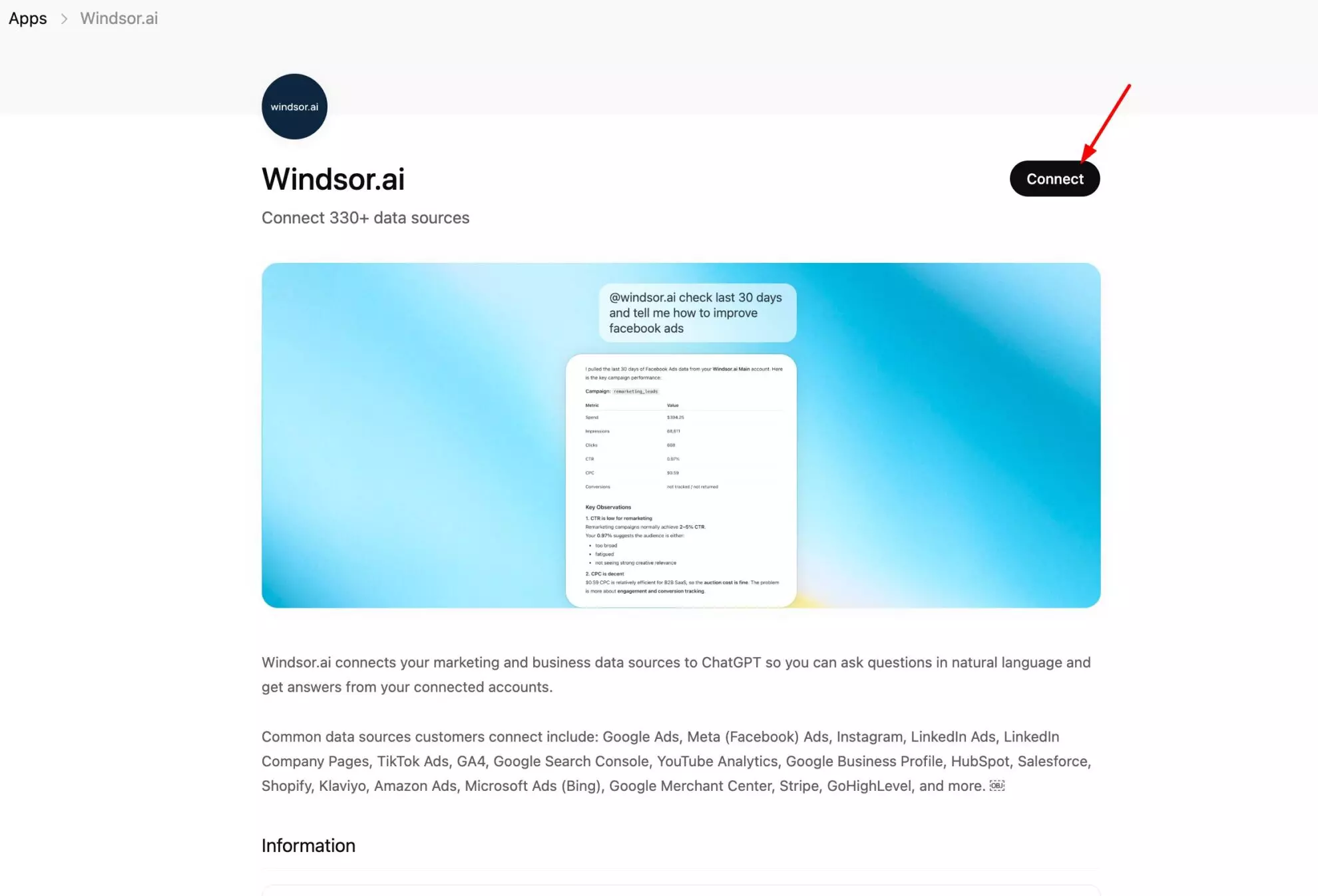
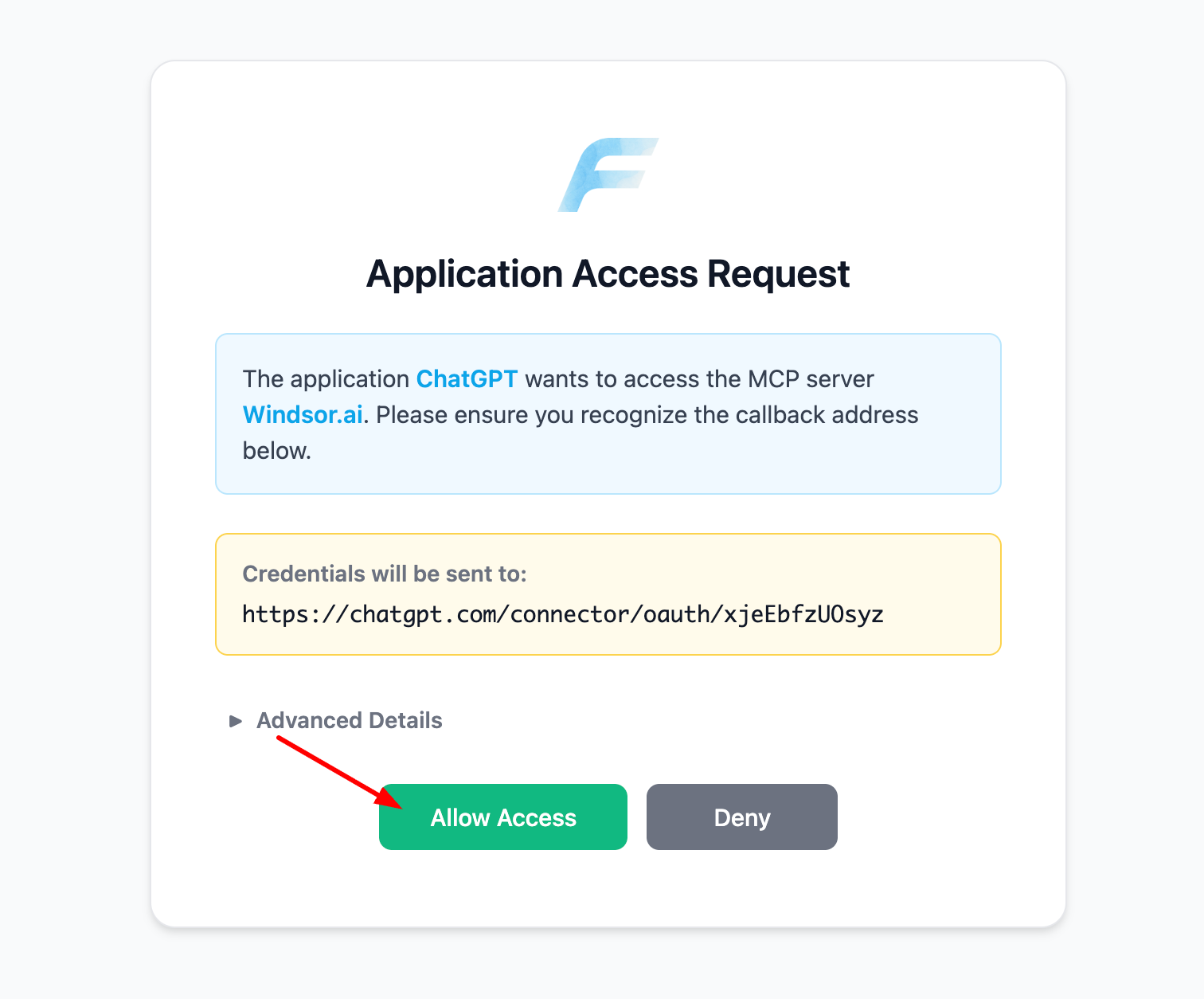
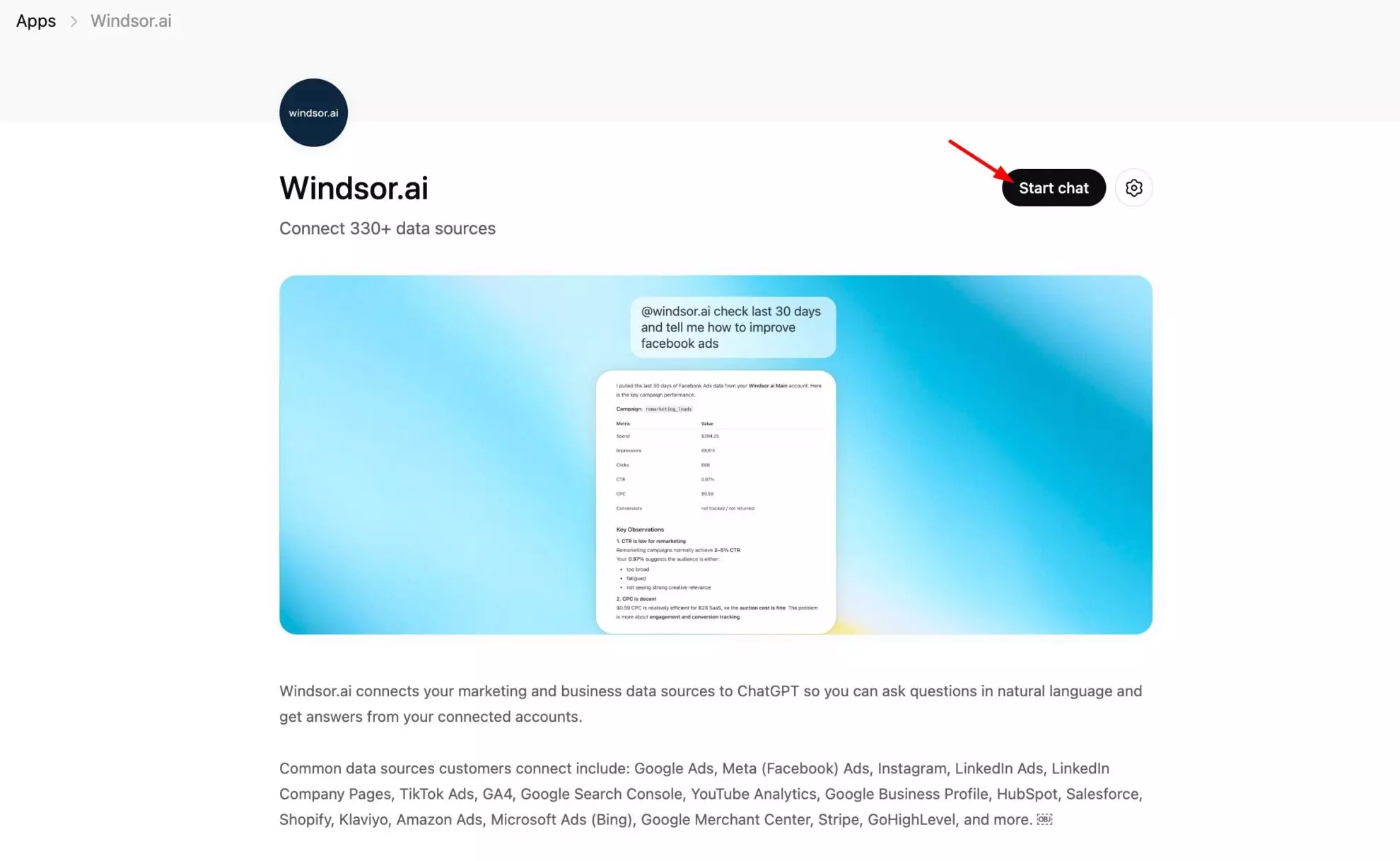
Confirm the connection is live by asking ChatGPT:
List the data sources connected to my Windsor account. Do you see PageSpeed Insights there?If it shows up, you’re ready to query your Core Web Vitals data in natural language.
The metrics that matter for PageSpeed Insights
| Metric | What it tells you |
|---|---|
| PS Insights Desktop Score | The overall lab-test performance score for the desktop version of the page, a quick single number for whether a redesign or code change made the page faster or slower. |
| PS Insights Mobile Score | The overall lab-test performance score for the mobile version of the page, worth watching separately since most sites lose more traffic to a slow mobile experience than a slow desktop one. |
| Cumulative Layout Shift (CLS) | How much content jumps around while a lab-tested page loads, a leading cause of mis-clicks and abandoned checkouts on pages with late-loading ads or images. |
| CrUX Mobile Overall category | Whether real mobile visitors are getting a FAST, AVERAGE, or SLOW experience on your page, the closest thing to a pass or fail grade for Google’s Core Web Vitals ranking signal. |
| CrUX Desktop Overall category | The same FAST, AVERAGE, or SLOW verdict for real desktop visitors, useful for spotting a page that passes on one device and fails on the other. |
| CrUX Mobile Largest Contentful Paint (LCP) | How long real mobile visitors wait for the main content to appear, at the 75th percentile, the Core Web Vital most tied to whether someone bounces before the page is even usable. |
| CrUX Desktop Largest Contentful Paint (LCP) | The same real-user load-speed measurement for desktop visitors, useful for confirming a fix actually reached live traffic rather than only improving the lab score. |
| CrUX Mobile Interaction to Next Paint (INP) | How responsive the page feels when real mobile visitors tap, scroll, or type, the Core Web Vital that replaced First Input Delay and now directly affects Google’s ranking. |
| CrUX Mobile Cumulative Layout Shift (CLS) | The real-user version of layout shift on mobile, showing whether the jumpiness you see in a lab test actually reaches visitors on live traffic. |
| CrUX Mobile First Contentful Paint (FCP) | How long real mobile visitors wait to see anything render at all, an early trust signal before the page is fully interactive. |
| CrUX Mobile Time to First Byte (TTFB) | How long real mobile visitors wait for the server to start responding, a signal of hosting and network speed that sits upstream of every other metric on this list. |
What to ask ChatGPT: prompt ideas
Core Web Vitals health
Which of my tracked URLs are failing Core Web Vitals for real users, based on CrUX Mobile Overall category and CrUX Desktop Overall category?
Show me mobile LCP and INP for every URL I track and flag anything that falls outside Google's "good" thresholds.
Mobile vs. desktop performance
Compare PS Insights Desktop Score and PS Insights Mobile Score across all my URLs and tell me which pages have the biggest mobile-desktop gap.
Page-by-page performance trends
How has CrUX Mobile Largest Contentful Paint changed for my homepage over the last 90 days?
Summarize Cumulative Layout Shift trends across my tracked pages this month and flag any page getting worse.
The PageSpeed Insights connection is read-only. ChatGPT can analyze your Core Web Vitals and flag what’s slow, but it can’t fix or change anything about the site’s performance itself.
Other ways to connect PageSpeed Insights to ChatGPT
Manual export
You can run the PageSpeed Insights web tool against each URL yourself and copy the scores into a spreadsheet, then upload or paste that into ChatGPT. It works for a one-off check, but it’s a static snapshot: no history, no automatic refresh, and it doesn’t scale past a handful of URLs before the manual copying becomes the bottleneck.
Zapier or Make
You can also wire up a Zapier or Make scenario to run PageSpeed Insights checks and push the results somewhere ChatGPT can read them. It’s still a workflow you have to build and maintain, and it doesn’t give ChatGPT the same live, queryable access to Core Web Vitals across every URL that the native Windsor.ai connector does.
Conclusion
Connecting PageSpeed Insights to ChatGPT through Windsor.ai takes two steps: add the URLs you want to monitor, then install the native ChatGPT app. From there, you can ask about Core Web Vitals trends across every page you track, blended with the rest of your marketing and SEO data, instead of running the PageSpeed Insights tool by hand and copying scores into a spreadsheet.
🚀 Ready to connect PageSpeed Insights to ChatGPT? Connect PageSpeed Insights to Windsor.ai and start asking ChatGPT about your Core Web Vitals today.
FAQs
What's the fastest way to connect PageSpeed Insights to ChatGPT?
The native Windsor.ai app is the fastest way. It takes under a minute and doesn’t require exporting CSVs or running the PageSpeed Insights tool manually for each URL.
Do I need to know how to code to connect PageSpeed Insights to ChatGPT?
No. Adding a URL in Windsor.ai and installing the Windsor.ai app in ChatGPT are both no-code steps.
Can ChatGPT analyze my Core Web Vitals once connected?
Yes. Once PageSpeed Insights is connected through Windsor.ai, ChatGPT can analyze lab and real-user Core Web Vitals for every URL you’re tracking and answer questions about trends, comparisons, and which pages need attention.
Can I track multiple URLs or an entire site?
Yes. Add as many URLs as you want to monitor when you set up PageSpeed Insights in Windsor.ai, and ChatGPT can compare performance across all of them in one conversation.
What's the difference between lab data and real-user (CrUX) data?
Lab data comes from a synthetic, one-off test of the page, covering metrics like CLS, FCP, LCP, TTFB, and the PageSpeed Insights scores. CrUX field data comes from real Chrome users who’ve visited the page, reported at the 75th percentile, and includes an INP metric lab tests don’t have. Field data reflects what actual visitors experience, lab data reflects a controlled test.
How much does it cost to connect PageSpeed Insights to ChatGPT?
Windsor.ai has a free forever plan with no credit card required, and paid plans start from $19/month for higher volume and more sources.
Is this better than manually running PageSpeed Insights for each URL?
Manually running the tool gives you a one-time snapshot with no history. The native connector keeps pulling data over time, so you can track trends and compare URLs in ChatGPT without repeating the manual process.
Can I combine PageSpeed Insights with other data in ChatGPT?
Yes. Windsor.ai connects PageSpeed Insights alongside 350+ other sources, including Google Search Console, so you can look at Core Web Vitals and search performance in the same conversation for blended reporting.
Is the connection secure, and can ChatGPT change anything on my site?
The connection is read-only. ChatGPT can read and analyze your Core Web Vitals data through Windsor.ai, but it can’t make changes to your site or its performance.


