 Destinations
 Data sources
 AI insights
 About us
 Careers
 Security
 Customer reviews
 Contact us
 Affiliate program
 Solution partners
 Template gallery
 Looker Studio templates
 Power BI templates
 Excel templates
 Google Sheets templates
 Tableau templates
 Facebook Ads templates
 Google Ads templates
 Data fields & Metrics
 AI prompt library & Guides
 Product documentation
 API documentation
 Case studies
 Blog
Blog Data models
 Windsor vs Supermetrics
 Windsor vs Funnel.io
 Windsor vs Fivetran
 Windsor vs Rivery
 Windsor vs Portermetrics
 Windsor vs Coupler.io
 Last updated: 1 September 2026




A marketing attribution model is the rule that decides which touchpoint gets credit when someone converts. Pick last click and your brand campaigns look worthless. Pick first click and your closing channels do. The model you choose changes which campaigns look profitable, which is why it decides where your budget goes.
There are eleven models in common use. Four of them were removed from Google Ads and Google Analytics 4 in November 2023, but all four are still available in other platforms and can still be built on your own data. Below is what each model does, where you can still run it, and how to choose.
What changed in November 2023
Google retired four attribution models across Google Ads and Google Analytics 4: first click, linear, time decay and position-based. Conversion actions that used them were moved to data-driven attribution. Google Ads now offers last click and data-driven only. Google Analytics 4 offers data-driven, paid and organic last click, and Google paid channels last click.
This was a change to Google’s reporting options, not a verdict on the models. Adobe Analytics still offers first touch, last touch, linear, time decay, U-shaped, J-curve and algorithmic. HubSpot Marketing Hub Enterprise still offers first touch, last touch, linear, time decay, U-shaped, W-shaped and full-path.
The third option is to stop depending on any platform’s built-in choice. If your cross-channel data sits in your own warehouse, the model becomes a calculation you control rather than a dropdown someone else can remove. That is the only version of this that cannot be retired out from under you.
The 11 attribution models at a glance
| # | Model | How credit is assigned | Best for | Where you can run it today |
|---|---|---|---|---|
| 1 | First click | 100% to the first touchpoint | Finding what creates awareness | Adobe, HubSpot Enterprise, your own data. Removed from Google, Nov 2023 |
| 2 | Last click | 100% to the final touchpoint | Short buying cycles | Google Ads, GA4, Adobe, HubSpot |
| 3 | Last non-direct click | 100% to the last non-direct channel | Stopping direct traffic absorbing credit | GA4 applies the same principle in “paid and organic last click”; Adobe |
| 4 | Linear | Equal credit to every touchpoint | Long cycles, nurture-heavy programmes | Adobe, HubSpot Enterprise, your own data. Removed from Google, Nov 2023 |
| 5 | Position-based (U-shaped) | 40% first, 40% last, 20% split across the middle | Valuing discovery and close equally | Adobe, HubSpot Enterprise. Removed from Google, Nov 2023 |
| 6 | W-shaped | 30% each to first touch, lead creation and deal creation; 10% across the rest | B2B with defined lead and deal milestones | HubSpot Enterprise. Never offered by Google |
| 7 | Time decay | Exponential weighting toward recent touches | Long cycles where recency matters | Adobe (custom half-life, 7 days default), HubSpot Enterprise. Removed from Google, Nov 2023 |
| 8 | Last Google Ads click | 100% to the last Google ad | Judging Google Ads in isolation | Google Ads, GA4 (“Google paid channels last click”) |
| 9 | Lead conversion touch | 100% to the touch that created the lead | Lead gen with one clear conversion point | CRM-side: HubSpot, Salesforce |
| 10 | Full-path (Z-shaped) | 22.5% each to first touch, lead creation, deal creation and closed-won; 10% across the middle | Mature B2B measuring through to revenue | HubSpot Enterprise. Never offered by Google |
| 11 | Data-driven (algorithmic) | Machine learning distributes credit from observed journeys | Cross-channel truth at sufficient volume | Google Ads (default), GA4, Adobe (“Algorithmic”), or your own Shapley or Markov build |
What is marketing attribution modeling?
Marketing attribution modeling is an organized set of rules that attribute credits for different touchpoints across the customer journey.
In other words, a way for you to measure the real impact of your marketing activities.
Why you’re putting yourself at risk by not having marketing attribution modeling in place
Some paid marketers I know are obsessed with optimizing their campaigns for higher CTR and lower CPC. Those who look a bit further are optimizing for conversions instead, which seems logical. But conversions don’t always impact main targets in the way you think.
If you want the concept itself rather than the model list, start with what marketing attribution is and come back here to pick a model.
Not all customers have equal LTV, and not all campaigns are converting from the first touchpoint. I would even say, not every touchpoint is designed to convert. But you still need to measure its effectiveness. For B2B, these rules are especially true.
So you can continue optimizing your Facebook ad campaign for the best-in-class CTR or conversion rate. For sure, it may bring you hundreds of dollars plus. But on the scale of a business, you might be doing a tiny thing that doesn’t make a difference at all.
Your company’s success is your success. So you should optimize marketing towards the primary company goal, revenue. And if you’ve never thought this way, you definitely should start.
Examples of marketing attribution modeling
Imagine you have a customer journey with a Google ad as the first touchpoint. By clicking the ad, people start engaging with your brand on social, webinars, whatever. And eventually, after a month or so, they type in your website address and buy your product.
Most likely, you’ll attribute revenue to direct or organic traffic and forget about what happened during this journey.
But it’s like getting your salary and saying it was not essential to do the job to get it.
So you can end up turning off a campaign that brings you customers just because it has a low conversion rate. But it can drive awareness like crazy. The thing is nobody cares.
During our project with Betty Bossi, there were multiple channels and even website pages tracked as a part of the customer journey. So each touchpoint was considered. And one essential and surprising insight was gained from the analysis. The Google Ads branding campaigns turned out to be invaluable in attracting customers who then return over organic channels. This was not visible using the standard, simplistic last-click attribution models.
Is marketing attribution modeling only for paid channels?
No, it is not.
With marketing attribution modeling tools, you can pull the data from your ad accounts, social media accounts, email provider, website, programmatic ad network, influencer marketing campaigns, etc. It even works with offline channels and TV advertising, where it is called “Mix Modeling.”
It’s all about getting a full picture of your customer journeys and giving credit to marketing activities that deserve it.
Why Google Analytics is not always the answer
Many marketers use Google Analytics as a hub of their cross-channel marketing data. Google offers its own attribution models to help you measure channel performance, though as of November 2023 that choice is down to three. As you add more channels, like programmatic advertising, it becomes painful to measure the impact.
Sometimes, it makes much more sense to have all costs and conversions easily accessible in a dashboard and different attribution models compared on the same screen.
This way, you have much clearer and actionable data, save time, and even headcount. Of course, if you do it right.
Which attribution model should you use?
Your buying cycle is days, not months. Last click or last non-direct click. With one or two touchpoints there is little to distribute, and the added complexity buys you nothing.
Your buying cycle runs months. Linear, time decay or data-driven. Last click will credit whatever happened to be nearest the purchase and hide the work that created demand.
You are B2B with lead and deal stages. W-shaped or full-path. These are the only models that treat lead creation and deal creation as milestones worth crediting, which is why they live in CRMs rather than analytics tools.
You are ecommerce running several paid channels. Data-driven, if you have the volume. Google Ads and Meta will each claim the same conversion, so a model that reads the whole journey is the only way to stop double counting. If volume is thin, position-based is a reasonable stand-in.
You want to know what creates awareness. First click, as a diagnostic rather than a reporting default.
You want to value SEO against paid. Avoid last click, which systematically under-credits organic. Organic search usually appears early and mid-journey, so linear or data-driven will show its contribution where last click erases it.
The 11 attribution models in detail
To get the most out of marketing attribution modeling, you need to understand your goals and have a firm grip on the customer journey. Below is each model, with when to use it and when to avoid it.
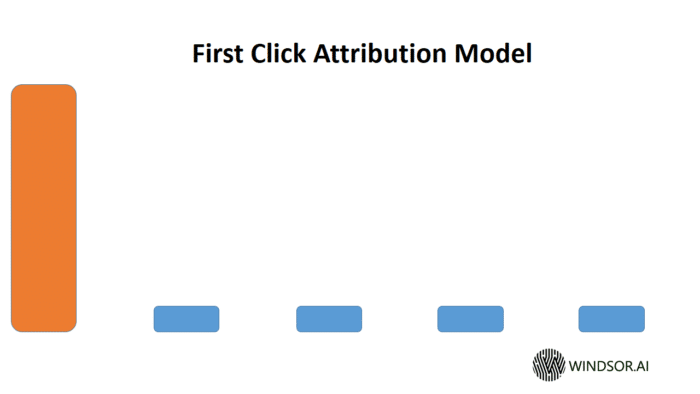
1. First Click Attribution Model
Removed from Google Ads and Google Analytics 4 in November 2023. Still available in Adobe Analytics and HubSpot Marketing Hub Enterprise, and buildable on your own data.
The first click attribution model works on a simple formula. It attributes a conversion to the source that referred a buyer to your website for the first time.
Example. A prospective visitor sees your Google ad and lands on your website for the first time. They might browse around, sign up to your email newsletter, follow your Facebook page, and leave. After a few days, they come back and purchase your product. Despite no immediate purchase and interactions with other channels, the credit goes to the Google ad as it was the first touch of your brand with the client.
Use it when:
- To identify channels that bring in the most leads or customers.
- To determine the best channel for creating awareness of your brand.
- If you have minimal marketing channels (i.e., focusing only on Facebook and Google Ads).
Avoid it when:
- If you have multiple marketing channels and a sophisticated customer journey. This model gives no value to other touchpoints.
- If your buying cycle runs longer than your analytics tool’s lookback window, since first touches that fall outside it are never recorded.
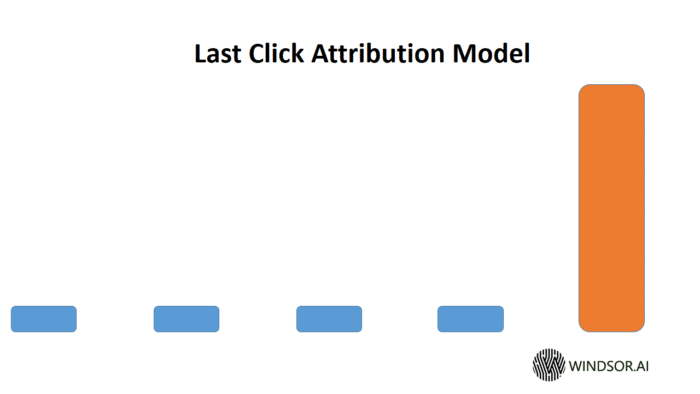
2. Last Click Attribution Model
The last click model completely brushes aside the value the website has in getting paying customers. Thus, a company relying on this model will be overvaluing one marketing channel while dramatically undervaluing another marketing channel.
In the last click attribution model, all credit goes to the marketing touchpoint that resulted in conversion.
Example. You knew Apple for years from their ads and word of mouth. But you bought a new Mac during the Black Friday sale. According to last click attribution, the Black Friday campaign gets all the credits for the conversion.
Use it when:
- To understand high-impact touchpoints at the bottom of your funnel. It helps you find channels that are driving the most conversions.
Avoid it when:
- If you have a complicated customer journey that requires research before making a buying decision. With this model, you neglect other critical touchpoints and limit your understanding of marketing performance.
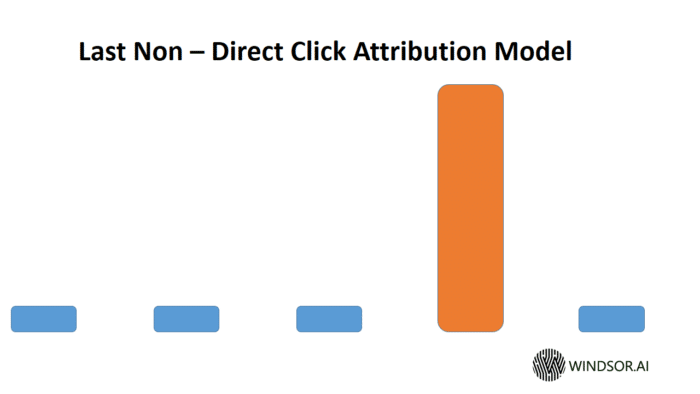
3. Last Non-Direct Click Attribution Model
In this attribution model, the significance is given only to the last non-direct marketing channel.
Google Analytics considers as Direct traffic when a user types in your website address into a search bar. Any traffic that has no referral folds into this bucket as well.
Example. It’s like saying that the user who typed in yourwebsite.com into search and purchased your product made the decision beforehand. So you’re giving all the credits to the touchpoint that came before the direct visit resulted in conversion.
Use it when:
- To understand the effectiveness of your marketing tactics, without accounting for the direct traffic.
Avoid it when:
- If you have offline campaigns that lead a user to the website to convert. In this case, “direct” could be the only touchpoint with your brand online.
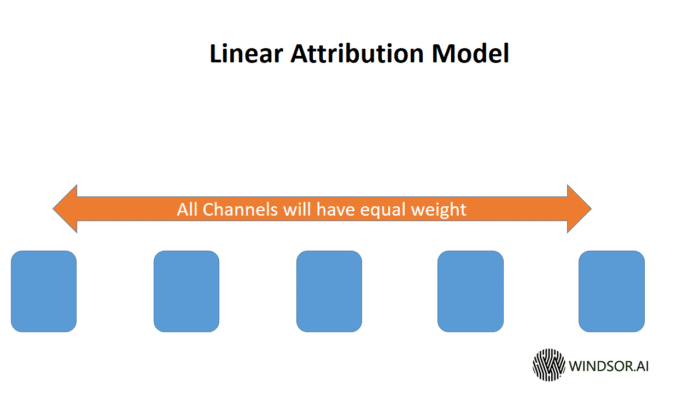
4. Linear Attribution Model
Removed from Google Ads and Google Analytics 4 in November 2023. Still available in Adobe Analytics and HubSpot Marketing Hub Enterprise, and buildable on your own data.
The linear attribution model gives the same credit to every channel across the whole customer journey from the first interaction to making a purchase.
Example. Someone sees your ad on Facebook and clicks it to visit the website (33.3%). They come back later, directly typing your website address to compare your products with the competition (33.3%). A few days later, they click on your retargeting ad and buy (33.3%).
Important note: if the user directly visited your website 6 times, 75% of the value will go to direct traffic. Every touchpoint is credited.
Use it when:
- To understand and find channels that result in brand awareness and conversion.
- To identify channels that are consistent across all customer journeys, especially the ones driving actual conversions.
Avoid it when:
- If you already have a decent understanding of your customer journey and need to identify critical touchpoints. Equal value to each touchpoint is not what you’re looking for in this case.
- You have a journey where most of the decision making happens within a particular touchpoint like having a 1-to-1 workshop alongside social media. The magic happens during a conversation.
5. Position-Based Attribution Model (U-shaped)
Removed from Google Ads and Google Analytics 4 in November 2023. Still available in Adobe Analytics and HubSpot Marketing Hub Enterprise, and buildable on your own data.
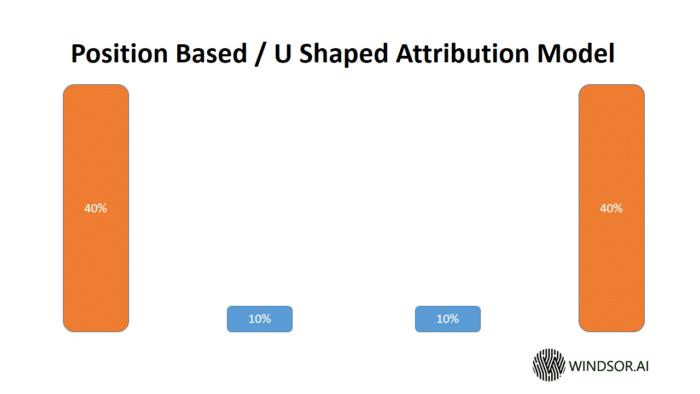
The position-based or U-shaped attribution model gives a certain percentage to all the touchpoints contributing towards conversion. The first and last touchpoints get 40% of the credit each, and the rest of the touchpoints divide the remaining 20%.
Example. Someone decides to purchase an insurance policy online and starts researching it on Google, landing on your website from the SERP (40%). They find you on Facebook and click an article from the feed (10%). A few days later they come back directly to read more articles and leave an email for a brochure (10%). They eventually convert after seeing your Facebook retargeting ad (40%).
Use it when:
- To understand which channel is best for acquiring an audience and which one is excellent for conversions.
- If your buying cycle fits inside your analytics tool’s lookback window.
Avoid it when:
- If you heavily rely on nurturing campaigns.
- If you have a long decision-making cycle. First touch data outside the lookback window is lost, so you can end up acting on an incomplete journey.
- If you’re in the e-commerce business and have many seasonal campaigns. In this case, the first touchpoint will most likely get too much credit assigned compared to the influence it made.

6. W-Shaped Attribution Model
In the W-shaped attribution model, 90% of the credit is equally divided among three touchpoints: first touch, lead creation and conversion. The remaining 10% is distributed among other channels within the journey. It is an enhanced version of the position-based or U-shaped model.
Example. Take the U-shaped case above. 90% would be divided among the first touch (30%), the brochure signup (30%) and the converting retargeting ad (30%), with the remaining 10% going to the Facebook article click.
Use it when:
- For identifying the touchpoints that result in an action. It removes focus from additional channels and helps you identify your audience builder, lead generator, and conversion creator channels.
- You’re in B2B marketing with clear funnel stages your customers go through.
Avoid it when:
- If you’re in B2C marketing with short sales cycles and user journeys, not necessarily including a lead generation step.

7. Time Decay Attribution Model
Removed from Google Ads and Google Analytics 4 in November 2023. Still available in Adobe Analytics and HubSpot Marketing Hub Enterprise, and buildable on your own data.
In this attribution model, the preference goes to the channels that are closer to the conversion point.
Example. You’re walking to the kitchen from the living room. With time decay, your first steps count for much less than the last few before you arrive. The same applies to marketing touchpoints: the first website visit has the least value, while the touchpoint that led to the conversion is weighted most heavily.
Use it when:
- To understand which channels are assisting and driving conversions in B2C space or B2B with short customer journeys.
Avoid it when:
- If you’re focusing on driving awareness.
- If you have long B2B sales cycles where the decision is usually made before the last touchpoint, which becomes a formality.

8. Last Google Ads Click Attribution Model
This attribution model focuses only on the performance of Google Ads campaigns. It gives all credit to the last Google Ads campaign on a journey, or the Google ad that directly led to a conversion.
The same applies to other channels like Facebook, LinkedIn and the rest. Be careful using it to evaluate multiple channels at once. If you have Google Ads and Facebook Ads within one journey, each platform will attribute the same conversion to its own channel, which leaves you with duplicated conversions and misleading reports.
Use it when:
- To determine which ad campaign is driving the best results for your business.
- To identify top Google ad keywords driving the conversions.
Avoid it when:
- If you have a complicated customer journey with valuable touchpoints within.
- If you want to evaluate the performance of multiple paid channels at a time.
9. Lead Conversion Touch Attribution Model
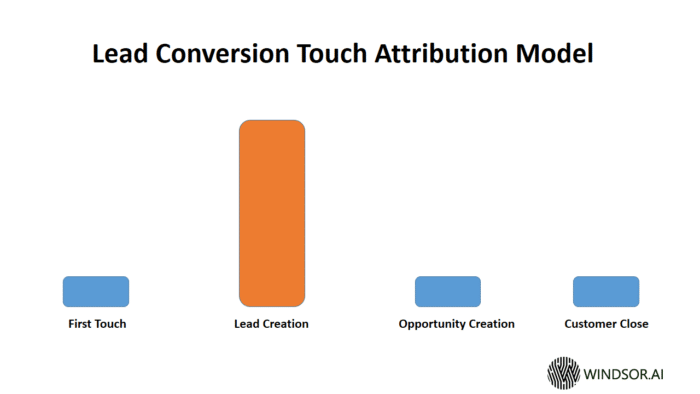
The lead conversion touch attribution model gives all the credit to the channel through which the lead was generated.
Example. It is widely applicable in B2B, where a visitor becomes a lead but doesn’t convert into a customer straight away. Say you landed on this article, didn’t buy anything, but signed up for updates. At that point you become a lead, and if you later convert, all the credit goes to the channel that produced the signup.
Use it when:
- If you need to identify touchpoints or channels that are driving leads.
Avoid it when:
- If you have a long nurturing process with multiple activities. That said, if your nurturing funnel works well and all you need is more leads in the pipeline, the lead conversion touch model is a reasonable choice.

10. Full-Path (Z-Shaped) Attribution Model
In the full-path (Z-shaped) attribution model, 90% of the credit is equally divided among four primary stages: first touch (22.5%), lead generation (22.5%), opportunity creation (22.5%) and customer close (22.5%). The remaining 10% is shared among the rest of the channels.
Example. You own an online training course website. First touch: someone Googles for a training course and lands on your site. Lead generation: a few days later they return and download an ebook. Opportunity creation: you email them a free class for their preferred course and they accept. Customer close: after the free class you send a 20% discount and they buy.
Use it when:
- To evaluate which marketing channels are driving actions towards closing a deal.
- If you have a comprehensive customer journey and strong alignment between marketing and sales teams.
Avoid it when:
- If you have a simple customer journey.
- If your sales team works on closing opportunities without marketing support.
11. Custom, Algorithmic, or Data-Driven Attribution Model
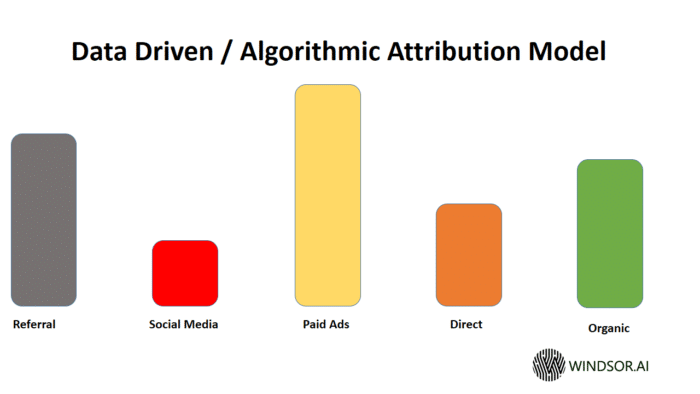
The custom, algorithmic or data-driven attribution model performs an in-depth analysis of the customer journey. It identifies all marketing channels playing a significant role in bringing visitors to your website and converting them into customers.
Compared to other models’ focus on extremes, this model uses algorithms to give each channel the credit it deserves. It helps you better evaluate the performance of each click and interaction.
Example. There is no single defined process here, since it varies by organization and marketing process. You review past marketing performance, identify your end goals, and evaluate each channel against its effectiveness in reaching them. In Google’s implementation the underlying method is the Shapley value; Markov chains are the other common approach.
Use it when:
- You have enough conversion volume for the model to find real patterns rather than noise.
- You run several paid channels that each claim the same conversions.
- You want one number to optimize against instead of comparing clicks and click-through rates side by side.
Avoid it when:
- You have very low conversion volume, where the model has too little to learn from.
- You need to explain exactly why a given touchpoint got the credit it did. Algorithmic models are harder to show your stakeholders than a fixed percentage split.
Getting the data these models actually need
Every model above needs the same raw material: clean, complete touchpoint data from every channel a customer touched, not just the one that happened to convert. Most of that data sits in separate ad platforms, a CRM, and an analytics tool that don’t share it with each other.
Windsor.ai connects those sources into one place with consistent field names, so whichever model you pick above has a complete dataset to run on. Connect your data in 1 minute. Free forever plan.
Conclusion
Each marketing attribution model solves its purpose. The four models Google retired in November 2023 are still perfectly usable elsewhere, and the algorithmic model gives the most advanced view but is not always worth the resources to build. Start with a clear goal, define your channels, then choose the model that fits your case.

Get started for free
Access all your data from your favorite sources in one place.
Free forever plan, no credit card


