 Destinations
 Data sources
 AI insights
 About us
 Careers
 Security
 Customer reviews
 Contact us
 Affiliate program
 Solution partners
 Template gallery
 Looker Studio templates
 Power BI templates
 Excel templates
 Google Sheets templates
 Tableau templates
 Facebook Ads templates
 Google Ads templates
 Data fields & Metrics
 AI prompt library & Guides
 Product documentation
 API documentation
 Case studies
 Blog
Blog Data models
 Windsor vs Supermetrics
 Windsor vs Funnel.io
 Windsor vs Fivetran
 Windsor vs Rivery
 Windsor vs Portermetrics
 Windsor vs Coupler.io
 Last updated: 1 September 2026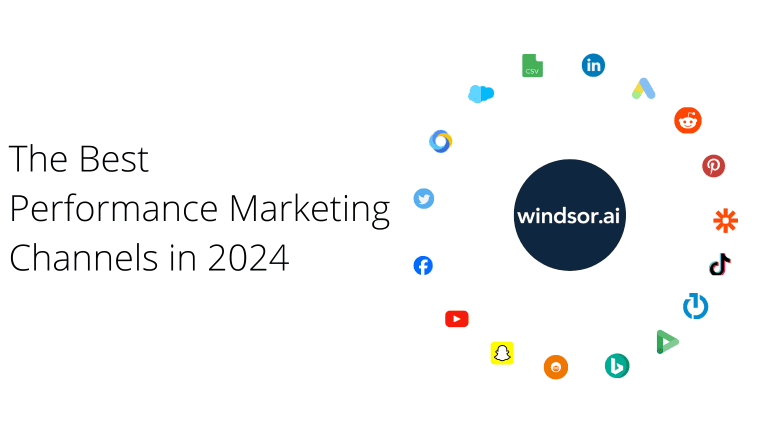



The best performance marketing channels in 2026 are TikTok, Retail Media Networks, Reddit, Snapchat, Pinterest, Quora, Twitch, native advertising, email, search engine marketing, and podcasts, each measurable against clear KPIs like clicks, installs, or conversions, rather than impressions alone.
Performance marketing channels are online platforms, including Facebook, YouTube, and Instagram, that let businesses run campaigns tied to measurable results rather than exposure alone. A data-driven marketing strategy goes beyond the usual mix of Google, Facebook, and Instagram. The 11 channels below are where real incremental performance is being found in 2026.
What are performance marketing channels?
Performance marketing channels are online platforms and avenues, including digital marketing and display advertising channels, that enable businesses to execute marketing campaigns with the specific goal of achieving measurable results.
Before diving into specific performance channels, it’s wise to build a strong strategic foundation. Whether you’re new to digital marketing or refining your expertise, this curated list of the best marketing books offers essential insights to complement your campaign efforts.
These results typically revolve around key performance indicators (KPIs) such as clicks, ad views, downloads, and app installs.
These channels provide businesses with the means to track and measure the performance of their campaigns in real-time, allowing for a data-driven approach to optimize marketing strategies for better outcomes.
11 Best Performance Marketing Channels in 2026
-
Snapchat
Snapchat is frequently underestimated by marketers, a significant oversight. With its continuously expanding number of daily active users, it presents a potentially lucrative performance marketing channel.
Utilizing Snapchat Ads to reach potential customers (Snapchatters) based on demographics, interests, devices, and even location.
Leveraging AR shopping lenses that empower brands to seamlessly integrate their products into content, allowing users to effortlessly browse, interact, and make direct purchases from their catalog.
2. Reddit
Reddit serves as a network of communities where individuals immerse themselves in their interests, hobbies, and passions. Tap into the influence of Reddit’s extensive and closely-knit communities, referred to as “Subreddits,” to access the engaged and highly impressionable market of Redditors.
Redditors demonstrate a nearly 50% higher likelihood of trusting a brand that advertises on Reddit compared to other social media platforms and websites.
Key ad products on Reddit include:
- Reddit Pixel: This tool empowers marketers to utilize the insights of actively engaged Reddit users, optimizing campaigns, targeting qualified leads, and driving conversions.
- Promoted Carousel: Reddit’s Promoted Carousel feature enables brands to craft a compelling narrative, connecting with customers in a distinctly Reddit-oriented manner through images and GIFs.
- Engagement retargeting: Build a stronger connection by re-engaging with users who have previously encountered or taken action on your Reddit Ads.
3. TikTok
Having a digital marketing strategy without TikTok is impractical in 2026. The platform now has roughly 2 billion monthly active users globally (136 million in the US alone), and converts 55-60% of monthly users into daily users, a notably higher rate than Facebook or Instagram. The average user spends 58 minutes a day on the app, giving brands an unusually engaged audience to reach.
TikTok provides diverse avenues for performance marketing campaigns, including:
- Paid Ads: Through TikTok Promote, advertisers can select a goal, whether it’s achieving video views, gaining new followers, or driving website visits. The video presentation is tailored to TikTok users based on the specified goal.
- Ad auctions: These auctions enable advertisers to bid on TikTok Ads, ensuring optimal results for their performance marketing campaigns. Bid options include cost per view (CPV), cost per click (CPC), cost per mille/thousand impressions (CPM), and optimized cost per mille/thousand impressions (oCPM). For those seeking increased website traffic, bidding for cost per click is a viable option.
4. Quora
Quora stands out as a unique Q&A social media platform where users pose questions, seek answers, and engage with one another.
Given its substantial engagement levels, Quora presents itself as a performance marketing channel worth exploring, offering access to its 300 million monthly users. Utilizing this platform can assist in building authority and driving high-quality traffic and leads to your website and products.
Quora provides a self-service ad platform that empowers advertisers to craft customized native ads targeting users based on interests, geography, and browser preferences.
Quora Ads are exclusively available through auction, requiring advertisers to specify a bid value for each click, akin to platforms like Google Ads and Facebook Ads. Notably, there is no minimum budget constraint for Quora Ads, allowing advertisers to choose their budget freely.
5. Twitch
For those aiming to connect with a youthful demographic, Twitch proves to be the ideal platform, as the typical user falls within the 16–24 age range, often identified as Innovators. Twitch still draws over 240 million monthly active users and roughly 2.2 million concurrent viewers at any given moment, though total watch time has eased slightly (19 billion hours in 2025, down from 20.9 billion in 2024) as competition from YouTube Gaming and Kick grows, worth weighing against the newer channels on this list.
Twitch offers two advertising programs: banner ads and in-video ads. Advertisers have the flexibility to strategically place their ads before, during, or after a stream, aligning with the optimal timing based on when the partnered creator anticipates the highest viewer count. For brands looking to boost visibility, Twitch banners provide a highly engaging and prominent way to reach this active audience.
6. Native advertising with Outbrain
The most effective advertisements improve a user’s website experience rather than causing interruptions. Native advertising allows the creation of ads that seamlessly blend with the regular content of a website, avoiding competition for consumers’ attention.
Instances of native ads encompass:
- Article suggestions placed at the conclusion of a blog post
- Hashtags on platforms like Twitter or TikTok
- Filters in Instagram or Snapchat stories
- Trends on TikTok
Outbrain plays a role in expanding brands’ customer bases through its recommendations, facilitating connections with approximately one-third of global consumers engaged in online content. There are even specialized tools like Anstrex that allow you to spy on native ads and analyze your competition.
Besides this, some tools are becoming increasingly popular that allow you to export tweets and use that data to improve your overall strategy.
7. Pinterest
Individuals visit Pinterest to seek inspiration for items they already desire. This can range from hard-to-find formal wear like purple suits to vintage home decor pieces. As a result, 85% of Pinterest users actively seek visually appealing content, highlighting the platform’s unique ability to host a diverse range of content, including blog posts, photos, videos, and AI-generated images.
On Pinterest, users, known as “Pinners,” share their content on dedicated boards for their followers to discover. This creates a cascading effect for marketers, allowing content to spread from user to user on Pinterest, serving as a powerful method to boost brand awareness and reach. Notably, 83% of Pinterest users have made purchases based on content encountered on the platform.
The platform’s allure lies in the fact that users often visit Pinterest with specific interests in mind, such as home trends, custom embroidery, other fashion ideas, and business inspiration, including designs to use with a free merch maker and beauty. Consequently, they are primed to make immediate purchases once they find what they are looking for, streamlining the marketer’s task. Simply by presenting an eye-catching and engaging ad for products, marketers can attract buyers effortlessly.
Emphasizing the significance of numbers, Pinterest Ads reports that marketers leveraging the platform can reach a vast audience of over 600 million Pinners on a monthly basis, up 11% year-over-year and Pinterest’s highest user count on record.
8. Email marketing
In every conceivable niche, there are bloggers catering to diverse interests, spanning from cat enthusiasts to chefs, tech analysts, and makeup artists. A considerable number of these bloggers offer newsletters that you can subscribe to, providing a valuable opportunity for advertising.
While some may argue that sponsoring a newsletter doesn’t strictly fall under traditional performance marketing (as it doesn’t involve paying per user action), it can be construed as such when you negotiate a mutually beneficial arrangement with the newsletter sender. For instance, you might agree to pay a fixed amount per email opened or per user who visits your website.
Alternatively, an affiliate marketing model could be employed, where compensation is made only when the publisher’s email results in lead generation for your business.
9. Search engine marketing channels
Utilizing search engine marketing (SEM) as a performance-driven channel involves displaying ads on search engines such as Google, Bing, and Yahoo, targeted at specific search terms. When online users search for a particular term, your ad is prominently featured at the top of their search results.
As an advertiser, payment occurs when a potential consumer clicks on the ad. You have the flexibility to manage your SEM performance independently or opt to engage a specialized partner like Blank Theory, compensating them based on campaign results through a commission structure.
Integrating SEM with a robust SEO strategy for your business has the added benefit of enhancing the search engine results pages (SERPs) algorithm. This approach contributes to higher rankings and increased discoverability. Many local businesses have effectively employed these performance marketing campaigns.
To further optimize your visibility and manage campaigns across multiple accounts and regions, marketers often rely on multi-account management solutions to create different environments and test performance globally.
To understand how your content appears across regions or devices, Virtual Private Networks can be useful for simulating different locations, allowing marketers to test ad placements and SERP performance globally.
10. Podcast
Podcasts have firmly solidified their status as a formidable industry. 58% of Americans aged 12+ now consume a podcast monthly, up from 55% in 2025, reaching an estimated 167 million people.
Podcasting stands out as a personal and intimate medium. The primary motivation behind people downloading and listening to podcasts is their affinity for the host and the genuine connection they share. Consequently, when a host endorses a product, their listeners trust the recommendation, often leading to consideration and purchase.
A notable advantage is that by providing a podcast host with a unique promo code for your website, you can accurately track how many listeners discovered your brand through that specific show. Partnering with a specialized B2B podcast agency like Fame can further enhance this strategy by helping brands launch, grow, and measure high-impact podcast campaigns that drive measurable awareness and leads.
This positions podcasts as ideal collaborators for brands seeking to reach niche audiences, simultaneously delivering value to listeners (potential customers) through entertaining, informative, and/or educational content.
11. Retail Media Networks
Retail media has become one of the fastest-growing performance channels in advertising, now ranked alongside search and social as a top-three ad category. US advertisers are projected to spend $71 billion on retail media in 2026 (up from $60 billion in 2025), and the channel is forecast to keep outgrowing social media advertising through 2028.
Amazon Ads remains the dominant player (roughly $68.6 billion in ad revenue in 2025), with Walmart Connect the fastest-growing challenger (37-46% annual growth). These networks let advertisers target shoppers with strong purchase intent directly on the retailer’s own site or app, with sales-linked attribution built in, a natural fit for any brand selling through e-commerce.
Best performance marketing platforms & tools to manage these channels
Running campaigns across 11 different channels creates a real reporting problem: each platform has its own dashboard, its own metrics, and no shared view of what’s actually working. That’s the gap performance marketing platforms are built to close, pulling data from every channel above into one place so you can compare, attribute, and optimize spend across all of them.
Windsor.ai connects to 350+ marketing data sources, including every channel covered here, and centralizes them into a single dashboard, warehouse, or BI tool, so you can see cross-channel performance without manually exporting from each platform. It also supports write-back actions, so campaign adjustments can happen from the same place you analyze results.
Which types of advertising formats are applicable on performance marketing channels?
After selecting your performance marketing channels, it’s crucial to consider the methods and ad formats for your campaigns, which may encompass:
Video and CTV
Video advertising boasts the highest engagement among digital formats, with CTRs typically ranging 0.5-2% depending on platform and placement. Meta leads at roughly 1.62%, followed by TikTok at 0.84%.
Particularly effective on social platforms like Facebook, where videos outperform image ads in driving engagement (Databox), it serves as an ideal way to capture the attention of target users in the upper funnel. Leveraging a short video app, brands can amplify this effect by delivering micro-drama content that engages audiences quickly and encourages repeat interactions.
Video ads often perform well programmatically, either embedded within videos or rolled before or after video content. Typical pricing models include Cost per View (CPV) and Cost per Completed View (CPCV). And for brands targeting professional audiences, b2b explainer videos offer a powerful format to simplify complex solutions while increasing both engagement and message retention.
Programmatic Media Buying
This method involves buying or selling advertising programmatically, tailoring ads based on users’ interests and viewing history.
Native advertising, as an informative and engaging form, captures consumer interest and sets the stage for effective retargeting in the user journey.
Programmatic media buying can be applied to native advertising, social media (Facebook, Instagram, Snapchat), affiliate marketing, and display advertising.
Display Advertising & Programmatic Display Advertising
Display advertising, encompassing various formats such as banner ads and rich media, utilizes images, video, audio, and text to convey messages and calls-to-action on websites, blogs, publications, and apps.
Programmatic display advertising enables publishers to collect audience and segmentation data, facilitating the strategic placement of display ads through advanced contextual targeting.
Global programmatic ad spend is projected to hit $821 billion in 2026 (up 9% year-over-year), with Retail Media the fastest-growing segment (+34% YoY) and Connected TV programmatic spend jumping to $36 billion. Average display ad CTR sits around 0.46%. Rich media and native formats can run 2.5-4x higher than standard banners. Common pricing models include Cost per Click (CPC) and Cost per Mille/Thousand Impressions (CPM).
Conclusion
Windsor.ai empowers performance marketers, advertising experts, and social media managers to craft a diverse array of insightful and visually rich data visualizations, allowing constant monitoring of key performance indicators (KPIs). Moreover, it facilitates delving into the data to identify inconsistencies, trends, and revenue opportunities.
In addition to presenting performance marketing channels transparently, Windsor.ai ensures that your marketing team retains complete control over campaigns, fostering a commitment to the overall success of the company.
- The setup is done in minutes
- No coding is required
- SOC 2 Type 2 certified, supports single sign on and multi factor authentication
- Windsor.ai supports API integrations, allowing businesses to connect with other tools and platforms seamlessly
- Businesses can create customizable marketing dashboards tailored to their specific needs
- Windsor.ai centralizes cross-channel campaign data so you can analyze and optimize customer journeys across all touchpoints
- 350+ data sources to 14 data destinations
- Extract – Transform – Load functionality for all data destinations available on all plans
Get started for free
Access all your data from your favorite sources in one place.
Free forever plan, no credit card


