 Destinations
 Data sources
 AI insights
 About us
 Careers
 Security
 Customer reviews
 Contact us
 Affiliate program
 Solution partners
 Template gallery
 Looker Studio templates
 Power BI templates
 Excel templates
 Google Sheets templates
 Tableau templates
 Facebook Ads templates
 Google Ads templates
 Data fields & Metrics
 AI prompt library & Guides
 Product documentation
 API documentation
 Case studies
 Blog
Blog Data models
 Windsor vs Supermetrics
 Windsor vs Funnel.io
 Windsor vs Fivetran
 Windsor vs Rivery
 Windsor vs Portermetrics
 Windsor vs Coupler.io
 Last updated: 31 August 2026




You connect Metabase to ChatGPT by installing Windsor’s native app inside ChatGPT and linking it to your Metabase account through Windsor.ai, no code, CSV exports, or custom connector setup required.
Metabase itself is great for building and viewing dashboards, but it isn’t built for auditing the structure of a whole instance, how many questions and dashboards exist, which collections they live in, who created them, in natural language. Connecting Metabase to ChatGPT through Windsor.ai lets you ask about your Metabase setup directly in chat, and blend that with the other data sources your team already has connected, instead of clicking through screens one at a time.
2 steps to connect Metabase to ChatGPT
Takes under a minute, no code or manual CSV work required.
See the full walkthrough in Windsor’s documentation: How to integrate data into ChatGPT.
Prerequisites
- A Windsor.ai account (free forever plan, no credit card, or paid from $19/month for higher usage)
- A Metabase account or instance with at least one dashboard or saved question already set up
- A ChatGPT account on a plan that supports installing apps
Step 1. Connect Metabase to Windsor.ai
- Create a free Windsor.ai account, or sign in, at onboard.windsor.ai/app/metabase
- Select Metabase from the connector list
- Authorize Windsor to access your Metabase instance
- Connect additional Metabase instances the same way if your team or agency runs more than one
Step 2. Connect the Windsor.ai app in ChatGPT
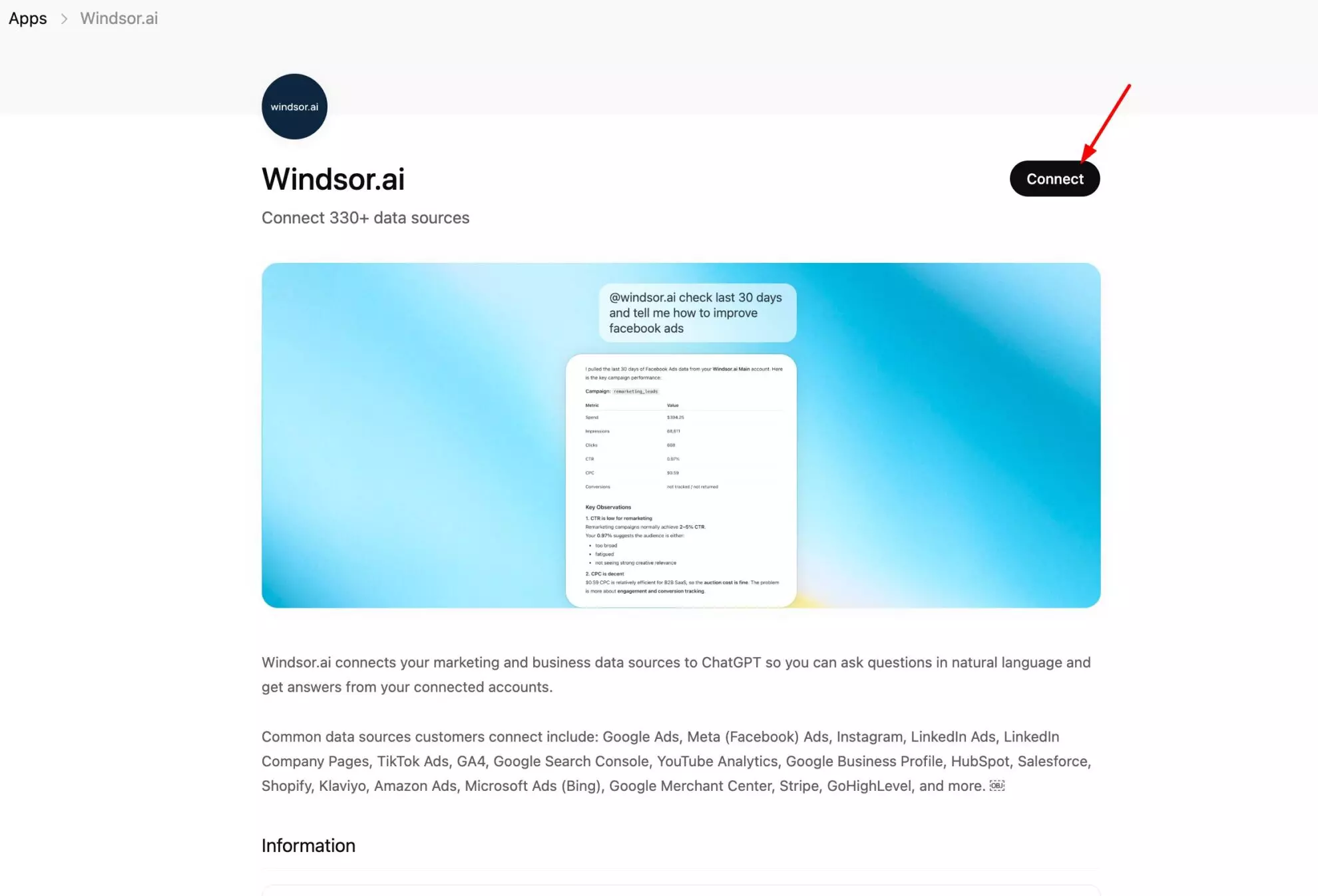
In ChatGPT, open the connectors or apps settings, search for Windsor.ai, and install it as a native app.
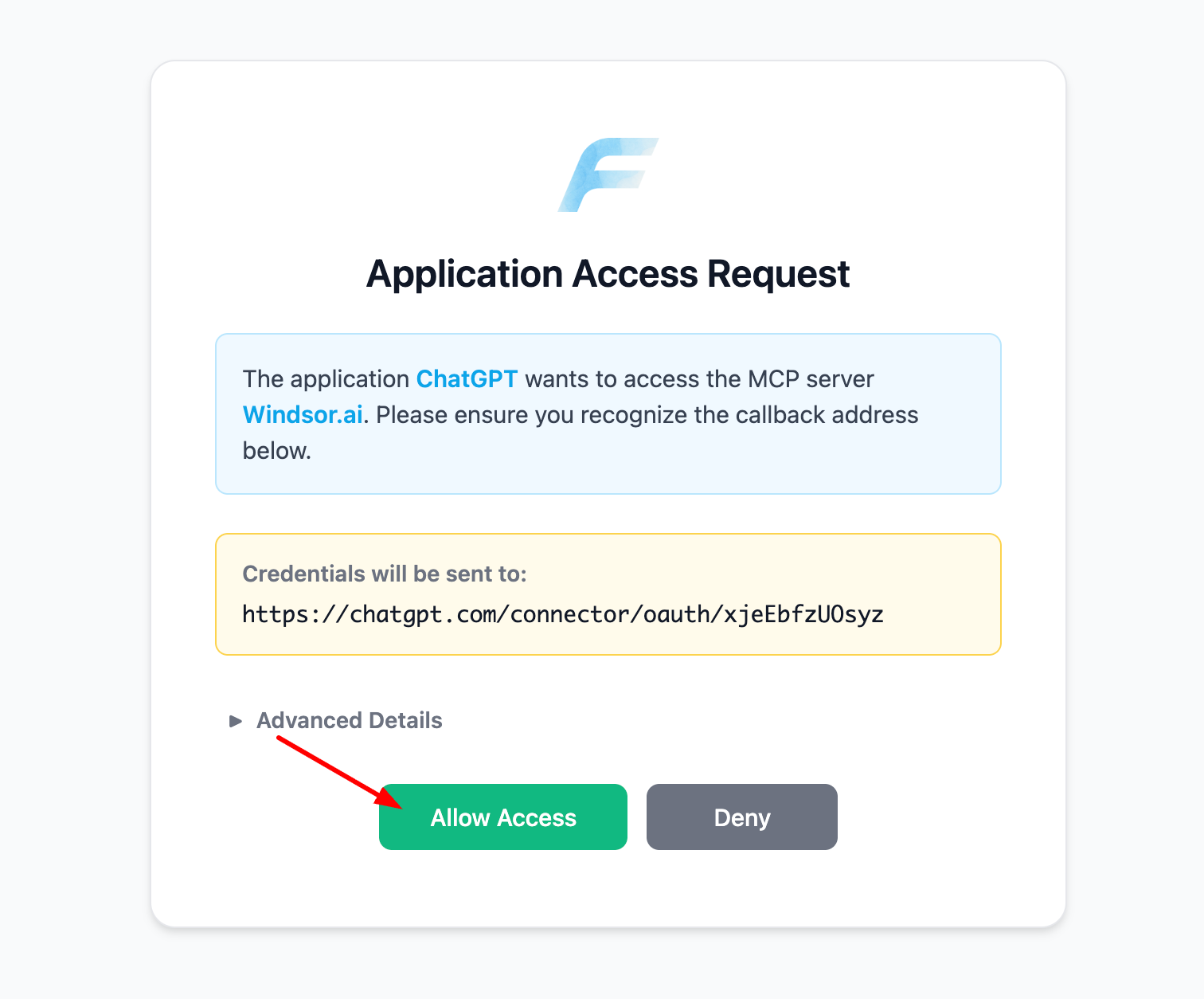
Allow ChatGPT access to your Windsor.ai account when prompted.
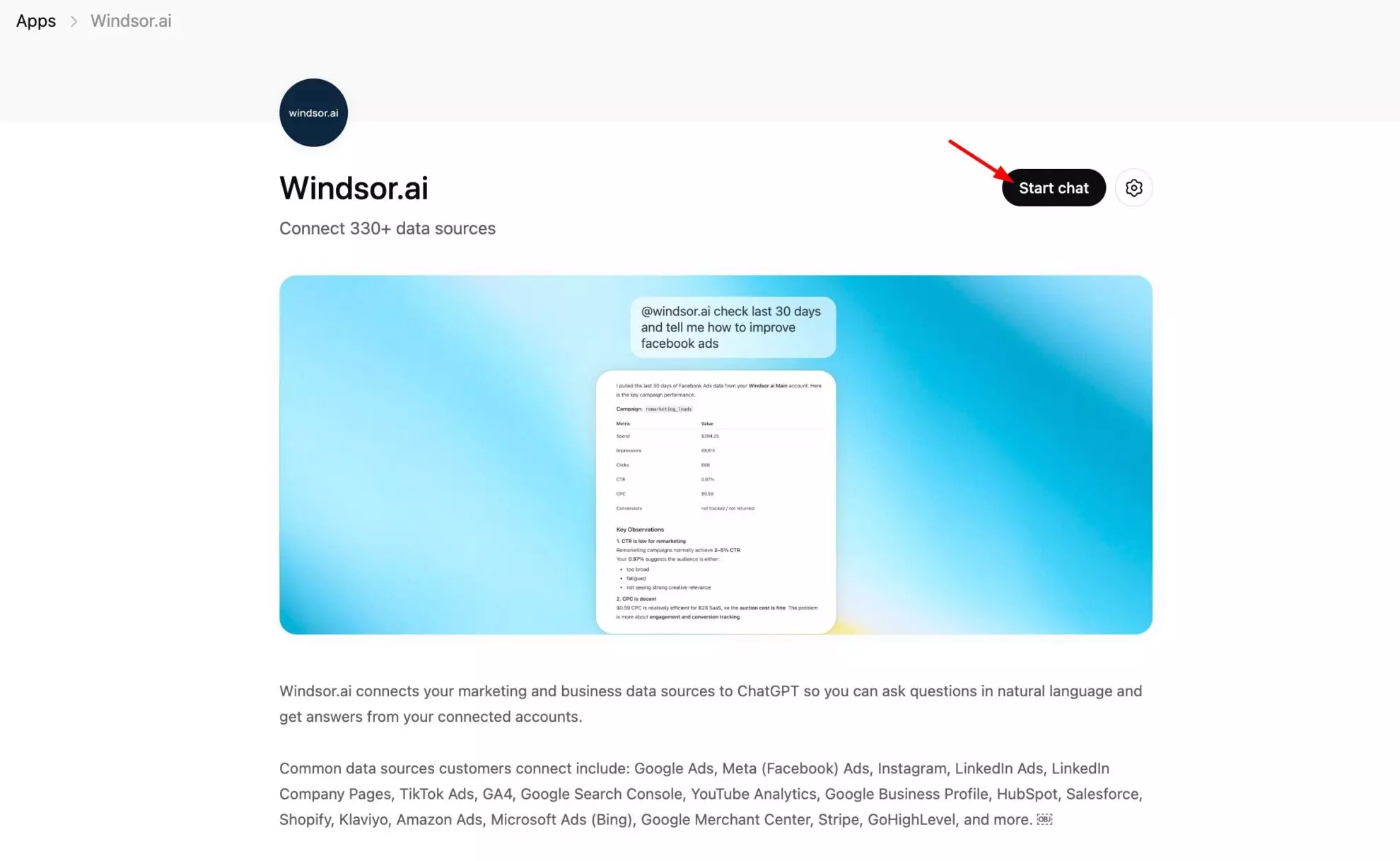
Once it’s connected, the Windsor.ai app shows up in ChatGPT ready to query.
Check that the connection worked by asking:
List the data sources connected to my Windsor account. Do you see Metabase there?If it shows up, you’re ready to query your Metabase instance in natural language.
The metrics that matter for Metabase
| Field | What it tells you |
|---|---|
| dashboards.name | The name of each dashboard in your instance, the starting point for inventorying what’s actually been built. |
| dashboards.collection_id | Which collection a dashboard lives in, so you can see how dashboards are organized across teams or projects. |
| dashboards.archived | Whether a dashboard has been archived, useful for spotting outdated dashboards that are no longer maintained. |
| dashboards.created_at | When a dashboard was first created, letting you track how the instance has grown over time. |
| cards.name | The name of each saved question, the building block that dashboards are made from. |
| cards.collection_id | Which collection a saved question belongs to, useful for auditing question sprawl outside their intended folders. |
| cards.query_type | Whether a question was built with the visual query builder or written as raw SQL, showing how much self-serve versus hand-coded analysis exists. |
| cards.archived | Whether a saved question has been archived, flagging stale questions still cluttering a collection. |
| collections.name | The name of each collection, the folders that questions and dashboards are grouped into. |
| collections.location | A collection’s position in the folder hierarchy, showing how deeply nested your organization scheme is. |
| databases.name | The name of each database connected to Metabase, the underlying data source that dashboards and questions query against. |
| users.common_name | Who’s active on the instance, letting you see which team members are creating dashboards, questions, and collections. |
What to ask ChatGPT: prompt ideas
Dashboard and question activity
List every dashboard in Metabase along with its collection and creation date, sorted by most recently created.
Show me all Metabase cards flagged as archived, grouped by the collection each one belongs to.
Collection organization
Which collections have the most dashboards and questions, and how deep is the folder hierarchy for each one?
Usage tracking
List the databases connected to Metabase and how many questions query each one.
Show me which users have created the most dashboards and questions in Metabase.
The Metabase connection through Windsor is read-only. ChatGPT can inventory and analyze your dashboards, questions, and collections, but it can’t create, edit, or publish anything back into Metabase.
Other ways to connect Metabase to ChatGPT
Manual export
You can export card and dashboard details from Metabase manually and paste or upload them into ChatGPT. It works, but it’s a static snapshot: every update means exporting again, and it doesn’t refresh as your Metabase instance changes.
Zapier or Make
Zapier or Make can move Metabase data into other tools on a schedule or trigger. That’s a still-maintained workflow, but it requires building and keeping up a separate automation, and it’s a copy of the data rather than a live connection.
Neither approach gives you the same live view inside ChatGPT as the direct Windsor.ai connection.
Conclusion
Connecting Metabase to ChatGPT through Windsor’s native app takes a couple of minutes and gives you a live way to ask about your Metabase instance, its dashboards, cards, collections, and databases, in plain language, alongside any of the other 350+ sources you connect.
🚀 Ready to connect Metabase to ChatGPT? Connect Metabase to Windsor.ai and start asking ChatGPT about your Metabase setup today.
FAQs
What's the fastest, native way to connect Metabase to ChatGPT?
The Windsor.ai app inside ChatGPT. It connects directly to your Metabase instance, no custom connector URL to paste and no CSV exports to manage.
Do I need to write any code to connect Metabase to ChatGPT?
No. Both creating the Windsor.ai account and installing the Windsor.ai app in ChatGPT are point-and-click steps.
Can ChatGPT analyze my Metabase data once it's connected?
Yes, but keep in mind what the Metabase connector actually returns: mostly structural fields like card names, creators, collections, dashboards, and databases, rather than numeric business metrics. It’s best used to audit and inventory your Metabase setup in plain language, not to crunch KPIs.
Can I connect more than one Metabase instance?
Yes. Connect each instance separately through Windsor.ai. This is useful for agencies managing Metabase for multiple clients, or teams running more than one instance.
What data does the Metabase connector return?
105 fields in total: 23 metrics and 82 dimensions. Most of the metrics are actually ID and reference fields (card ID, collection ID, creator ID, database ID) rather than summable numbers. The dimensions cover things like card names, descriptions, creators, collections, creation dates, archive status, query type, and embedding settings.
Is Windsor.ai free to use?
Windsor offers a free forever plan with no credit card required. Paid plans start from $19/month for higher usage.
Is the Metabase connection read-only?
Yes. Windsor doesn’t currently support write actions for Metabase, so you can analyze and audit your setup through ChatGPT, but you can’t create, edit, or publish dashboards and questions back into Metabase through this connection.
How does this compare to manually exporting Metabase data or using Zapier/Make?
A manual export is a static snapshot that goes stale as soon as your Metabase instance changes. Zapier or Make can move the data on a schedule, but that means building and maintaining a separate automation. The direct Windsor.ai connection gives you a live view inside ChatGPT without either.
Can I combine Metabase with other data sources in ChatGPT?
Yes. Windsor connects over 350+ sources through the same app, so you can blend your Metabase structure with data from other connected platforms and ask about all of it in one conversation.
Does the connector show real business numbers, or just IDs?
Mostly IDs and metadata. Fields like card ID, collection ID, creator ID, and database ID are reference keys, not KPIs to sum or average. The connector is genuinely useful for inventorying and auditing a Metabase setup, not for pulling business numbers.


