 Destinations
 Data sources
 AI insights
 About us
 Careers
 Security
 Customer reviews
 Contact us
 Affiliate program
 Solution partners
 Template gallery
 Looker Studio templates
 Power BI templates
 Excel templates
 Google Sheets templates
 Tableau templates
 Facebook Ads templates
 Google Ads templates
 Data fields & Metrics
 AI prompt library & Guides
 Product documentation
 API documentation
 Case studies
 Blog
Blog Data models
 Windsor vs Supermetrics
 Windsor vs Funnel.io
 Windsor vs Fivetran
 Windsor vs Rivery
 Windsor vs Portermetrics
 Windsor vs Coupler.io
 Last updated: 1 September 2026




Static reports have long been the go-to for analytics among marketers and business owners. But it’s quickly fading out. And that’s because while it shows the numbers you need, these reports don’t directly explain the why, how, when, where, or what’s influencing each change.
- The CPA doubled? But why?
- Which audience actually moved the needle this week?
- How should we shift spend before lunch, not next quarter?
Without the insights from those questions, you can’t optimize your marketing strategy or business decisions appropriately.
This is where conversational analytics comes in. With this approach, reporting becomes a two-way dialogue where you see the numbers, can ask why they are there, and get instant personalized answers.
Windsor.ai plays a crucial role in this process by providing Windsor MCP that enables direct connection of data from 350+ sources to your favorite AI chats, such as ChatGPT, Claude, Copilot, Gemini, and others. Analysis-ready, structured data across your core business channels is delivered right into LLMs with no code or manual effort.
In this article, we’ll explain how conversational analytics works and why you need it beyond static reports to make critical business decisions that influence your direction and revenue. You’ll also see how easy it is to connect data to the most popular AI chats with Windsor.
The limitations of static reports in marketing
Most static reports follow the same playbook:
- A defined set of charts, refreshed on a schedule, wrapped in a deck or dashboard
- They’re clear, tidy, and also one-dimensional
- If a question falls outside the prebuilt view, you’re unable to proceed
- If you need to slice by a new audience, narrow to an emerging creative, or separate branded from non-branded queries on the fly, you’re in line for another version of the report
Adrian Iorga, Founder & President at Stairhopper Movers, where he leads the company’s growth strategy and data-driven marketing initiatives, says,
“The sticking points are that static reports and dashboards provide no real-time context when trends spike midday, offer limited interactivity that hinders follow-up questions, and use one-size-fits-all metrics that obscure segment-level insights. If we put that into practice, it would mean waiting two days for a reload before you can confirm whether ROAS dipped. It also means missing a micro-trend, say, a sudden conversion bump from a creator’s TikTok mention, because the weekly reporting cycle hasn’t yet caught up.”
Besides, there’s still no data on why, even after you get the numbers, unless you technically dig in and overhaul your entire department to know what fixes coincided with the change.
In the end, you miss the golden window to meet your audience at their points of need before they ask.
What is conversational analytics, and how does it replace static reports?
Conversational analytics means interacting with your data by asking questions in natural language and receiving clear, contextual answers from AI.
For instance, using Windsor’s MCP, you can deeply analyze different aspects of your business by writing prompts like “Summarize my key performance indicators across Facebook Organic for the last month.”
In turn, the AI (f.e, Claude) provides a detailed response like the following:
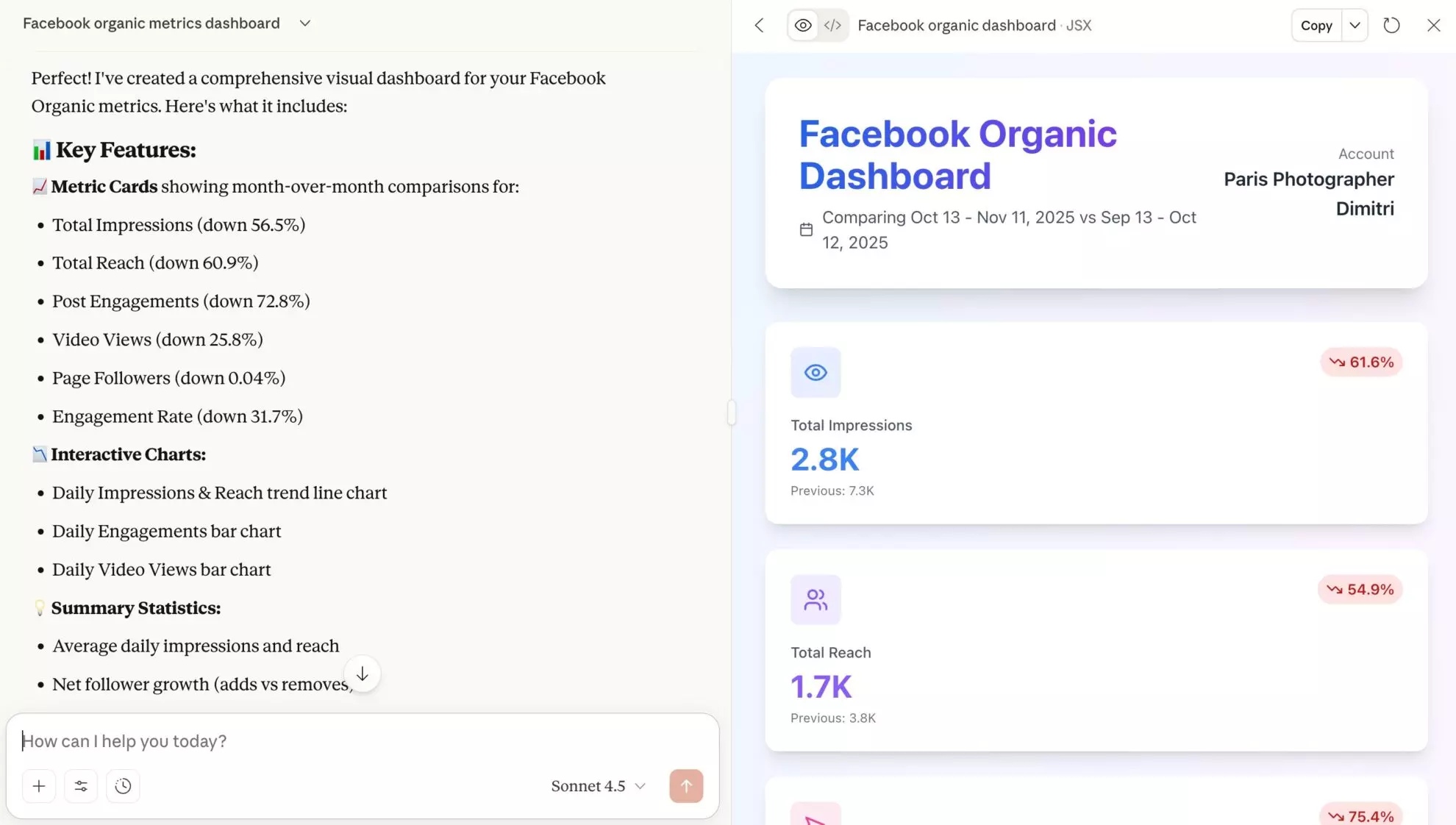
You can continue asking narrower questions to get deeper insights or even ask Claude to generate visual summaries on top of the response.
💡 Learn more about Windsor MCP capabilities: How to Use Windsor MCP for AI Data Analysis: Examples & Use Cases.
Since Windsor connects directly to source APIs, AI insights are based on accurate, up-to-date data from your accounts.
Putting that into practice, imagine a fashion-type commerce business with a warehouse using a vertical lift module to manage storage and retrieval. Inventory data flows into the ERP or warehouse system, and Windsor connects data from these fragmented systems to conversational analytics tools.
This allows you to ask, in plain language, how much customized apparel is in storage, what’s currently being picked, and what’s out of stock, helping the business avoid stockouts, optimize campaigns, and make faster, more informed decisions.
This differs from static analytics, where you manually import spreadsheet rows, scroll through dashboards, and interpret fixed charts. With conversational analytics, you interact with your data as if you were speaking to a colleague.
Behind the scenes, this is what happens:
- Natural language processing interprets the question you type or speak and identifies your intent
- A semantic data model maps your business terms, such as conversion, CPC, or paid social, to the correct data sources
- Machine learning resolves ambiguity, understands context, and selects the most relevant metrics
- The system queries your connected platforms and analyzes data in real time
- It returns a clear, contextual answer and allows immediate follow-up questions for deeper exploration
As you can see, this reporting approach leverages conversational AI, whose market value is expected to exceed $41.39 billion by 2030.
Benefits of conversational analytics
According to Nextiva, 77% of businesses invested more in reports and analytics. Why? Because analytics give you refined insights.

Insights drive decisions. Now imagine being able to interact with those insights to find answers to your questions.
The benefits of that are the following:
-
Open data access across teams
Data no longer sits with specialists alone. Even as a non-technical person, you can simply ask unrefined questions and receive streamlined answers. This allows all team members to explore performance without waiting for reports or analysts.
-
Encourages exploration and curiosity
Conversational analytics enables you to test a theory, investigate an anomaly, refine a segment, and keep digging until the insight makes sense. Learning becomes an active dialogue instead of a static deliverable.
-
Delivers speed with context
When you ask what drove a spike in conversions, you receive a breakdown from paid social, a specific platform, and a defined audience segment. Follow-up comparisons, such as CPC trends versus last week, also happen instantly. This ensures you receive detailed reports on time.
-
Transforms data into actionable insight
Conversational analytics shifts data from passive reporting to active decision support. Instead of reviewing what happened, you understand why it happened and what changed. That clarity improves campaign optimization, budget allocation, and overall marketing performance.
How to implement conversational analytics
Conversational analytics is no longer a negotiable option if you want to scale your business faster and make the right decisions.
The best part is that you can implement this process really quickly by following these simple steps:
1. Choose a conversational analytics tool
That’s a platform that lets you ask questions about your data in plain language and receive contextual answers instantly. Core features of a good conversational analytics tool you need to look out for include:
- Natural language-based insights without coding or SQL
- Visual summaries and trend breakdowns delivered inside your preferred AI tool
- Integrations with data movement tools that can sync data from marketing, sales, and analytics platforms
- Real-time visibility into performance across segments, channels, and customer journeys

The most popular tools offering advanced conversational analytics capabilities are Claude.ai, ChatGPT, Microsoft Copilot, Cursor, Gemini, and Perplexity. Select the best-fit platform based on your data access needs, security requirements, existing workflows, and the level of analytical depth you expect from an AI assistant.
2. Connect and model your cross-channel data
Conversational analytics relies on a unified data model that brings together paid media, CRM, web analytics, and sales data. This process, known as data centralization, ensures your conversational tools can access all required information from a single, consistent source rather than scattered files or siloed systems. Equally important, the data must be normalized and delivered in an analysis-ready format.
Windsor.ai addresses these requirements by handling data normalization, centralization, and AI integration behind the scenes. It allows you to connect business data from 350+ sources, such as Facebook Ads, Google Analytics 4, Shopify, and more, to your preferred LLMs, enabling real-time, AI-generated insights in seconds.
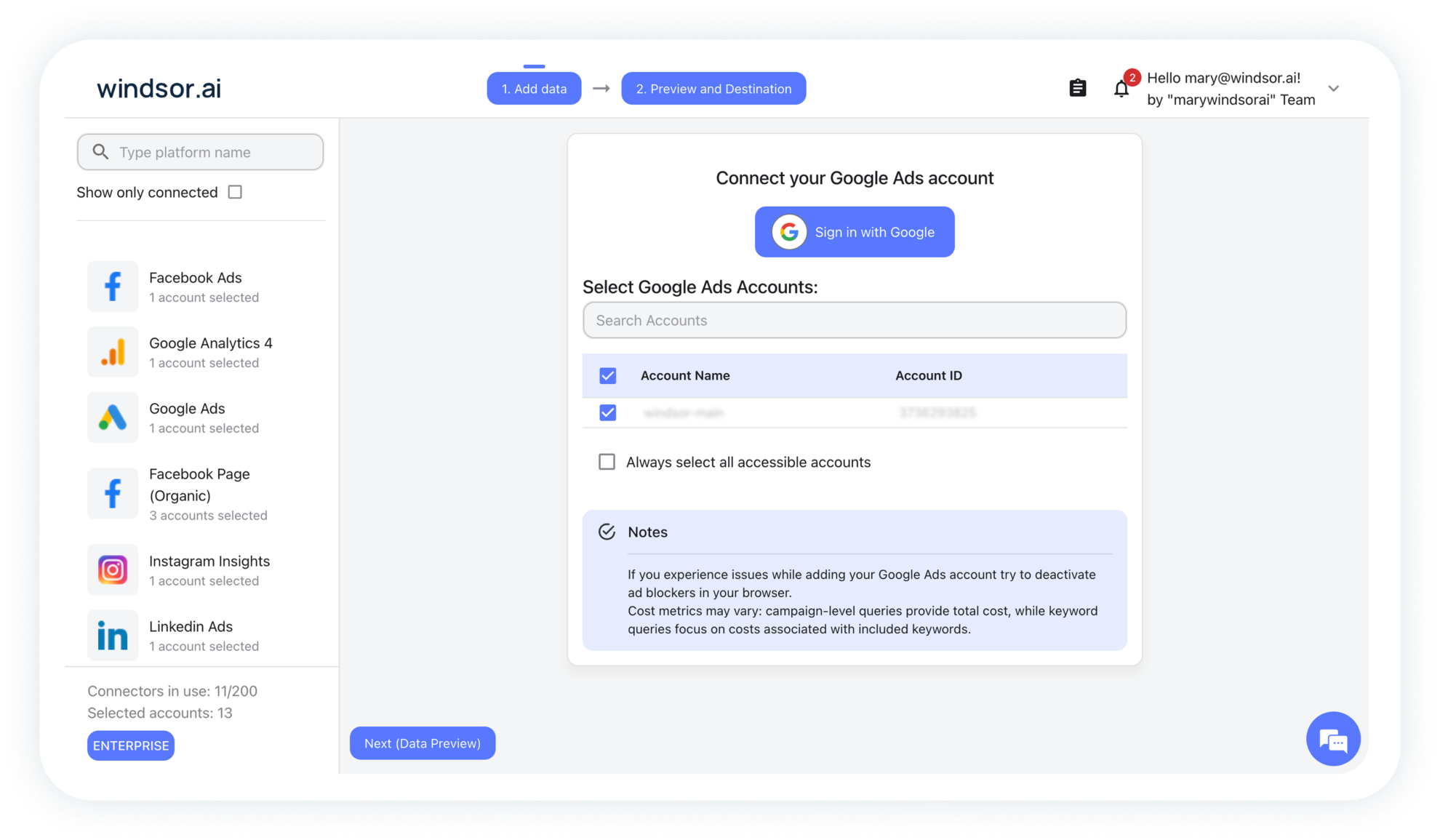
⚙️ Windsor MCP Setup Guides: How to Connect Your Data to Different LLMs.
3. Map your business language to a semantic layer
Conversational analytics works because generative AI systems understand your terminology.
Ensure that terms such as lead, new customer, assisted conversion, branded search, and incrementality are clearly defined and embedded in a semantic data model. Also, communicate these terminologies to your team. This layer translates natural-language questions into accurate data queries and ensures everyone receives the same answer to the same question.
Of course, if you’re using a ready-built and NLP-trained platform like Windsor, you can skip this part. Windsor MCP handles all integration with your data sources, automatically enforcing a semantic data model suitable for your needs, and delivers accurate insights through your preferred generative AI tool.
4. Drive adoption through daily use
Andrew Bates, COO of Bates Electric, says,
“Implementation succeeds when conversational analytics becomes part of daily decision-making. At the start, pilot with a motivated marketing squad to generate early wins. Once you decide there’s no friction, equip your team to use conversational queries during campaign reviews and budget discussions at the organization level.”
In addition, collect feedback and refine metric definitions as usage expands. This continuous iteration helps reduce time-to-insight, strengthens the cross-functional rhythm, and ensures marketing decisions are made with evidence when it matters.
Conclusion
While static reports primarily provide a snapshot, conversational analytics gives you a steering wheel and a detailed interactive map to guide your brand’s vision. It enables you to ask direct questions, get fast, contextual answers, and follow your curiosity without leaving the flow of work.
To implement conversational analytics successfully, start by choosing a conversational analytics platform, then connect all your data sources through an automated data integration solution like Windsor.ai.
🚀 Try Windsor.ai free for 30 days and start unlocking powerful, AI-driven insights in seconds: https://onboard.windsor.ai/


