 Destinations
 Data sources
 AI insights
 About us
 Careers
 Security
 Customer reviews
 Contact us
 Affiliate program
 Solution partners
 Template gallery
 Looker Studio templates
 Power BI templates
 Excel templates
 Google Sheets templates
 Tableau templates
 Facebook Ads templates
 Google Ads templates
 Data fields & Metrics
 AI prompt library & Guides
 Product documentation
 API documentation
 Case studies
 Blog
Blog Data models
 Windsor vs Supermetrics
 Windsor vs Funnel.io
 Windsor vs Fivetran
 Windsor vs Rivery
 Windsor vs Portermetrics
 Windsor vs Coupler.io
 Last updated: 1 September 2026




You connect Close to ChatGPT by installing Windsor’s free native app inside ChatGPT and linking your Close account through Windsor.ai, no CSV exports or custom code required. Once it’s connected, you can ask ChatGPT about your Close pipeline, deal value, and rep activity in plain language and get an answer pulled from live data.
Close’s own dashboard is built for working leads and calls one record at a time, not for answering a broad question like “which reps are driving the most opportunity value this month.” Getting that answer the manual way usually means exporting leads or opportunities to a spreadsheet and rebuilding the numbers by hand. Windsor’s ChatGPT app skips that step and keeps the pipeline data live and queryable in one place.
2 steps to connect Close to ChatGPT
Takes under a minute, no code or manual CSV work required.
Full walkthrough here: Windsor’s ChatGPT integration documentation.
Prerequisites
- A Windsor.ai account (free forever plan, no credit card, or paid from $19/month).
- A Close account with at least one lead, opportunity, or logged activity.
- A ChatGPT account.
Step 1. Connect Close to Windsor.ai
Start on the Windsor.ai side so your Close data is ready to pull into ChatGPT.
- Create a free Windsor.ai account, or sign in if you already have one.
- Go to onboard.windsor.ai/app/close_com and select Close from the connector list.
- Authorize Windsor to read your Close data.
- Connect additional Close accounts too, if you run more than one sales team or workspace.
Step 2. Connect the Windsor.ai app in ChatGPT
In ChatGPT, open the connectors menu and install Windsor’s native app, then allow it access to your Windsor.ai account.
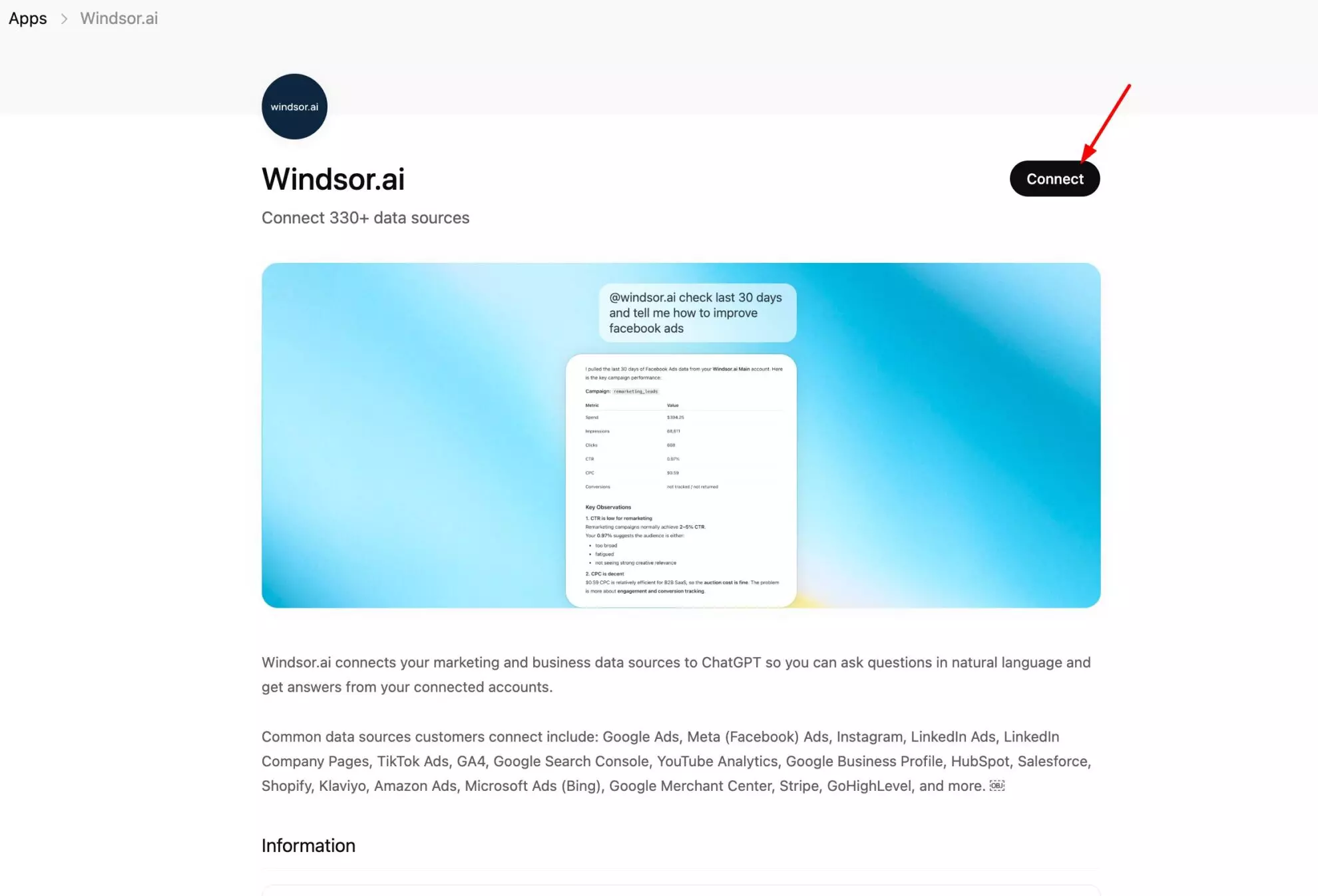
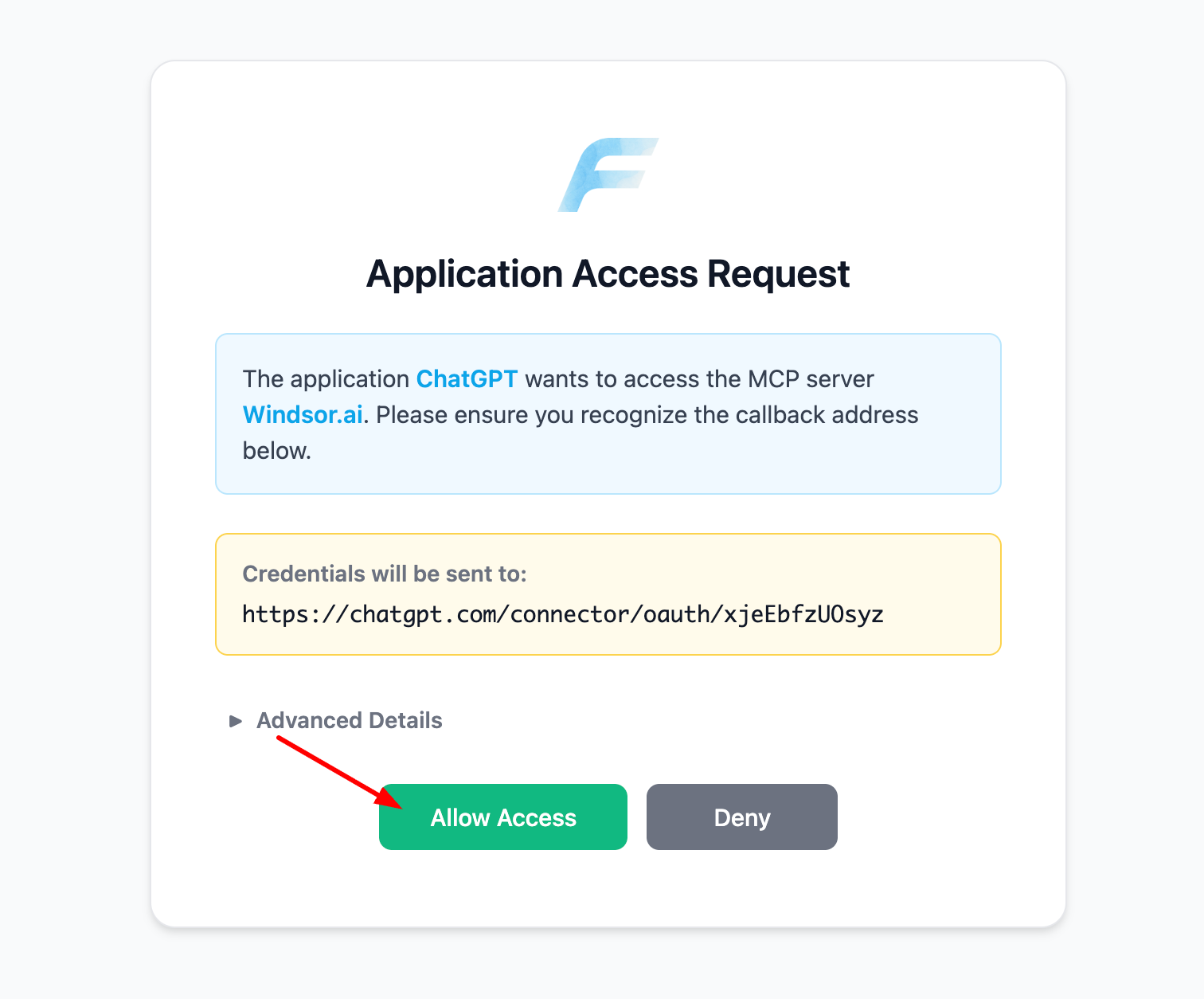
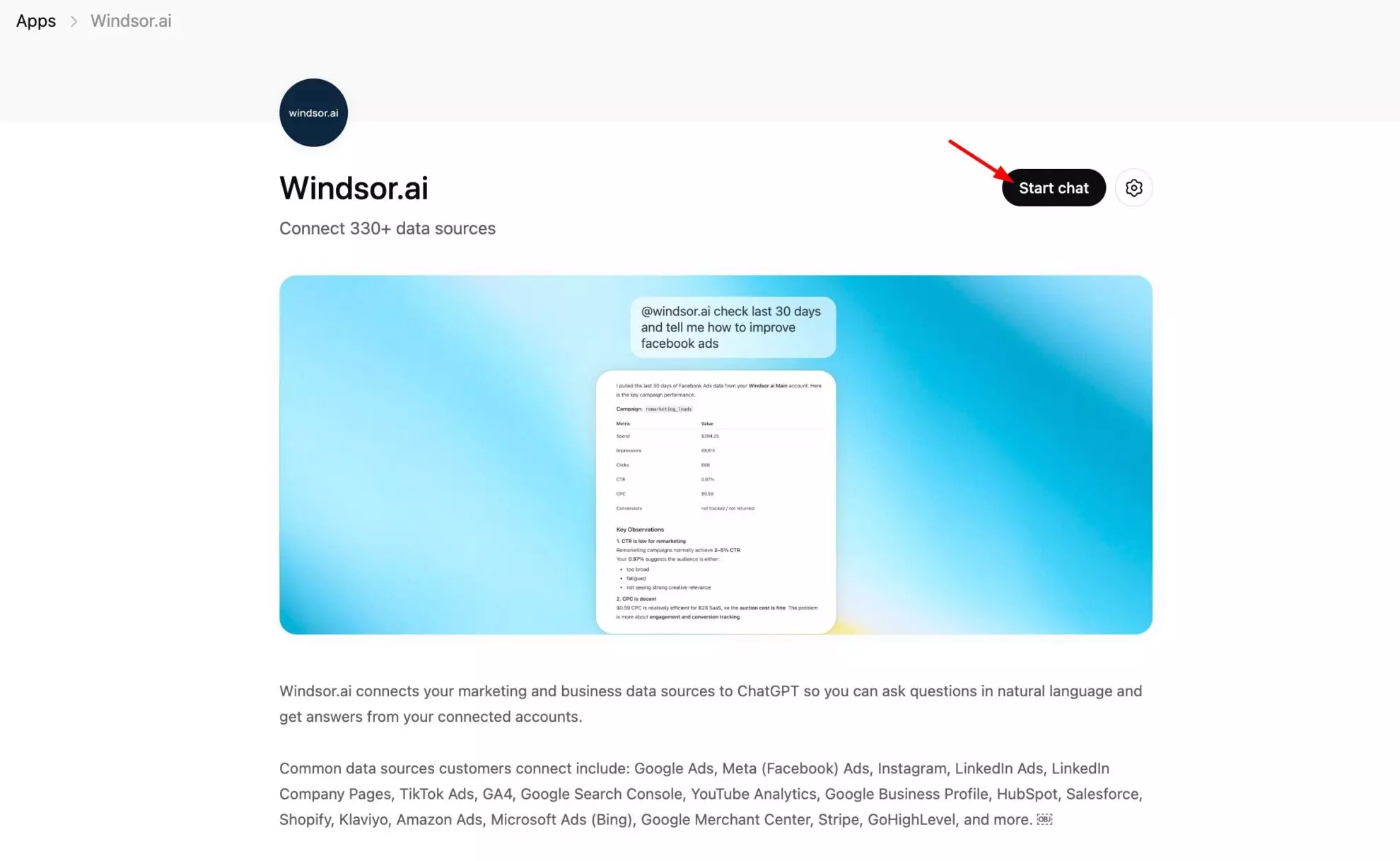
Once the app shows as connected, confirm Close is actually reachable before you start asking real questions:
List the data sources connected to my Windsor account. Do you see Close there?If Close is on that list, you’re ready to query your pipeline in natural language, no dashboard exports needed.
The metrics that matter for Close
| Metric | What it tells you |
|---|---|
| opportunities.value | The total dollar value of a specific deal, before any confidence weighting is applied. |
| opportunities.expected_value | Deal value weighted by confidence, a more realistic read on what a deal is worth to your forecast right now. |
| opportunities.confidence | The percentage likelihood a rep has assigned to a deal closing, the input behind every forecast weighting. |
| opportunities.annualized_value | Deal value normalized to a full year, so recurring-revenue deals compare fairly against one-time ones. |
| opportunities.status_label | The exact pipeline stage a deal currently sits in, such as Qualified or Proposal. |
| opportunities.status_type | Whether a deal counts as active, won, or lost, the roll-up you’d use to calculate a win rate. |
| opportunities.date_won | The date a deal actually closed, the anchor for time-to-close and sales-cycle-length reporting. |
| call_activities.duration | How long a logged call lasted in seconds, a rough proxy for how substantive the conversation was. |
| call_activities.disposition | The outcome tag attached to a call, such as connected or no answer, useful for spotting reps who aren’t getting through. |
| meeting_activities.duration | How long a logged meeting actually ran, handy for catching meetings that got cut short or never really happened. |
| email_activities.has_reply | Whether a sent email actually got a reply, the clearest single signal of real prospect engagement. |
| email_thread_activities.n_emails | How many emails are in a given thread, a rough read on how much back-and-forth it took to move a conversation forward. |
What to ask ChatGPT: prompt ideas
Pipeline and deal performance
Show me total Close opportunity value and expected value grouped by status_label for all open deals.
Which open opportunities have the highest confidence score right now, and what's their combined annualized value?
Sales activity and outreach
Summarize call duration and disposition by rep for the last 7 days.
Which sent emails tied to open opportunities got a reply, and which didn't?
Lead and opportunity tracking
List every opportunity that reached status_type Won this month, along with its value and date_won.
The Close connection through Windsor is read-only (confirmed live: Close has no listed write actions). ChatGPT can analyze and summarize your leads, opportunities, and activity, but it can’t create, edit, or delete anything back in Close.
Bonus: analyze Close alongside your full stack
Windsor connects 350+ sources, so Close doesn’t have to live in its own silo. A few realistic blends:
- True cost per closed deal. Blend Close’s won-opportunity value with your Google Ads and Facebook Ads spend to calculate a real cost per closed deal instead of stopping at cost per lead.
- Lead-source-to-close reporting. Blend Close’s opportunity and lead data with GA4 session data to see which channels and campaigns actually produce closed revenue, not just form fills.
- Activity vs. outcome view. Blend Close’s call, meeting, and email activity data with the rest of your marketing stack to see whether higher rep activity in a given week actually correlates with more closed deals.
Other ways to connect Close to ChatGPT
Manual CSV export
Close lets you export leads, opportunities, and activity to CSV, and you can upload that file into ChatGPT to ask questions about it. It works, but it’s a static snapshot the moment you export it, and you’d need to repeat the export and re-upload every time the numbers move.
Zapier or Make
Close integrates with Zapier and Make, so you can build an automation that fires on a new lead, opportunity, or activity. That’s useful for notifications and handoffs, but it’s a workflow you build and maintain, not a way to ask ChatGPT an open-ended question about your pipeline.
Neither route gives you the live, queryable view that the direct Windsor connection does.
Conclusion
Connecting Close to ChatGPT through Windsor’s native app takes two steps and keeps your pipeline data live instead of stuck in a one-off export. From there, deal value, rep activity, and pipeline confidence are just a question away, in ChatGPT, in plain language.
🚀 Ready to connect Close to ChatGPT? Connect Close to Windsor.ai free and start asking ChatGPT about your pipeline today.
FAQs
What's the fastest, native way to connect Close and ChatGPT?
Installing Windsor’s app directly from within ChatGPT. It’s a one-click install and authorization, not a custom connector URL you have to paste in.
Do I need to write any code to connect Close to ChatGPT?
No. Both the Windsor.ai side (connecting Close) and the ChatGPT side (installing the app) are point-and-click, no code or API keys to manage yourself.
Can ChatGPT actually analyze my Close pipeline once it's connected?
Yes. Once Close is connected, you can ask ChatGPT plain-language questions about opportunity value, confidence, call and meeting activity, and email thread counts, and it pulls the answer from live Close data.
Can I connect more than one Close account or sales team?
Yes. You can connect multiple Close accounts through Windsor.ai if you manage more than one sales team or workspace, and query them together or separately from ChatGPT.
What metrics and data does the Close connector actually return?
Metrics include call and voicemail duration, meeting duration, opportunity value, expected value, annualized value, annualized expected value, opportunity confidence, email thread activity counts, and bulk-action counts. Dimensions include custom field metadata and standard lead, opportunity, and contact identifiers.
Is Windsor.ai free to use for connecting Close to ChatGPT?
Windsor.ai has a free forever plan with no credit card required, and paid plans start from $19/month if you need higher usage or more sources.
Is a CSV export a better option than connecting Close directly?
A CSV export is a static snapshot that goes stale as soon as your pipeline changes, and needs to be re-exported and re-uploaded every time. The direct Windsor connection stays live, so ChatGPT is always working from current data.
Can I combine Close data with other channels in the same ChatGPT conversation?
Yes. Windsor connects to 350+ sources, so you can blend Close pipeline data with ad platforms, email, or other tools for a single blended view instead of switching between reports.
Can ChatGPT update or edit records in Close through Windsor?
No. The Close connection through Windsor is read-only, so ChatGPT can analyze and summarize your leads, opportunities, and activity, but it can’t create, edit, or delete anything back in Close.


