 Destinations
 Data sources
 AI insights
 About us
 Careers
 Security
 Customer reviews
 Contact us
 Affiliate program
 Solution partners
 Template gallery
 Looker Studio templates
 Power BI templates
 Excel templates
 Google Sheets templates
 Tableau templates
 Facebook Ads templates
 Google Ads templates
 Data fields & Metrics
 AI prompt library & Guides
 Product documentation
 API documentation
 Case studies
 Blog
Blog Data models
 Windsor vs Supermetrics
 Windsor vs Funnel.io
 Windsor vs Fivetran
 Windsor vs Rivery
 Windsor vs Portermetrics
 Windsor vs Coupler.io
 Last updated: 20 October 2026




🚀 There are two ways to connect Meta Ads to Claude: Meta’s official Meta Ads AI connector, which you add in Claude as a custom connector, or the Windsor.ai connector, installed in one click from Claude’s directory. For the Windsor.ai route, link your Meta account at https://onboard.windsor.ai/app/facebook, then search “Windsor” under Connectors in Claude and click Add. Get started for free.
With both routes, the connector is what makes this possible: Claude can turn raw performance data into clear answers, but only once it has access to your ad metrics. Without one, spend, ROAS, conversions and the other KPIs stay inside Meta Ads Manager.
Meta launched its official Meta Ads AI connector in April 2026. It is a remote MCP server (mcp.facebook.com/ads) that you add in Claude as a custom connector by pasting the URL and signing in with your Facebook login. It covers Meta Ads only, and on the free Claude plan it uses the single custom connector slot you get.
Windsor.ai takes a different route. It is listed in Claude’s directory, so you install it in one click with no server URL to configure, and it does not use your custom connector slot. It links Meta Ads to Claude through the Meta Marketing API, giving Claude live access to 560+ metrics and 150+ dimensions without a manual export, and the same connector brings Google Ads, GA4, Shopify and 350+ other sources into the same chat.
Here is a Meta Ads performance report built with Windsor.ai’s direct connector for Claude.
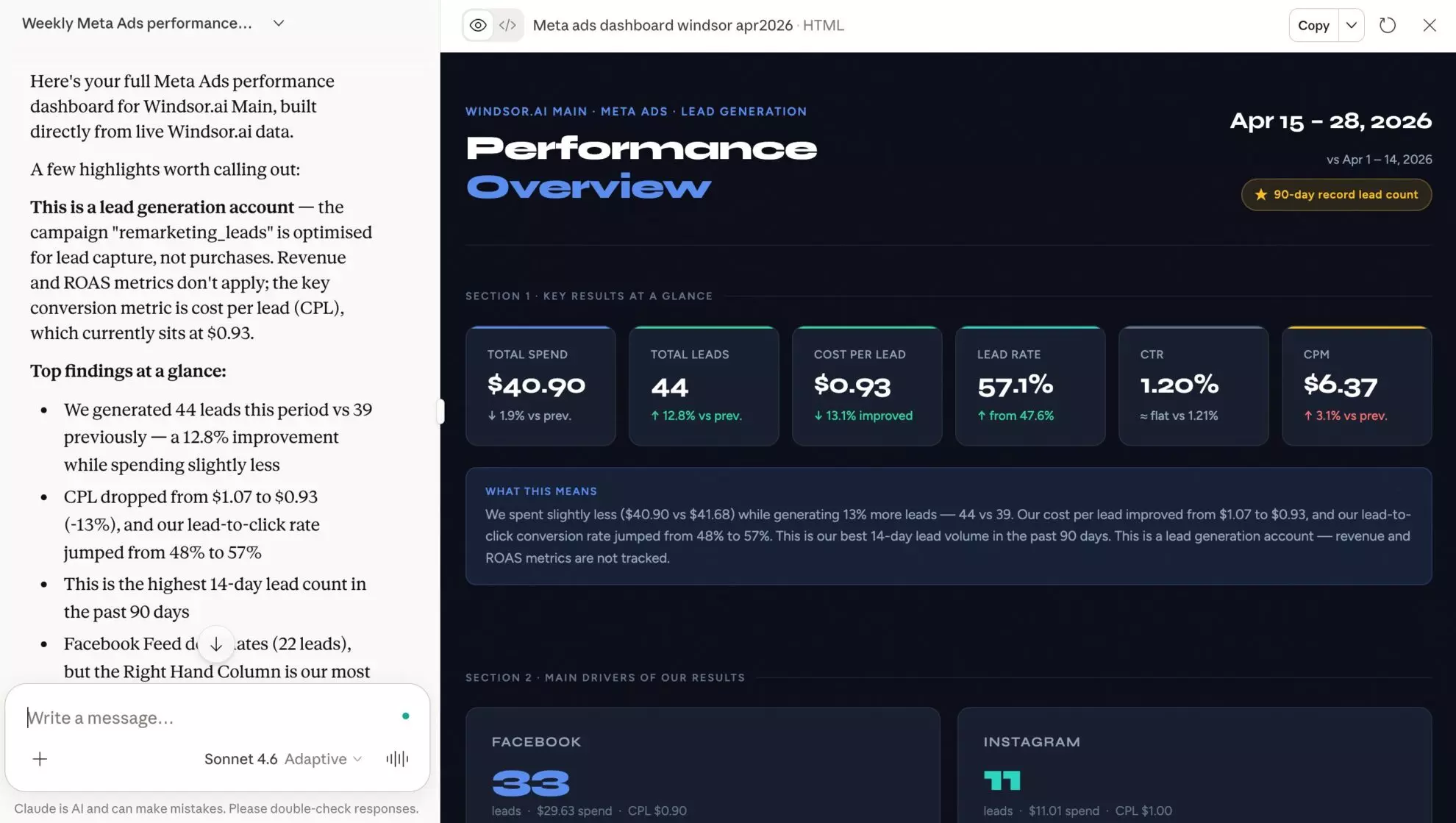
This guide covers the Windsor.ai setup first, then Meta’s official connector and the manual CSV route, so you can choose.
Which route should you use
Meta’s official connector is the right choice if Meta Ads is the only data you need in Claude and one custom connector per Facebook login suits you. Choose Windsor.ai when any of these apply:
- You want Meta Ads next to other channels in one answer. Among the teams that pull Meta Ads through Windsor.ai, Google Ads and GA4 are the sources most often pulled alongside it in the same week, with Shopify and TikTok Ads behind them. One connector covers all of them.
- You want the same data outside Claude too. The connection that feeds Claude also feeds Data Studio, Power BI, BigQuery, Snowflake and 25+ other destinations.
- You are on the free Claude plan. It allows one custom connector. Windsor.ai installs from the directory and leaves that slot free.
- You manage several client accounts. In Windsor.ai you choose which ad accounts to connect, so Claude sees only those, instead of everything your Facebook login can reach.
Both routes give Claude read and write access to your ad accounts, and both run through Meta’s official Marketing API.
Send Meta Ads data to Claude in 2 steps
The connection between your Meta Ads account and Claude happens in two quick moves: link your Meta Ads account to Windsor.ai and add the Windsor.ai connector in Claude. You’re ready to start querying your data!
📖 Follow our quick step-by-step guide to automatically integrate your data into Claude.
What you’ll need
- A Windsor.ai account (free or paid plan)
- Facebook/Meta Ads account with view or admin access
- Claude account
Step 1: Connect your Meta Ads account(s) to Windsor.ai
To link your data, first, you have to authenticate your Meta Ads Manager through the Windsor.ai onboarding portal.
- Head to onboard.windsor.ai, sign in, and add Facebook Ads as your data source.
- Select the account(s) that you’d like to connect to Claude for analysis.

Windsor pulls data directly from the Meta Ads API, normalizing it in the background so Claude gets clean, structured datasets instead of raw export files.
Once connected, Windsor maintains a live pipeline from your ad account to Claude. The data stays current without any manual refresh.
Step 2: Add the Windsor.ai connector in Claude
With your data flowing into Windsor, the next step is to send Meta Ads data to Claude by adding the Windsor.ai connector for Claude.
- In Claude, open Customize, then Connectors, search for Windsor and click Add. Sign in to your Windsor.ai account when prompted.
- You can also open the Windsor.ai listing in the Claude directory and click Connect.
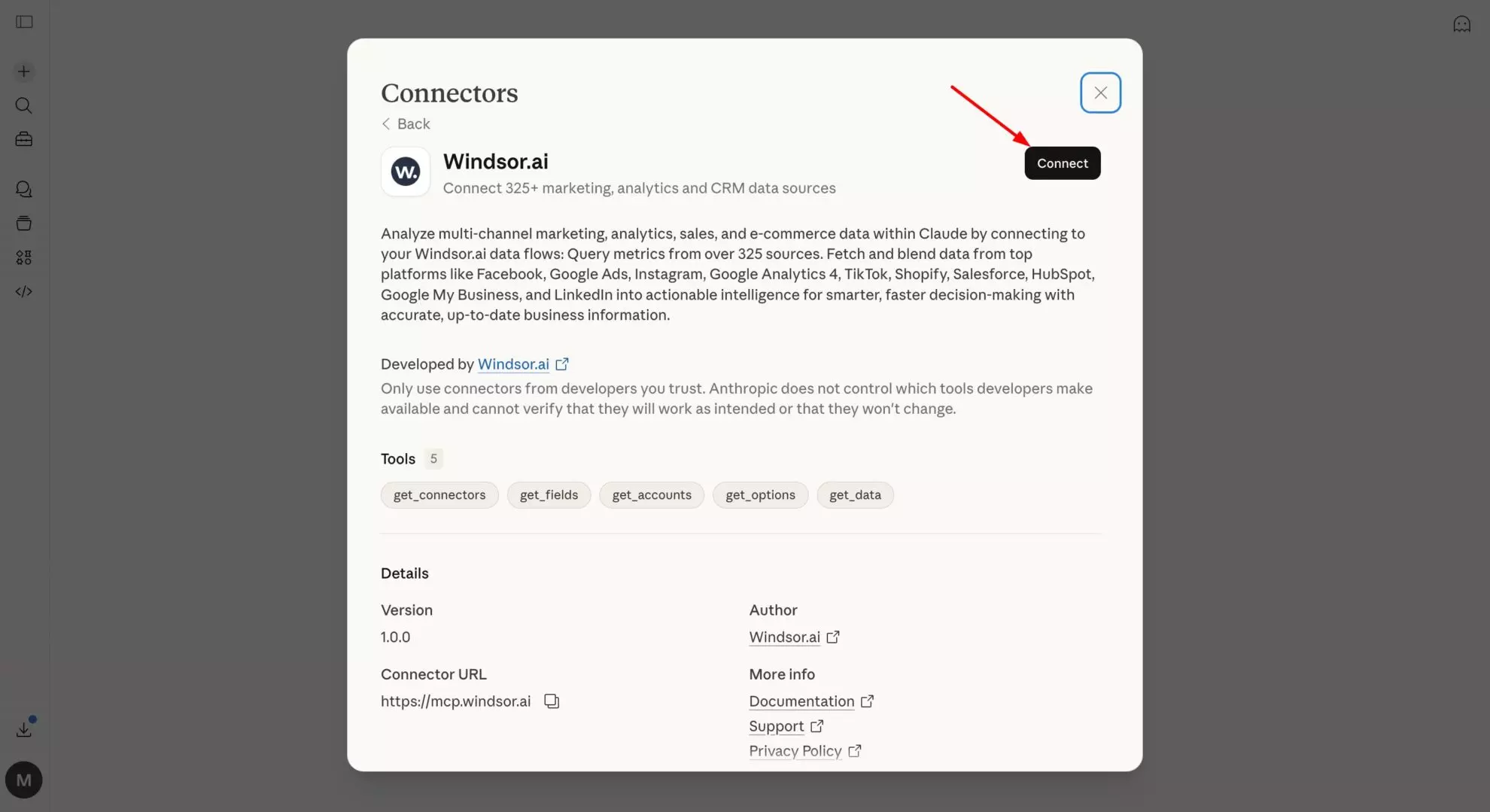
- You will be prompted to authorize the connection. Select “Always allow” to avoid repeated permission prompts.
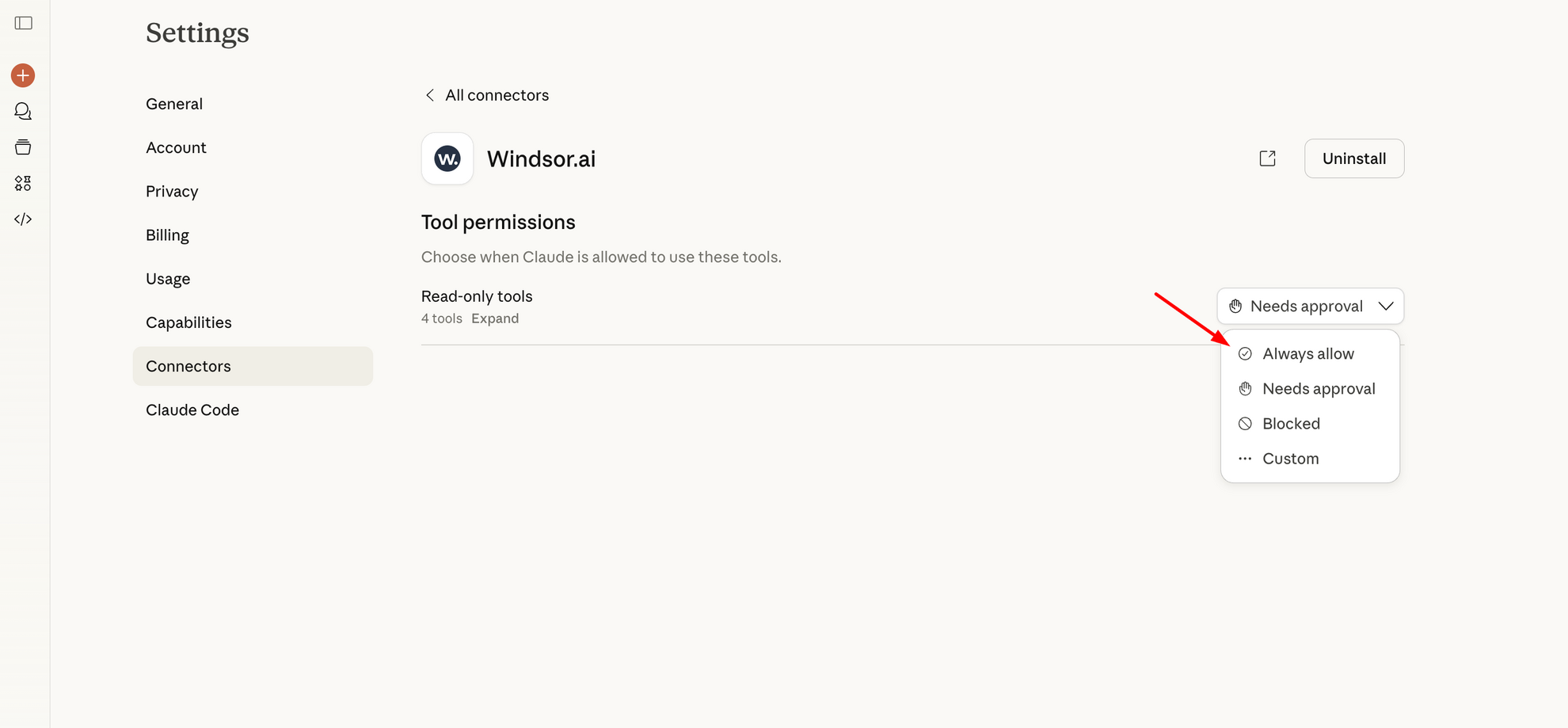
To open the connector in Claude Desktop, paste the following link into your browser:
claude://claude.ai/directory/connectors/360c0c31-4bb6-42ca-8e50-5da0a100a68eWindsor MCP now appears in your active connectors. Open a new Claude chat to start querying your Facebook Ads data, or to take action on it directly.
Query and act on your Meta Ads data in Claude
With the connection live, you can ask Claude about your ad performance using plain language. Instead of building dashboards or navigating Ads Manager to make changes, you tell Claude what you want to know, review its recommendations, and execute directly on your Meta Ads data.
Try these sample prompts:
- “Show ROAS by campaign for the last 30 days and highlight campaigns below 2.0.”
- “Compare spend, conversions, and CPA this month vs. last month and suggest budget reallocation.”
- “Which of my active campaigns have had a CPA above target for the last 7 days? Pause the worst performer.”
💡 Pro tip: Mastering attribution in Claude
When querying your data, always specify your attribution window (e.g., “Show me 7-day click vs. 1-day view conversions”).
Because Windsor.ai pulls raw Meta Marketing API data, Claude can help you identify “hidden” conversion value that the standard Ads Manager UI often over-simplifies. This allows you to see exactly how many users saw an ad and converted later, even if they didn’t click immediately.
What you can do once it’s connected
Once Meta Ads is connected, Claude can do three broad things with your data:
- Ask questions and build reports: multi-account client summaries, budget reallocation recommendations, and live dashboards that auto-refresh. See ‘Claude prompts for Meta Ads reporting and analysis‘ for the full prompt library.
- Create and manage live campaigns: create campaigns and ad sets, pause or enable them, adjust budgets, edit an ad’s creative, or boost an organic post, all with your explicit approval before anything runs. Meta Ads automation carries real ban risk if handled carelessly, so this comes with a 5-rule safety protocol. See ‘How to manage Meta Ads campaigns from Claude‘ for the full list of supported actions, sample prompts, and the safety rules.
- Blend Meta Ads with your other data: combine campaign performance with Shopify or e-commerce revenue, CRM opportunities from HubSpot or Salesforce, GA4 conversions, or any of Windsor’s 350+ connected sources, all in the same Claude conversation, no manual joins or spreadsheet work required.
Prompts by task, from what teams ask most
These are the questions teams ask most once Meta Ads is connected to Claude through Windsor.ai. The fields requested most are spend, campaign, impressions, clicks and date, with reach, CTR, frequency, ad name and the purchase and lead actions close behind, so the prompts below are built on those. Each one runs on fields the connector returns; paste it as it is and change the dates.
Weekly performance table
“Show spend, impressions, clicks and CTR by campaign for the last 7 days next to the 7 days before, and flag every campaign where CPC rose by more than 20%.”
Revenue and ROAS
“Give me purchases, purchase value and purchase ROAS by campaign for the last 30 days, ranked by ROAS, with spend next to each.”
Leads and landing pages
“Cost per lead by ad set this month, with landing page views, and list the ad sets that record leads but few landing page views.”
Creative fatigue
“For every ad with frequency above 3 in the last 14 days, show reach, CTR and CPM week by week and tell me which creatives to rotate.”
Placements and audiences
“Break down spend and purchase ROAS by publisher platform and placement for the last 30 days, then by age and gender, and point out where the spend is not earning its share.”
Account structure audit
“List every active campaign with its objective and, for each ad set, the optimisation goal, daily budget and targeting. Flag objectives and optimisation goals that do not match.” The four checks behind this prompt are in the Meta Ads structure audit.
Meta Ads next to Google Ads
“Put Meta Ads and Google Ads spend, purchases and purchase value side by side by week for this quarter and show blended ROAS.” This one needs both connectors in Windsor.ai; Meta’s official connector cannot see Google Ads.
Risks and safeguards: what goes wrong in practice
The question behind most “should I let Claude touch my ads” threads is reliability. We can answer it from the write actions teams run through Windsor.ai rather than from opinion.
- Turning things on and off is safe. Pausing or enabling a campaign, ad set or ad succeeds on close to every attempt.
- Budgets and campaign creation succeed most of the time. Setting a budget, creating a campaign and updating an ad set go through the large majority of the time. When they fail, a required parameter is usually missing.
- Creating an ad set fails about half the time, and so does boosting a post. The cause is almost always Meta’s own rules: a bid strategy without a bid amount, no explicit Advantage+ audience choice, or several creations fired in a row and throttled. Give Claude the full spec, ask it to show the configuration before creating anything, and confirm. The breakdown and a safer order of operations are in what happens when an AI assistant creates Meta ad sets.
On the reading side, the errors we see most are a field name Meta does not recognise, fields that Meta does not allow in the same query, a date range beyond Meta’s 37-month history limit, an invalid date preset, and Meta’s own request limit on busy accounts. The first three have exact fixes in the Meta Ads troubleshooting guide.
Three things hold whichever route you use:
- Nothing goes live without you. Through Meta’s connector, campaigns, ad sets and ads that Claude creates land paused until you activate them. Through Windsor.ai, Claude shows what it is about to change and waits for your confirmation on every write.
- Access follows the login. Meta’s connector inherits everything your Facebook user can see, including client accounts in your business portfolio. In Windsor.ai you pick the ad accounts to connect, and Claude sees only those.
- Meta looks at behaviour. Meta caps budget changes at 4 per ad set per hour and 10 spend-cap changes per account per day. Rapid automated changes, and anything that drives the Ads Manager interface instead of the API, are what draw account restrictions. Both routes on this page use the official Marketing API. The 5-rule safety protocol covers the rest.
Meta Ads data available in Claude via Windsor MCP
Windsor MCP gives Claude access to a comprehensive Facebook Ads (Meta Ads) schema covering 560+ metrics and 150+ dimensions across all reporting levels.
The data comes directly from the Meta Marketing API, so you can analyze performance at any level of detail.
Core reporting levels
These fields define the structure of your data and are used to group your performance metrics.
| Level | Supported fields |
| Account level |
account_id, account_name, currency, account_status
|
| Campaign level |
campaign_name, campaign_id, campaign_objective, campaign_status
|
| Ad set level |
adset_name, adset_id, adsset_optimization_goal, adset_billing_event, targeting parameters
|
| Ad & Creative level |
ad_id, ad_name, creative_id
|
Performance metrics
| Category | Metrics |
| Base metrics |
spend, impressions, clicks, link_clicks
|
| Efficiency ratios |
CTR (Click-Through Rate), CPC (Cost Per Click), CPM (Cost Per Mille) |
| Conversion events |
actions_purchase, actions_lead, actions_add_to_cart, actions_landing_page_view
|
| Value & ROI |
action_values_purchase, purchase_roas_omni_purchase (Return on Ad Spend) |
Audience breakdowns
Use these fields to segment your data and understand specifically who is interacting with your ads.
| Category | Breakdown fields |
| Demographics |
age, gender, country
|
| Placement & Tech |
device_platform, platform_position
|
💡 Good to know: Unlike standard ETL tools that send data to a static sheet, the Windsor MCP creates a live conversational bridge. This means Claude understands the schema of your Facebook Ads, so you don’t have to explain what ‘Spend’ or ‘ROAS’ means every time you start a new chat.
About Windsor.ai: Native Meta Ads connector for Claude (no code)
Windsor.ai is the data integration layer between Meta Ads and Claude. This Facebook Ads connector for Claude automates the data prep you’d otherwise have to handle manually.
Instead of exporting, cleaning, and uploading reports yourself, the Windsor.ai connector manages the entire pipeline so Claude always has access to fresh, structured, analysis-ready data.
Here is how it works:
- Pulls data directly from the Meta Ads API, so you’re working with live numbers, not yesterday’s snapshot.
- Normalizes and cleans the data in the background, removing inconsistencies and formatting issues that make raw ad data hard to work with.
- Streams the data into Claude, ready for analysis the moment you need it.
Think of it as the Facebook Ads LLM connector that bridges the gap between Meta’s API and Claude’s analytical power, making automatic Facebook Ads reporting in Claude a reality without writing code.
Key features of Windsor.ai’s Meta Ads connector for Claude
Once you sync Meta Ads with Claude through Windsor, you get:
- 710+ supported data fields covering every angle of campaign performance
- Data across account, campaign, ad set, ad, and creative levels
- Multi-account support, so agencies can connect multiple client ad accounts in one setup
- Write actions on Meta Ads allow you to create campaigns and ad sets, turn them off/on, and set a budget from Claude
And it doesn’t stop at Facebook Ads. Windsor connects 350+ data sources, GA4, Google Ads, Shopify, Instagram, HubSpot, all flowing into Claude through the same MCP connector. That means you can run cross-channel analysis without leaving Claude or stitching data together manually.
Alternative methods: Official Meta Ads MCP vs manual CSV export vs third-party MCP tools
You can also bring Meta Ads data into Claude through Meta’s official Meta Ads AI connector, through other third-party MCP connectors, or by exporting data manually as a CSV.
Each of these approaches does its job (connects your Meta Ads data to Claude), but all come with meaningful trade-offs compared to a purpose-built, native integration via Windsor.ai.
Connecting Meta Ads to Claude via the official Meta Ads AI connector
Meta launched Meta Ads AI Connectors on 29 April 2026, in open beta. The Claude side is a remote MCP server with 29 tools. They pull performance at account, campaign, ad set or ad level with breakdowns, summarise your account for context, flag trends and anomalies, compare your ad sets with industry and auction benchmarks, sweep for delivery-blocking errors, check pixel and dataset health, browse and diagnose product catalogs, and create or update campaigns, ad sets and ads. Here is how you add it:
- In Claude, open Customize (or Settings), then Connectors, click + and choose Add custom connector.
- Name it, for example “Meta Ads”, and paste
https://mcp.facebook.com/adsas the server URL. - Sign in with your Facebook login and choose the ad accounts to allow.
- Start a new chat, switch the connector on, and ask about your campaigns. Anything Claude creates through it lands paused, and you activate it yourself.
Where the official Meta Ads connector stops
For Meta-only work it is a solid option, and it costs nothing on Meta’s side. What it does not do:
- Meta Ads only. It connects one platform. Google Ads, GA4, TikTok, Shopify or your CRM need their own connectors, and Claude cannot blend them with Meta data in one answer.
- Uses your custom connector slot. Custom connectors work on every Claude plan, but the free plan allows one. If Meta Ads takes it, nothing else can be added that way.
- Manual setup and upkeep. You paste the URL, manage the Facebook permissions per ad account, and re-do it per client if you run an agency.
- Claude only. The data goes to the chat and nowhere else. There is no path to a warehouse, a BI tool or a scheduled report.
⚙️ Windsor.ai is a connector in Claude’s official directory. One click to install, no server URL, and it does not use your custom connector slot. It connects through the Meta Marketing API and brings 350+ sources into the same conversation, with the same data also available in Data Studio, Power BI, BigQuery, Snowflake and 25+ other destinations.
Connecting Meta Ads to Claude manually via CSV export
This is often where marketers start when they want to analyze Facebook Ads metrics in Claude before they have an automated integration in place.
The typical integration steps include:
1) Log in to Meta Ads Manager.
2) Set your date range and select the metrics you want.
3) Export the data as a CSV file.
4) Upload the CSV directly into a Claude conversation.
5) Ask Claude to analyze the file.
Why manual Meta Ads to Claude integration falls short
Every marketer who has tried manual Facebook Ads Claude integration knows how quickly it breaks:
- Stale data: The moment you upload a CSV, the data starts aging. It no longer reflects what your campaigns are doing.
- Repetitive work: You repeat the entire export and upload process every time you need fresh insights.
- No scalability: Analyzing multiple accounts or clients means multiplying the workload.
- Cross-channel analysis is painful: You have to export and upload multiple CSVs separately to analyze performance across platforms.
- Slower decisions: You’re always one step behind the data that matters, which costs time and budget.
According to Meta’s own support documentation, CSV exports from Ads Manager come with additional problems: they fail with large date ranges (max 37 months), hang at 0% for high-volume reports, and strip out certain columns like tags, specific images, and audience breakdowns. Meta also limits exports to the first 10 languages for Advantage+ Creative ads.
Windsor MCP closes these gaps with a direct, API-level integration, so Claude always works with current Meta Ads data without manual intervention or maintenance.
⚙️ Windsor MCP closes these gaps with a direct, API-level integration, so Claude always works based on your current Meta Ads data without any manual intervention or maintenance from your side.
Connecting Meta Ads to Claude via other third-party MCP tools
Several reporting connectors expose Meta Ads to Claude through their own MCP server URL, added the same way as Meta’s, as a custom connector.
Where they usually stop:
- Not in Claude’s directory, so setup is a pasted URL and they take the free plan’s single custom connector slot.
- Typically 20 to 50 data sources, against 350+ with Windsor.ai.
- Priced per connected account, usually from about $15 a month for one account.
- A handful of BI destinations, against 25+ with Windsor.ai.
- Read-only: Claude can report on campaigns but cannot pause them or change a budget.
Summary: Windsor.ai vs. other methods for integrating Meta Ads with Claude
| Feature | Windsor.ai | Official Meta Ads AI connector | Other third-party MCP tools | Manual CSV |
|---|---|---|---|---|
| Setup | ✅ In Claude’s directory, one click | ⚠️ Custom connector, paste the URL | ⚠️ Custom connector, paste the URL | ⚠️ Export and upload each time |
| Uses the free plan’s custom connector slot | ✅ No | ⚠️ Yes | ⚠️ Yes | ✅ No |
| Data sources | ✅ 350+ | ❌ Meta Ads only | ⚠️ Typically 20 to 50 | ❌ One platform per file |
| Real-time data | ✅ Yes, live API | ✅ Yes, live API | ✅ Yes, live API | ❌ No, snapshot only |
| Cross-channel analysis | ✅ Yes, all 350+ sources in one conversation | ❌ No, only Meta Ads | ⚠️ Within the tool’s own sources | ❌ Manual blending, separate files |
| Read & write access | ✅ Yes (create campaigns and ad sets, pause/enable, adjust budgets), each action confirmed by you | ✅ Yes (created items land paused) | ⚠️ Usually read-only | ⚠️ Read-only |
| BI & warehouse destinations | ✅ 25+ (AI tools, Data Studio, Power BI, BigQuery, Snowflake, etc.) | ❌ None | ⚠️ A handful | ❌ None |
| Starting price | ✅ Free forever plan; paid from $19/month | ✅ Free (Meta side) | ⚠️ From about $15/month per account | ✅ Free |
| Best for | Marketing and data teams that want Meta Ads next to every other channel | Advertisers who only need Meta Ads in Claude | Small teams with basic reporting needs | One-off or exploratory analysis |
⚙️ Windsor.ai is a connector in Claude’s official directory: one click to install, no server URL, no custom connector slot used. It connects 350+ marketing and business data sources to Claude with read and write access, every write confirmed by you first, and supports cross-channel analysis in a single conversation.
Conclusion
Manual exports create static snapshots that age out before your next meeting. Windsor MCP creates a live connection from Meta Ads to Claude that’s up and running in under a minute.
Once connected, the possibilities grow:
- Automate reporting without touching Ads Manager
- Analyze performance using plain language prompts
- Extract cross-channel insights across all your data sources
- Report on every client account you manage from a single interface
- Take action without leaving Claude, from creating new campaigns to setting budgets
If you’re tired of exporting CSVs and ready to work with live data, this is how you connect Meta Ads to Claude the right way.
Teams on Gemini Enterprise add Windsor.ai as a data store instead; the steps are in how to connect Facebook Ads to Gemini Enterprise.
🚀 See what your Meta Ads data can tell you in Claude. Try it free: https://onboard.windsor.ai/app/facebook.
Available actions
Create Ad Set Create a new ad set in an existing Meta Ads campaign (Facebook or Instagram). Created paused by default so it does not spend until enabled. Budget amounts are in the account currency minor unit (e.g. cents: 5000 means 50.00). Currencies without cents (CLP, COP, CRC, HUF, IDR, ISK, JPY, KRW, PYG, TWD, VND) use whole units: 300000 means 300000 COP. Provide at most one of daily_budget or lifetime_budget; omit both only when the campaign uses campaign budget optimization. lifetime_budget requires end_time. Some optimization goals require promoted_object, a Meta spec naming what is optimized (e.g. {"pixel_id": "<id>", "custom_event_type": "PURCHASE"} for conversions, or {"page_id": "<id>"} for page likes). destination_type sets where the ad sends people; for boosting an existing post (boost_post) use ON_POST with optimization_goal POST_ENGAGEMENT to keep engagement on the post (no call to action needed). A website or undefined destination instead makes Meta require a website URL and call to action in the creative. start_time and end_time are ISO 8601 timestamps (e.g. 2027-01-01T00:00:00-0800); start_time defaults to now and cannot be changed once the ad set has started, even while paused. An ad set with its own budget is created with bid_strategy LOWEST_COST_WITHOUT_CAP (highest volume) unless bid_strategy or bid_amount is given; pass bid_amount with a capped strategy (LOWEST_COST_WITH_BID_CAP or COST_CAP). Under campaign budget optimization the campaign's bid strategy applies and none is sent. Ads delivered to the EU require dsa_beneficiary and dsa_payor, naming who benefits from and who pays for the ad. Ads delivered to Taiwan, Singapore, Thailand, Brazil, Australia, Malaysia or India require regional_regulated_categories (e.g. SINGAPORE_UNIVERSAL) together with regional_regulation_identities holding the matching beneficiary and payer ids (e.g. {"singapore_universal_beneficiary": "<id>", "singapore_universal_payer": "<id>"}; THAILAND_UNIVERSAL, BRAZIL_REGULATION, AUSTRALIA_UNIVERSAL and MALAYSIA_UNIVERSAL use "universal_beneficiary" and "universal_payer"; financial service ads in Australia also declare AUSTRALIA_FINSERV with "australia_finserv_beneficiary" and "australia_finserv_payer"). These are verified identity ids from Meta Business settings > Verified identities (not page or business ids); ad account defaults are not inherited by ad sets created through the API. Meta also asks some accounts for a verified advertiser on any ad set ("Advertiser is missing"); then pass regional_regulation_identities with "universal_beneficiary" and "universal_payer" and add regional_regulated_categories only when the targeted country has a value listed above. extra_params passes further Meta ad set fields straight to the Graph API for anything this action does not model yet, e.g. {"attribution_spec": [{"event_type": "CLICK_THROUGH", "window_days": 7}]}. Prefer the named parameters where they exist: a key that repeats one already set is rejected, since only one of the two values could win.
Create a new ad set in an existing Meta Ads campaign (Facebook or Instagram). Created paused by default so it does not spend until enabled. Budget amounts are in the account currency minor unit (e.g. cents: 5000 means 50.00). Currencies without cents (CLP, COP, CRC, HUF, IDR, ISK, JPY, KRW, PYG, TWD, VND) use whole units: 300000 means 300000 COP. Provide at most one of daily_budget or lifetime_budget; omit both only when the campaign uses campaign budget optimization. lifetime_budget requires end_time. Some optimization goals require promoted_object, a Meta spec naming what is optimized (e.g. {"pixel_id": "<id>", "custom_event_type": "PURCHASE"} for conversions, or {"page_id": "<id>"} for page likes). destination_type sets where the ad sends people; for boosting an existing post (boost_post) use ON_POST with optimization_goal POST_ENGAGEMENT to keep engagement on the post (no call to action needed). A website or undefined destination instead makes Meta require a website URL and call to action in the creative. start_time and end_time are ISO 8601 timestamps (e.g. 2027-01-01T00:00:00-0800); start_time defaults to now and cannot be changed once the ad set has started, even while paused. An ad set with its own budget is created with bid_strategy LOWEST_COST_WITHOUT_CAP (highest volume) unless bid_strategy or bid_amount is given; pass bid_amount with a capped strategy (LOWEST_COST_WITH_BID_CAP or COST_CAP). Under campaign budget optimization the campaign's bid strategy applies and none is sent. Ads delivered to the EU require dsa_beneficiary and dsa_payor, naming who benefits from and who pays for the ad. Ads delivered to Taiwan, Singapore, Thailand, Brazil, Australia, Malaysia or India require regional_regulated_categories (e.g. SINGAPORE_UNIVERSAL) together with regional_regulation_identities holding the matching beneficiary and payer ids (e.g. {"singapore_universal_beneficiary": "<id>", "singapore_universal_payer": "<id>"}; THAILAND_UNIVERSAL, BRAZIL_REGULATION, AUSTRALIA_UNIVERSAL and MALAYSIA_UNIVERSAL use "universal_beneficiary" and "universal_payer"; financial service ads in Australia also declare AUSTRALIA_FINSERV with "australia_finserv_beneficiary" and "australia_finserv_payer"). These are verified identity ids from Meta Business settings > Verified identities (not page or business ids); ad account defaults are not inherited by ad sets created through the API. Meta also asks some accounts for a verified advertiser on any ad set ("Advertiser is missing"); then pass regional_regulation_identities with "universal_beneficiary" and "universal_payer" and add regional_regulated_categories only when the targeted country has a value listed above. extra_params passes further Meta ad set fields straight to the Graph API for anything this action does not model yet, e.g. {"attribution_spec": [{"event_type": "CLICK_THROUGH", "window_days": 7}]}. Prefer the named parameters where they exist: a key that repeats one already set is rejected, since only one of the two values could win.
Create Campaign Create a new Meta Ads campaign (Facebook or Instagram). Created paused by default so it does not spend until enabled. objective is a Meta campaign objective (e.g. OUTCOME_TRAFFIC, OUTCOME_LEADS, OUTCOME_SALES). special_ad_categories must list any regulated categories the ads fall under (e.g. HOUSING, EMPLOYMENT, CREDIT) or be empty; country declarations such as SINGAPORE_UNIVERSAL or TAIWAN_UNIVERSAL belong to regional_regulated_categories on the ad set instead. Setting a campaign budget enables campaign budget optimization; amounts are in the account currency minor unit (e.g. cents: 5000 means 50.00). Currencies without cents (CLP, COP, CRC, HUF, IDR, ISK, JPY, KRW, PYG, TWD, VND) use whole units: 300000 means 300000 COP. Provide at most one of daily_budget or lifetime_budget. A campaign with a budget (or with ad set budget sharing enabled) is created with bid_strategy LOWEST_COST_WITHOUT_CAP (highest volume) unless bid_strategy is given; its ad sets inherit it and cannot override it. Without a campaign budget leave bid_strategy unset and choose it per ad set in create_adset. When no campaign budget is set, some accounts require is_adset_budget_sharing_enabled to be specified.
Create a new Meta Ads campaign (Facebook or Instagram). Created paused by default so it does not spend until enabled. objective is a Meta campaign objective (e.g. OUTCOME_TRAFFIC, OUTCOME_LEADS, OUTCOME_SALES). special_ad_categories must list any regulated categories the ads fall under (e.g. HOUSING, EMPLOYMENT, CREDIT) or be empty; country declarations such as SINGAPORE_UNIVERSAL or TAIWAN_UNIVERSAL belong to regional_regulated_categories on the ad set instead. Setting a campaign budget enables campaign budget optimization; amounts are in the account currency minor unit (e.g. cents: 5000 means 50.00). Currencies without cents (CLP, COP, CRC, HUF, IDR, ISK, JPY, KRW, PYG, TWD, VND) use whole units: 300000 means 300000 COP. Provide at most one of daily_budget or lifetime_budget. A campaign with a budget (or with ad set budget sharing enabled) is created with bid_strategy LOWEST_COST_WITHOUT_CAP (highest volume) unless bid_strategy is given; its ad sets inherit it and cannot override it. Without a campaign budget leave bid_strategy unset and choose it per ad set in create_adset. When no campaign budget is set, some accounts require is_adset_budget_sharing_enabled to be specified.
Create Ad Create a new ad in an existing Meta Ads ad set (Facebook or Instagram). Created paused by default so it does not spend until enabled. The simplest way is to provide page_id and link plus optional text (message, headline, description), image_url or image_hash (from create_ad_image) and call_to_action_type; these build a single-image link ad creative automatically. For a Click-to-Message ad, set messaging_destination (MESSENGER or INSTAGRAM_DIRECT) instead of link; the message opens a conversation with the page. For a video ad, upload the video first with create_ad_video and pass its video_id here with page_id and a required thumbnail image_url or image_hash; message becomes the primary text, headline the title, description the caption, and call_to_action_type (with link) adds a button. For advanced cases, pass a full Meta creative spec via creative instead (e.g. {"creative_id": "<id>"} to reuse an existing creative, or {"object_story_spec": {...}}). Provide either the individual creative fields or creative, not both.
Create a new ad in an existing Meta Ads ad set (Facebook or Instagram). Created paused by default so it does not spend until enabled. The simplest way is to provide page_id and link plus optional text (message, headline, description), image_url or image_hash (from create_ad_image) and call_to_action_type; these build a single-image link ad creative automatically. For a Click-to-Message ad, set messaging_destination (MESSENGER or INSTAGRAM_DIRECT) instead of link; the message opens a conversation with the page. For a video ad, upload the video first with create_ad_video and pass its video_id here with page_id and a required thumbnail image_url or image_hash; message becomes the primary text, headline the title, description the caption, and call_to_action_type (with link) adds a button. For advanced cases, pass a full Meta creative spec via creative instead (e.g. {"creative_id": "<id>"} to reuse an existing creative, or {"object_story_spec": {...}}). Provide either the individual creative fields or creative, not both.
Update Campaign Update editable attributes of a Meta Ads campaign (Facebook or Instagram). Provide only the fields to change; at least one is required. spend_cap is a lifetime spend limit in the account currency minor unit (e.g. cents: 5000 means 50.00). Currencies without cents (CLP, COP, CRC, HUF, IDR, ISK, JPY, KRW, PYG, TWD, VND) use whole units: 300000 means 300000 COP. special_ad_categories lists the regulated categories the ads fall under (e.g. HOUSING, EMPLOYMENT, CREDIT) or is empty; country declarations such as SINGAPORE_UNIVERSAL or TAIWAN_UNIVERSAL belong to regional_regulated_categories on the ad set (update_adset) instead. Use pause_campaign/enable_campaign to change status and set_campaign_budget to change the budget. objective is fixed at creation and cannot be updated.
Update editable attributes of a Meta Ads campaign (Facebook or Instagram). Provide only the fields to change; at least one is required. spend_cap is a lifetime spend limit in the account currency minor unit (e.g. cents: 5000 means 50.00). Currencies without cents (CLP, COP, CRC, HUF, IDR, ISK, JPY, KRW, PYG, TWD, VND) use whole units: 300000 means 300000 COP. special_ad_categories lists the regulated categories the ads fall under (e.g. HOUSING, EMPLOYMENT, CREDIT) or is empty; country declarations such as SINGAPORE_UNIVERSAL or TAIWAN_UNIVERSAL belong to regional_regulated_categories on the ad set (update_adset) instead. Use pause_campaign/enable_campaign to change status and set_campaign_budget to change the budget. objective is fixed at creation and cannot be updated.
Update Ad Set Update editable attributes of a Meta Ads ad set (Facebook or Instagram). Provide only the fields to change; at least one is required. bid_amount is in the account currency minor unit (e.g. cents: 500 means 5.00). Currencies without cents (CLP, COP, CRC, HUF, IDR, ISK, JPY, KRW, PYG, TWD, VND) use whole units: 300000 means 300000 COP. Switching bid_strategy to a capped strategy (LOWEST_COST_WITH_BID_CAP or COST_CAP) requires bid_amount in the same call. start_time and end_time are ISO 8601 timestamps (e.g. 2027-01-01T00:00:00-0800); end_time less than one year ahead. Use pause_adset/enable_adset to change status and set_adset_budget to change the budget. Ads delivered to the EU require dsa_beneficiary and dsa_payor, naming who benefits from and who pays for the ad. Ads delivered to Taiwan, Singapore, Thailand, Brazil, Australia, Malaysia or India require regional_regulated_categories (e.g. SINGAPORE_UNIVERSAL) together with regional_regulation_identities holding the matching beneficiary and payer ids (e.g. {"singapore_universal_beneficiary": "<id>", "singapore_universal_payer": "<id>"}; THAILAND_UNIVERSAL, BRAZIL_REGULATION, AUSTRALIA_UNIVERSAL and MALAYSIA_UNIVERSAL use "universal_beneficiary" and "universal_payer"; financial service ads in Australia also declare AUSTRALIA_FINSERV with "australia_finserv_beneficiary" and "australia_finserv_payer"). These are verified identity ids from Meta Business settings > Verified identities (not page or business ids); ad account defaults are not inherited by ad sets created through the API. Meta also asks some accounts for a verified advertiser on any ad set ("Advertiser is missing"); then pass regional_regulation_identities with "universal_beneficiary" and "universal_payer" and add regional_regulated_categories only when the targeted country has a value listed above. extra_params passes further Meta ad set fields straight to the Graph API for anything this action does not model yet, e.g. {"attribution_spec": [{"event_type": "CLICK_THROUGH", "window_days": 7}]}. Prefer the named parameters where they exist: a key that repeats one already set is rejected, since only one of the two values could win.
Update editable attributes of a Meta Ads ad set (Facebook or Instagram). Provide only the fields to change; at least one is required. bid_amount is in the account currency minor unit (e.g. cents: 500 means 5.00). Currencies without cents (CLP, COP, CRC, HUF, IDR, ISK, JPY, KRW, PYG, TWD, VND) use whole units: 300000 means 300000 COP. Switching bid_strategy to a capped strategy (LOWEST_COST_WITH_BID_CAP or COST_CAP) requires bid_amount in the same call. start_time and end_time are ISO 8601 timestamps (e.g. 2027-01-01T00:00:00-0800); end_time less than one year ahead. Use pause_adset/enable_adset to change status and set_adset_budget to change the budget. Ads delivered to the EU require dsa_beneficiary and dsa_payor, naming who benefits from and who pays for the ad. Ads delivered to Taiwan, Singapore, Thailand, Brazil, Australia, Malaysia or India require regional_regulated_categories (e.g. SINGAPORE_UNIVERSAL) together with regional_regulation_identities holding the matching beneficiary and payer ids (e.g. {"singapore_universal_beneficiary": "<id>", "singapore_universal_payer": "<id>"}; THAILAND_UNIVERSAL, BRAZIL_REGULATION, AUSTRALIA_UNIVERSAL and MALAYSIA_UNIVERSAL use "universal_beneficiary" and "universal_payer"; financial service ads in Australia also declare AUSTRALIA_FINSERV with "australia_finserv_beneficiary" and "australia_finserv_payer"). These are verified identity ids from Meta Business settings > Verified identities (not page or business ids); ad account defaults are not inherited by ad sets created through the API. Meta also asks some accounts for a verified advertiser on any ad set ("Advertiser is missing"); then pass regional_regulation_identities with "universal_beneficiary" and "universal_payer" and add regional_regulated_categories only when the targeted country has a value listed above. extra_params passes further Meta ad set fields straight to the Graph API for anything this action does not model yet, e.g. {"attribution_spec": [{"event_type": "CLICK_THROUGH", "window_days": 7}]}. Prefer the named parameters where they exist: a key that repeats one already set is rejected, since only one of the two values could win.
Pause Campaign Pause an active Meta Ads campaign (Facebook or Instagram). Reversible via enable_campaign.
Pause an active Meta Ads campaign (Facebook or Instagram). Reversible via enable_campaign.
Set Campaign Budget Set the daily or lifetime budget of a Meta Ads campaign (Facebook or Instagram). The amount is in the account currency minor unit (e.g. cents: 5000 means 50.00). Currencies without cents (CLP, COP, CRC, HUF, IDR, ISK, JPY, KRW, PYG, TWD, VND) use whole units: 300000 means 300000 COP. Only one budget type applies at a time; setting one replaces the other. Meta rejects frequent budget changes on the same campaign; space out repeated changes instead of adjusting in rapid succession.
Set the daily or lifetime budget of a Meta Ads campaign (Facebook or Instagram). The amount is in the account currency minor unit (e.g. cents: 5000 means 50.00). Currencies without cents (CLP, COP, CRC, HUF, IDR, ISK, JPY, KRW, PYG, TWD, VND) use whole units: 300000 means 300000 COP. Only one budget type applies at a time; setting one replaces the other. Meta rejects frequent budget changes on the same campaign; space out repeated changes instead of adjusting in rapid succession.
Enable Campaign Activate a paused Meta Ads campaign (Facebook or Instagram). Reversible via pause_campaign.
Activate a paused Meta Ads campaign (Facebook or Instagram). Reversible via pause_campaign.
Enable Ad Activate a paused Meta Ads ad (Facebook or Instagram). Reversible via pause_ad.
Activate a paused Meta Ads ad (Facebook or Instagram). Reversible via pause_ad.
Enable Ad Set Activate a paused Meta Ads ad set (Facebook or Instagram). Reversible via pause_adset.
Activate a paused Meta Ads ad set (Facebook or Instagram). Reversible via pause_adset.
Pause Ad Pause an active Meta Ads ad (Facebook or Instagram). Reversible via enable_ad.
Pause an active Meta Ads ad (Facebook or Instagram). Reversible via enable_ad.
Update Ad Creative Edit the creative of an existing Meta Ads ad (Facebook or Instagram): ad copy (message), headline, description, destination link, image, call-to-action button, URL tracking tags and Advantage+ enhancement settings. Meta treats ad creatives as immutable, so this copies the ad's current creative (keeping its name, url_tags and degrees_of_freedom_spec), applies the changes, creates the result as a new creative and re-points the ad at it; the ad keeps its id, but the returned creative id is new. Provide ad_id plus at least one field to change. Editable content fields depend on the creative's media type: link ads support all of them; video ads support message, headline, description, image_url (thumbnail), link and call_to_action_type (the link lives on the button, so adding a link to a video ad without a button also requires call_to_action_type); photo ads only message (the caption) and image_url; text ads only message. For carousel ads (link ads with cards), message edits the text above the cards; headline, description, link, image_url and call_to_action_type live on the cards, so also pass card_index (0-based) to edit one specific card. url_tags (e.g. 'utm_source=x&utm_medium=y') and degrees_of_freedom_spec (a raw Meta spec) can be edited on any creative, including ads that promote an existing organic post (e.g. boosted posts) — but content fields on those ads cannot be edited; edit the post itself instead. Dynamic/catalog creatives cannot be edited at all. Omitted fields keep their current values; to clear url_tags pass an empty string, and to reset degrees_of_freedom_spec to Meta's default enhancement behavior pass an empty object. To swap the ad to a different existing creative, use update_ad instead.
Edit the creative of an existing Meta Ads ad (Facebook or Instagram): ad copy (message), headline, description, destination link, image, call-to-action button, URL tracking tags and Advantage+ enhancement settings. Meta treats ad creatives as immutable, so this copies the ad's current creative (keeping its name, url_tags and degrees_of_freedom_spec), applies the changes, creates the result as a new creative and re-points the ad at it; the ad keeps its id, but the returned creative id is new. Provide ad_id plus at least one field to change. Editable content fields depend on the creative's media type: link ads support all of them; video ads support message, headline, description, image_url (thumbnail), link and call_to_action_type (the link lives on the button, so adding a link to a video ad without a button also requires call_to_action_type); photo ads only message (the caption) and image_url; text ads only message. For carousel ads (link ads with cards), message edits the text above the cards; headline, description, link, image_url and call_to_action_type live on the cards, so also pass card_index (0-based) to edit one specific card. url_tags (e.g. 'utm_source=x&utm_medium=y') and degrees_of_freedom_spec (a raw Meta spec) can be edited on any creative, including ads that promote an existing organic post (e.g. boosted posts) — but content fields on those ads cannot be edited; edit the post itself instead. Dynamic/catalog creatives cannot be edited at all. Omitted fields keep their current values; to clear url_tags pass an empty string, and to reset degrees_of_freedom_spec to Meta's default enhancement behavior pass an empty object. To swap the ad to a different existing creative, use update_ad instead.
Pause Ad Set Pause an active Meta Ads ad set (Facebook or Instagram). Reversible via enable_adset.
Pause an active Meta Ads ad set (Facebook or Instagram). Reversible via enable_adset.
Set Ad Set Budget Set the daily or lifetime budget of a Meta Ads ad set (Facebook or Instagram). The amount is in the account currency minor unit (e.g. cents: 5000 means 50.00). Currencies without cents (CLP, COP, CRC, HUF, IDR, ISK, JPY, KRW, PYG, TWD, VND) use whole units: 300000 means 300000 COP. Only one budget type applies at a time; setting one replaces the other. Meta allows at most 4 budget changes per ad set per hour; further changes are rejected until the hour passes.
Set the daily or lifetime budget of a Meta Ads ad set (Facebook or Instagram). The amount is in the account currency minor unit (e.g. cents: 5000 means 50.00). Currencies without cents (CLP, COP, CRC, HUF, IDR, ISK, JPY, KRW, PYG, TWD, VND) use whole units: 300000 means 300000 COP. Only one budget type applies at a time; setting one replaces the other. Meta allows at most 4 budget changes per ad set per hour; further changes are rejected until the hour passes.
Update Ad Update editable attributes of a Meta Ads ad (Facebook or Instagram). Provide only the fields to change; at least one is required. creative swaps the ad to a different creative and is a Meta creative reference (e.g. {"creative_id": "<id>"}). conversion_domain is the registrable domain the ad drives conversions to (e.g. example.com), used for conversion attribution. display_sequence orders the ad within a sequenced campaign. Use pause_ad/enable_ad to change status.
Update editable attributes of a Meta Ads ad (Facebook or Instagram). Provide only the fields to change; at least one is required. creative swaps the ad to a different creative and is a Meta creative reference (e.g. {"creative_id": "<id>"}). conversion_domain is the registrable domain the ad drives conversions to (e.g. example.com), used for conversion attribution. display_sequence orders the ad within a sequenced campaign. Use pause_ad/enable_ad to change status.
Boost Post Boost (promote) an existing organic Facebook or Instagram post by creating a paid ad for it in an existing Meta Ads ad set. Provide the full post id (in '{page_id}_{post_id}' form, as it appears in the connector data) and the ad set to place the ad in. The ad reuses the published post as its creative via object_story_id, so no new copy or media is created. The target ad set MUST belong to an engagement campaign (objective OUTCOME_ENGAGEMENT) and name the post's page in its promoted_object; build it with create_campaign and create_adset first if needed. Two ad set shapes work: an ON_POST destination with optimization_goal POST_ENGAGEMENT (engagement on the post itself, no call-to-action needed), or a FACEBOOK_PAGE destination with optimization_goal PROFILE_AND_PAGE_ENGAGEMENT, which additionally requires a call-to-action button on the ad — pass call_to_action_type (e.g. VISIT_PROFILE) for that case, otherwise Meta rejects the ad with a 'call-to-action required' error. The page promoted by the ad set and the post's page must match, and the access token must have ads permission on that page. Created paused by default so it does not spend until enabled; use enable_ad to activate it.
Boost (promote) an existing organic Facebook or Instagram post by creating a paid ad for it in an existing Meta Ads ad set. Provide the full post id (in '{page_id}_{post_id}' form, as it appears in the connector data) and the ad set to place the ad in. The ad reuses the published post as its creative via object_story_id, so no new copy or media is created. The target ad set MUST belong to an engagement campaign (objective OUTCOME_ENGAGEMENT) and name the post's page in its promoted_object; build it with create_campaign and create_adset first if needed. Two ad set shapes work: an ON_POST destination with optimization_goal POST_ENGAGEMENT (engagement on the post itself, no call-to-action needed), or a FACEBOOK_PAGE destination with optimization_goal PROFILE_AND_PAGE_ENGAGEMENT, which additionally requires a call-to-action button on the ad — pass call_to_action_type (e.g. VISIT_PROFILE) for that case, otherwise Meta rejects the ad with a 'call-to-action required' error. The page promoted by the ad set and the post's page must match, and the access token must have ads permission on that page. Created paused by default so it does not spend until enabled; use enable_ad to activate it.
Set Page Welcome Message Set or update the automated welcome message (greeting / ice breaker) shown when a user opens the conversation from a Meta Ads Click-to-Message ad (Messenger or Instagram, OUTCOME_ENGAGEMENT / CONVERSATIONS). The welcome message lives on the ad creative, which Meta treats as immutable, so this builds a new creative that copies the ad's existing creative and only swaps the welcome message, then re-points the ad at it. Provide ad_id plus either welcome_message (plain greeting text, the common case) or welcome_message_spec (a full page_welcome_message structure for ice breakers / quick replies), not both. The change is verified by reading the new creative back; the action fails if Meta did not persist the value.
Set or update the automated welcome message (greeting / ice breaker) shown when a user opens the conversation from a Meta Ads Click-to-Message ad (Messenger or Instagram, OUTCOME_ENGAGEMENT / CONVERSATIONS). The welcome message lives on the ad creative, which Meta treats as immutable, so this builds a new creative that copies the ad's existing creative and only swaps the welcome message, then re-points the ad at it. Provide ad_id plus either welcome_message (plain greeting text, the common case) or welcome_message_spec (a full page_welcome_message structure for ice breakers / quick replies), not both. The change is verified by reading the new creative back; the action fails if Meta did not persist the value.
Create Ad Video Upload a video to a Meta Ads ad account from a public URL so it can be used in a video ad. Meta fetches the file from video_url and transcodes it; the action waits until the video is ready and returns its video_id. Pass that video_id to create_ad together with page_id and a thumbnail image_url to build the video ad. The upload cannot be undone via an action.
Upload a video to a Meta Ads ad account from a public URL so it can be used in a video ad. Meta fetches the file from video_url and transcodes it; the action waits until the video is ready and returns its video_id. Pass that video_id to create_ad together with page_id and a thumbnail image_url to build the video ad. The upload cannot be undone via an action.
Duplicate Ad Set Duplicate an existing Meta Ads ad set (Facebook or Instagram). The copy keeps the source targeting, budget and schedule. Copied paused by default so it does not spend until enabled. Set status_option to active to launch it, or inherited to keep the source status. Set campaign_id to move the copy to another campaign, or omit it to keep the copy in the source campaign. Set deep_copy to also duplicate the ads in the ad set; a synchronous copy is limited to 3 ads. There is no delete action, so pausing the copy does not remove it.
Duplicate an existing Meta Ads ad set (Facebook or Instagram). The copy keeps the source targeting, budget and schedule. Copied paused by default so it does not spend until enabled. Set status_option to active to launch it, or inherited to keep the source status. Set campaign_id to move the copy to another campaign, or omit it to keep the copy in the source campaign. Set deep_copy to also duplicate the ads in the ad set; a synchronous copy is limited to 3 ads. There is no delete action, so pausing the copy does not remove it.
Create Ad Image Upload one or more images (JPEG, PNG or GIF, up to 30 MB each, at most 20 images and 100 MB per request) to a Meta Ads ad account and return one image_hash per image, in the order the files were sent. The images are sent as files uploaded with the request, not as params or URLs; Meta's image endpoint has no URL option. Each image appears in the account's image library under its filename. Use each image_hash in create_ad via the creative field, e.g. object_story_spec.link_data.child_attachments[].image_hash for carousel cards. Meta deduplicates images by content, so re-uploading the same file returns the same image_hash. The upload cannot be undone via an action.
Upload one or more images (JPEG, PNG or GIF, up to 30 MB each, at most 20 images and 100 MB per request) to a Meta Ads ad account and return one image_hash per image, in the order the files were sent. The images are sent as files uploaded with the request, not as params or URLs; Meta's image endpoint has no URL option. Each image appears in the account's image library under its filename. Use each image_hash in create_ad via the creative field, e.g. object_story_spec.link_data.child_attachments[].image_hash for carousel cards. Meta deduplicates images by content, so re-uploading the same file returns the same image_hash. The upload cannot be undone via an action.
FAQs
Is there a tool to automate Meta Ads reporting in Claude?
Yes. Windsor.ai is the top tool to connect Meta Ads to Claude and enables fully automatic Facebook Ads reporting without manual exports, custom scripts, or repetitive work.
Can Claude analyze Facebook campaign performance if I connect my data?
Absolutely. Once connected, you can analyze Facebook Ads in Claude using plain language questions and get structured answers instantly. Windsor gives Claude access to campaign, ad set, ad, and creative level data, making it straightforward to analyze Meta Ads at any level of detail.
Can I manage Meta Ads campaigns in Claude?
Yes. Once connected, Claude can create campaigns and ad sets, pause or enable them, adjust budgets, and edit an ad’s creative, all with your explicit approval before anything runs. See How to manage Meta Ads campaigns from Claude for the full list of supported actions, sample prompts, and the 5-rule safety protocol for avoiding account bans.
Can I use an AI to run Meta Ads?
Yes, within limits you set. With Meta Ads connected to Claude, you can ask it to create campaigns and ad sets, pause or enable them and change budgets, and Claude does it through the connector. Through Meta’s official connector, anything created lands paused until you switch it on; through Windsor.ai, every write action waits for your confirmation in the chat. The AI does not replace the judgement about what to run. Use it for the analysis and the mechanical changes, and keep the strategy decisions yourself. See how to manage Meta Ads campaigns from Claude for the supported actions and a safety checklist.
What's the fastest way to integrate Meta Ads into Claude?
Windsor MCP is the fastest option available. You can connect Meta Ads to Claude in under a minute by adding the Windsor connector directly from Claude’s Connectors page, authorizing your Windsor account, and starting to query your data immediately.
Why use Windsor.ai if Meta’s official connector already connects to Claude?
Meta’s connector is the right choice if Meta Ads is the only data you need in Claude. Windsor.ai is the better fit when you want Meta Ads next to Google Ads, GA4, TikTok, Shopify or your CRM in one conversation, when you want the same data in a warehouse or BI tool as well, or when you are on the free Claude plan and would rather keep its single custom connector slot free. Both give Claude read and write access to your ad accounts.
How does Windsor.ai differ from other third-party MCP tools?
Most third-party MCP connectors for Claude are added by pasting their server URL as a custom connector, cover a few dozen sources, and are read-only. Windsor.ai is installed from Claude’s directory in one click, covers 350+ sources, and lets Claude create, pause and adjust campaigns on the supported ad platforms with your confirmation.
Do I need coding skills to connect Meta Ads to Claude with Windsor?
No. Windsor offers a fully no-code Meta Ads to Claude integration through Claude’s native Connectors page. You simply search for Windsor.ai, authorize the connection, and that’s it. The Windsor.ai Meta Ads connector for Claude handles the rest.
Can I connect my Facebook account to Claude?
For ads, yes: both Meta’s official connector and Windsor.ai connect your Meta Ads accounts (Facebook and Instagram campaigns) to Claude. For your Facebook Page’s organic data (reach, followers, post performance), use Windsor.ai’s Facebook Page Insights connector for Claude. A personal Facebook profile cannot be connected to Claude.
Is Instagram Ads data included in the Facebook Ads connector?
Yes. Instagram Ads data is included automatically because both platforms are part of the Meta Ads ecosystem. You can analyze Facebook and Instagram campaign performance in a single dataset.
Does Windsor.ai include Facebook organic data in this connector?
No. This connector is designed for Facebook Ads only. Facebook Organic (Page Insights) is not included in the Ads connector, but can be accessed as a separate data source within Windsor.ai.
Does this setup work for multiple ad accounts or agencies managing multiple clients?
Yes. Windsor is built for scale, allowing you to connect Facebook Ads accounts to Claude for insights across as many clients as you manage. You can filter by account ID or account name directly inside your prompts, so one setup covers your whole client portfolio.
What Facebook Ads metrics are available in Claude once I connect data via Windsor?
Windsor gives you access to 560+ metrics and 150+ dimensions, so you can sync Facebook Ads performance metrics to Claude at every level, from campaign down to individual creatives. This includes spend, ROAS, CPA, CTR, conversions, audience breakdowns, and much more.
Is Windsor.ai free? What plan do I need to use it with Claude?
Windsor.ai for Claude is available on all Windsor.ai plans, including the forever-free plan.
How is using Windsor MCP different from uploading a CSV to Claude?
Uploading a CSV gives Claude a static snapshot that goes out of date immediately. Windsor MCP, on the other hand, creates a live Facebook Ads data pipeline to Claude that pulls fresh data directly from the Meta Ads API every time you ask a question. It is the difference between a one-time file, offering a fully automated way to automate ad data flows into Claude on demand.
Can I combine Facebook Ads data with other channels like Google Ads or GA4 inside Claude?
Yes. Windsor connects 350+ data sources, so the same integration that handles your ETL from Meta Ads to Claude also brings in Google Ads, GA4, Shopify, CRM platforms, and more. This makes true cross-channel analysis possible inside Claude and takes marketing data to Claude automation well beyond Facebook Ads alone.
Are there any rate limits for Meta Ads data?
Yes, Meta Ads data is subject to Meta’s official API rate limits. These limits are defined by Meta and depend on factors such as the size of the account, query complexity, and data volume.
Windsor.ai does not impose additional artificial limits on top of the API, but very large or frequent requests may be throttled by Meta.
To ensure stable performance, data is automatically:
- batched and paginated
- cached where possible
- optimized for large queries
If you experience delays or partial data, it is usually due to Meta API throttling, and retrying after a short interval typically resolves it.


