 Destinations
 Data sources
 AI insights
 About us
 Careers
 Security
 Customer reviews
 Contact us
 Affiliate program
 Solution partners
 Template gallery
 Looker Studio templates
 Power BI templates
 Excel templates
 Google Sheets templates
 Tableau templates
 Facebook Ads templates
 Google Ads templates
 Data fields & Metrics
 AI prompt library & Guides
 Product documentation
 API documentation
 Case studies
 Blog
Blog Data models
 Windsor vs Supermetrics
 Windsor vs Funnel.io
 Windsor vs Fivetran
 Windsor vs Rivery
 Windsor vs Portermetrics
 Windsor vs Coupler.io
 Last updated: 31 August 2026




The fastest way to connect MediaGo to ChatGPT is to link your MediaGo account to Windsor.ai and install Windsor’s native ChatGPT app, no code and no manual exports required. Once it’s connected, ChatGPT can pull your live MediaGo campaign numbers on demand and answer questions about them in plain language.
MediaGo’s own dashboard shows clicks, spend, and conversions per campaign, but it only shows MediaGo. Seeing how your native ad spend compares to the rest of your marketing mix means exporting a CSV and rebuilding the comparison in a spreadsheet by hand, a snapshot that’s out of date the moment it’s saved. Connecting MediaGo to Windsor.ai skips that step entirely and keeps the numbers live inside ChatGPT, ready to blend with every other channel you run.
2 steps to connect MediaGo to ChatGPT
Takes under a minute, no code or manual CSV work required.
Full walkthrough: how to integrate data into ChatGPT with Windsor.ai.
Prerequisites
- A Windsor.ai account (free forever plan or paid, either works).
- A MediaGo account with at least one active campaign.
- A ChatGPT account with access to apps and connectors.
Step 1. Connect MediaGo to Windsor.ai
- Create a free Windsor.ai account, or sign in if you already have one.
- Go to onboard.windsor.ai/app/mediago and select MediaGo as your data source.
- Sign in with your MediaGo credentials when prompted and authorize Windsor to read your account.
- If you run campaigns for multiple brands or clients, connect each MediaGo account you need reporting on. Windsor starts pulling the data right away.
Step 2. Connect the Windsor.ai app in ChatGPT
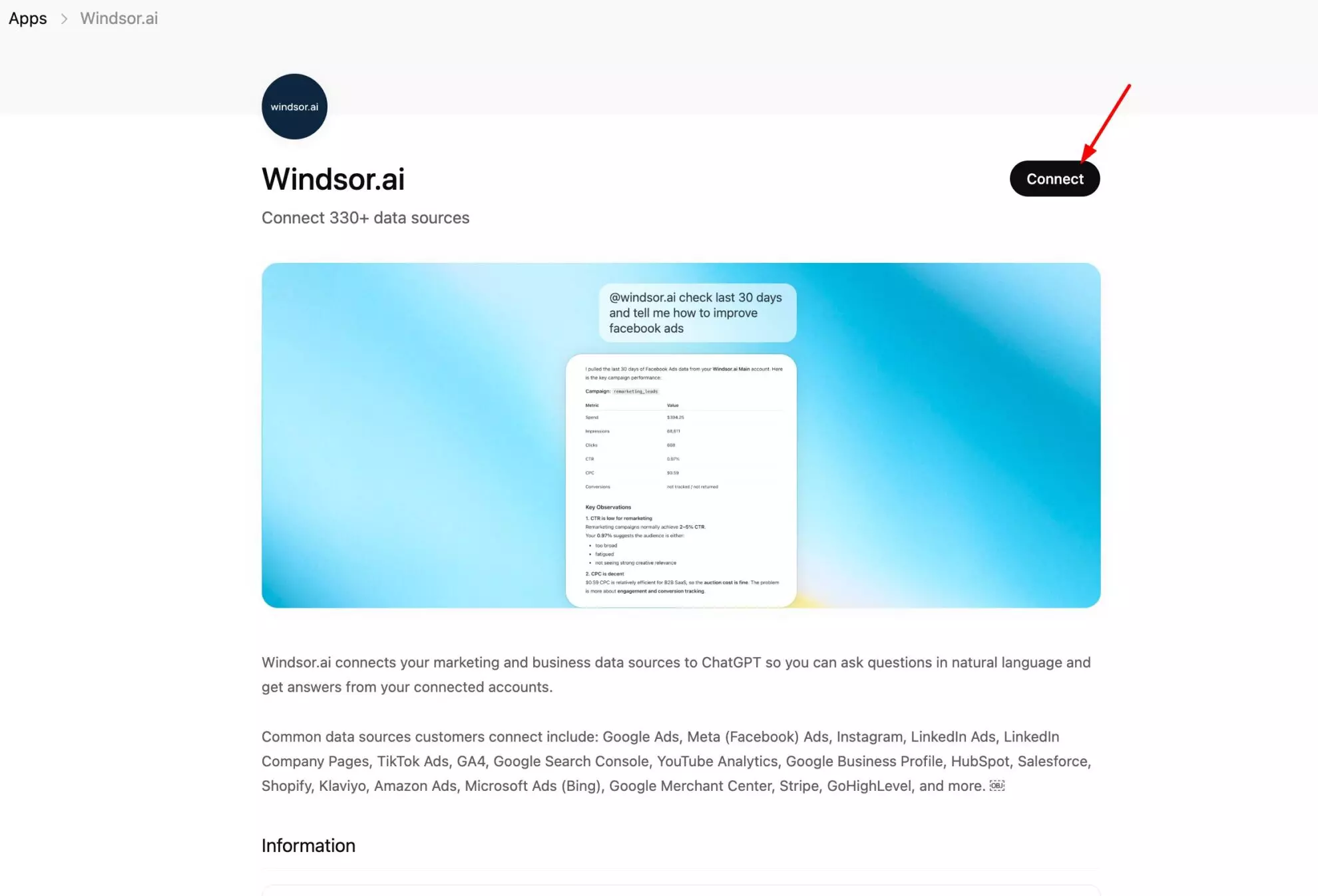
- In ChatGPT, open the apps and connectors settings and search for Windsor.ai.
- Click install and sign in to the same Windsor.ai account you used in Step 1.
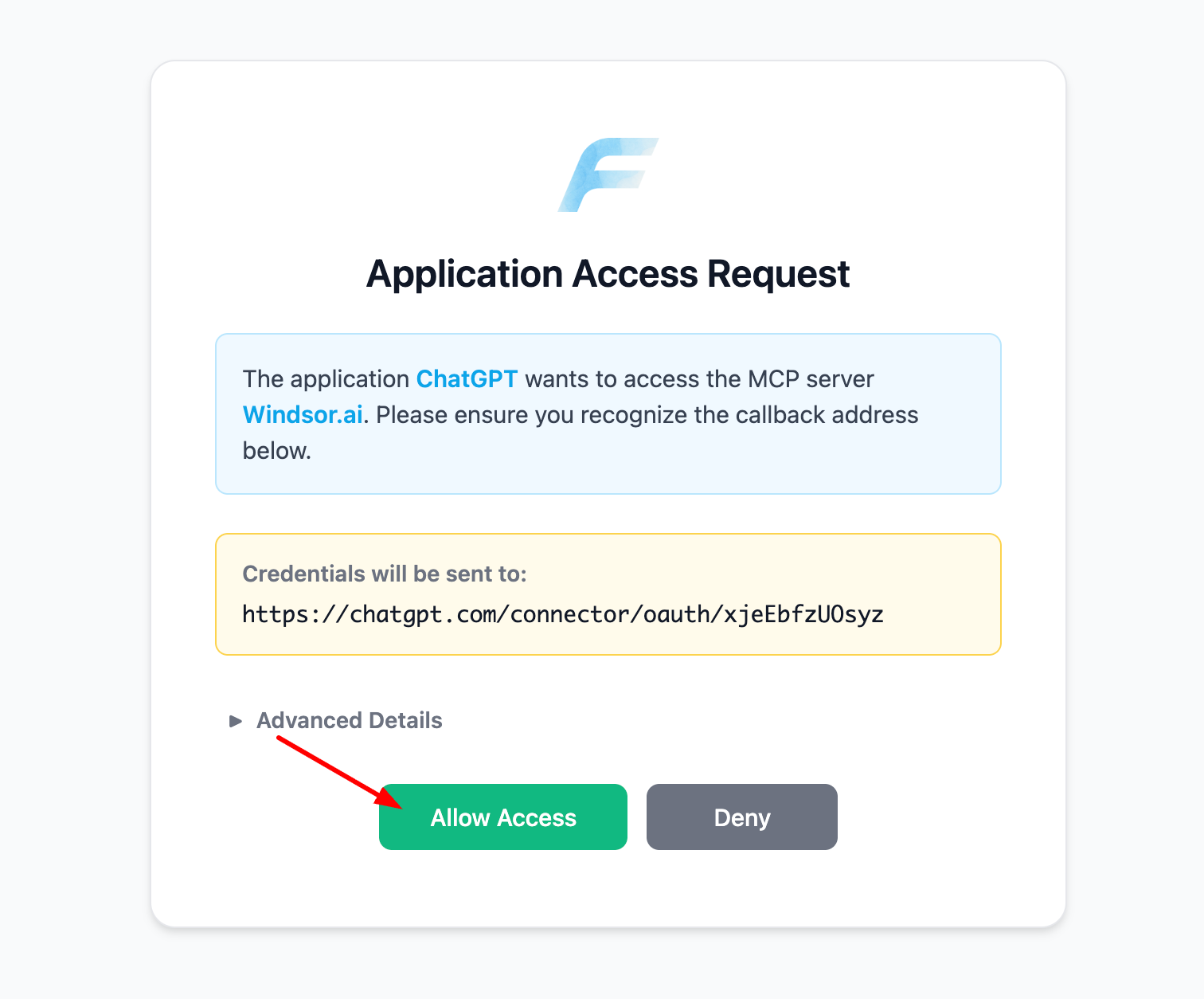
- Allow ChatGPT access to your Windsor.ai connector, then pick MediaGo from your connected sources.
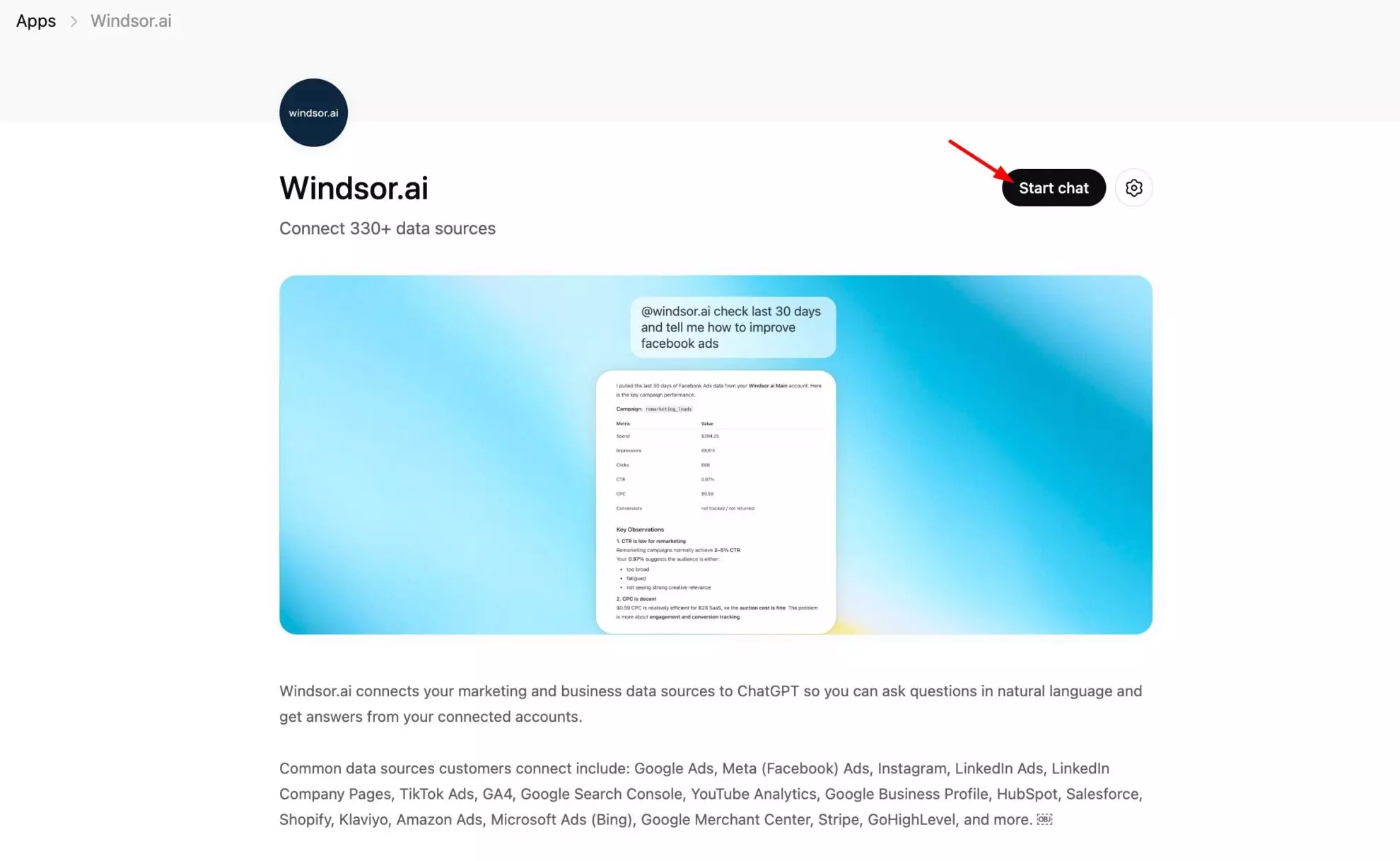
Verify it worked by asking ChatGPT:
List the data sources connected to my Windsor account. Do you see MediaGo there?If ChatGPT lists MediaGo among your connected sources, you’re ready to query your campaign data in natural language.
The metrics that matter for MediaGo
| Metric | What it tells you |
|---|---|
| Impressions | How many times your native ads were served, the top-of-funnel reach number everything else in the funnel builds on. |
| Clicks | How often someone actually engaged with an ad, letting you gauge creative and placement appeal separately from reach. |
| Spend | The real budget deployed on a campaign or placement, the baseline every efficiency metric gets measured against. |
| CPC (cost per click) | What each click actually costs, useful for spotting which campaigns or sites are getting expensive relative to the rest of your native spend. |
| Conversions | The total number of tracked actions credited to a campaign, the headline number for whether native ads are working. |
| Purchases | Conversions tagged specifically as completed purchases, the conversion type closest to actual revenue. |
| App installs | Conversions tagged as app installs, the primary KPI if you’re running MediaGo to grow app downloads rather than web sales. |
| Add to cart | An earlier funnel-stage conversion than purchase, useful for spotting campaigns that generate interest but stall before checkout. |
| Site name | Which publisher site or placement actually served the ad, so you can rank inventory by performance instead of judging the account as one block. |
| Campaign name | The campaign a row of performance data belongs to, the standard way to break spend and conversions down for reporting. |
| Daily cap and spend limit | The budget ceilings you’ve set on a campaign, useful for checking whether underperformance is a targeting problem or just a capped budget. |
| Target CPA | The cost-per-acquisition goal you configured for a campaign, so you can compare it against actual CPA and see whether optimization is on track. |
What to ask ChatGPT: prompt ideas
Spend and conversion performance
Show my total MediaGo spend, clicks, and conversions by campaign for the last 30 days, and flag which campaigns have the highest cost per purchase.
Break down MediaGo conversions by type for the last two weeks, purchases, app installs, add to cart, and everything else.
Site and placement performance
Rank my MediaGo sites by impressions and clicks for the last month, and tell me which ones are driving the most app installs.
Compare CPC across my MediaGo campaigns and highlight which ones are running above their target CPA.
Campaign configuration
List my active MediaGo campaigns with daily cap, spend limit, and target CPA next to actual spend so far this month.
The MediaGo connection through Windsor is read-only. ChatGPT can analyze your clicks, spend, and conversions, but it can’t create, pause, or edit anything inside MediaGo itself.
Bonus: analyze MediaGo alongside your full stack
Windsor connects 350+ sources, so MediaGo doesn’t have to live in its own silo. A few realistic blends:
- Blended ROAS across paid channels. Combine MediaGo spend with Google Ads and Facebook Ads spend to see one cross-channel ROAS number instead of judging native performance in isolation.
- On-site behavior from native traffic. Pair MediaGo clicks and conversions with GA4 to see what visitors from your native placements actually do once they land on your site.
- Full revenue view. Blend MediaGo conversions with your e-commerce revenue data for a complete, attribution-free view of which channels are actually driving sales.
Other ways to connect MediaGo to ChatGPT
Manual CSV export
You can export a MediaGo report as a CSV and upload it into a ChatGPT conversation. It works for a one-off question, but it’s a static snapshot the moment you download it, and every new question about fresher data means exporting and uploading again.
Zapier or Make
If MediaGo and ChatGPT both have building blocks available in Zapier or Make, you can wire up a workflow to move data between them. It’s a still-maintained workflow rather than a live connection, so it needs upkeep whenever either side changes, and it typically pushes data on a schedule rather than on demand.
Neither option gives you the live, ask-a-question-anytime view that the direct Windsor.ai connection does.
Conclusion
Connecting MediaGo to ChatGPT with Windsor.ai takes two steps and a couple of minutes, and it replaces the manual CSV routine with a live, queryable connection. Once it’s set up, ChatGPT can analyze your native ad performance, blend it with your other channels for a single source of truth, and answer follow-up questions without you touching a spreadsheet.
🚀 Ready to connect MediaGo to ChatGPT? Connect your MediaGo account to Windsor.ai, free forever plan, no credit card. Paid plans start from $19/month.
FAQs
What's the fastest, native way to connect MediaGo to ChatGPT?
Windsor.ai’s native ChatGPT app is the fastest way. It’s a one-click install inside ChatGPT’s apps and connectors settings, and it keeps your MediaGo data synced automatically once it’s linked, rather than a one-time file upload.
Do I need to know how to code to connect MediaGo to ChatGPT?
No. Both steps are point-and-click: authorize MediaGo at onboard.windsor.ai, then install Windsor’s native app in ChatGPT. There are no API keys, scripts, or custom connectors involved.
Can ChatGPT analyze my MediaGo campaign performance?
Yes. Once MediaGo is connected, you can ask ChatGPT to summarize spend, break down conversions by type, compare campaigns, or spot trends in plain language, using your live MediaGo data.
Can I connect multiple MediaGo accounts, or accounts I manage for clients?
Yes. If you manage MediaGo campaigns for multiple brands or clients, you can connect each account to Windsor.ai and query them individually or together from ChatGPT.
Which MediaGo metrics can I see in ChatGPT?
Clicks, impressions, spend, and CPC, plus conversions broken out by type: purchases, add to cart, add to wishlist, add payment info, start checkout, view content, search, lead, app install, complete registration, and an “other” bucket. These are available at the ad level, the campaign level, and the site or placement level, and can be broken down by campaign name, ad name, brand name, site or placement, and date, along with campaign settings like daily cap, spend limit, and target CPA.
Is connecting MediaGo to ChatGPT with Windsor.ai free?
Yes. Windsor has a free forever plan with no credit card required, and you can connect MediaGo and start asking ChatGPT questions on that plan. Paid plans start at $19/month if you need more sources or data volume.
How does this compare to exporting MediaGo reports manually?
A manual CSV export is a static snapshot the moment you download it, and comparing it against other channels means rebuilding the comparison by hand. The Windsor.ai connection stays live, so ChatGPT is always working from current MediaGo numbers instead of a one-time file.
Can I combine MediaGo with my other marketing data?
Yes, that’s the point. Windsor connects 350+ sources, so you can blend MediaGo with Google Ads, Facebook Ads, and other channels for one cross-channel view and a single source of truth instead of switching between dashboards.
Is the MediaGo connection secure, and can ChatGPT change anything in my account?
The connection is read-only. ChatGPT can analyze your MediaGo data through Windsor.ai, but it cannot create, pause, edit, or otherwise change campaigns, budgets, or settings inside MediaGo itself.


