 Destinations
 Data sources
 AI insights
 About us
 Careers
 Security
 Customer reviews
 Contact us
 Affiliate program
 Solution partners
 Template gallery
 Looker Studio templates
 Power BI templates
 Excel templates
 Google Sheets templates
 Tableau templates
 Facebook Ads templates
 Google Ads templates
 Data fields & Metrics
 AI prompt library & Guides
 Product documentation
 API documentation
 Case studies
 Blog
Blog Data models
 Windsor vs Supermetrics
 Windsor vs Funnel.io
 Windsor vs Fivetran
 Windsor vs Rivery
 Windsor vs Portermetrics
 Windsor vs Coupler.io
 Last updated: 31 August 2026




You connect Square to ChatGPT by linking your Square account to Windsor.ai and installing Windsor’s native app inside ChatGPT, a two-step, no-code setup that takes under a minute. Once it’s connected, you can ask ChatGPT about your Square sales, payments, and loyalty data in plain language instead of pulling reports by hand.
Square’s own dashboard is built for running a single location day to day, not for asking open-ended questions or combining that data with other channels. Pulling a CSV every time you want to check sales trends or loyalty activity is slow, and it keeps Square sitting in its own silo, disconnected from your other sales and marketing data. Connecting through Windsor.ai’s native ChatGPT app removes both problems at once.
2 steps to connect Square to ChatGPT
Takes under a minute, no code or manual CSV work required.
Full walkthrough: Windsor’s documentation on integrating data into ChatGPT.
Prerequisites
- A Windsor.ai account (free forever plan available, no credit card required, or paid from $19/month).
- A Square account with at least one active location or store processing orders and payments.
- A ChatGPT account on a plan that supports apps and connectors.
Step 1. Connect Square to Windsor.ai
- Create a free account at onboard.windsor.ai/app/square.
- Select Square as your data source.
- Authorize Windsor.ai to access your Square account.
- Connect additional Square locations or accounts too, if you manage more than one.
Step 2. Connect the Windsor.ai app in ChatGPT
In ChatGPT, open the apps menu and add the Windsor.ai app. Approve the access request, and Windsor’s connectors, including Square, become available inside your chats.
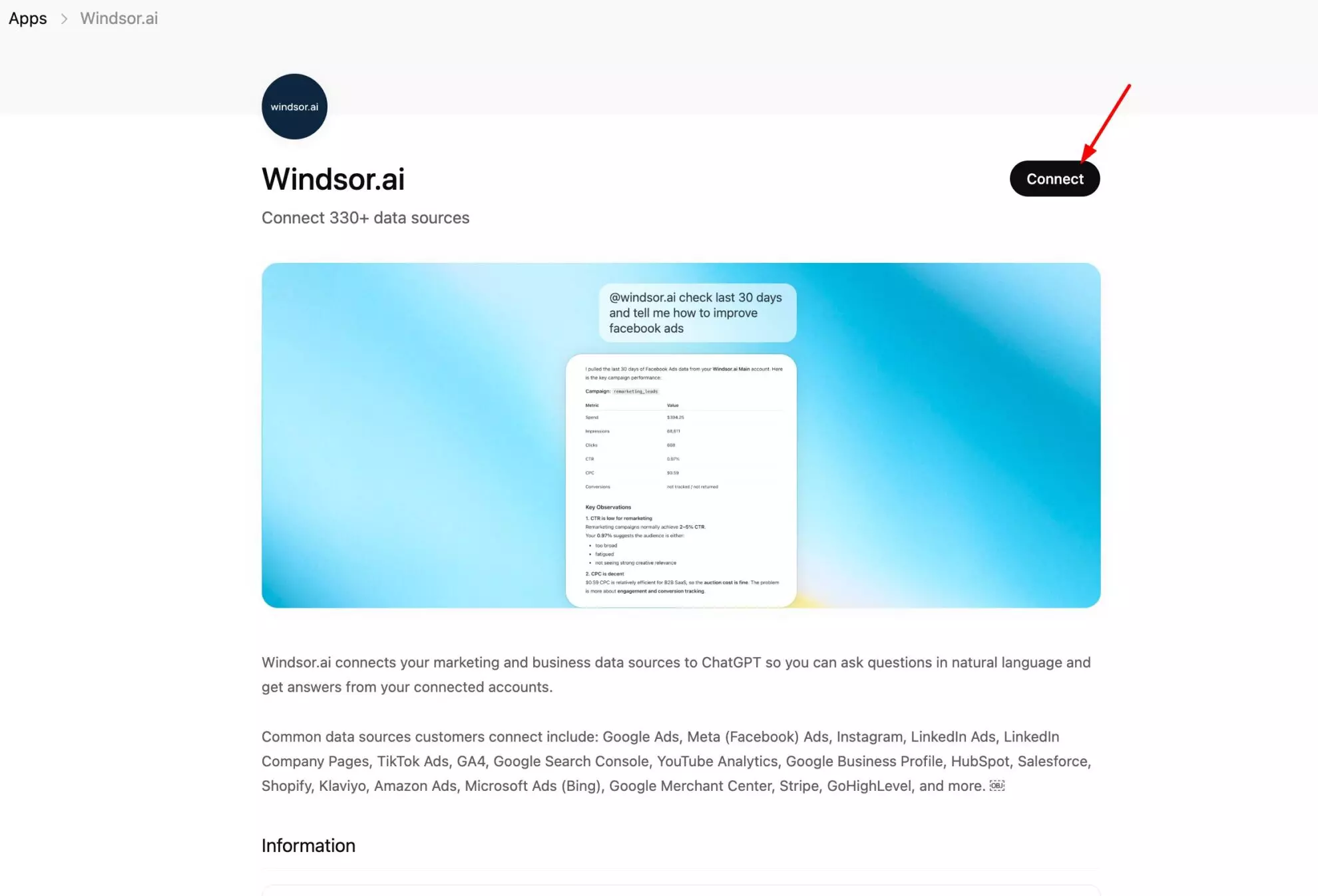
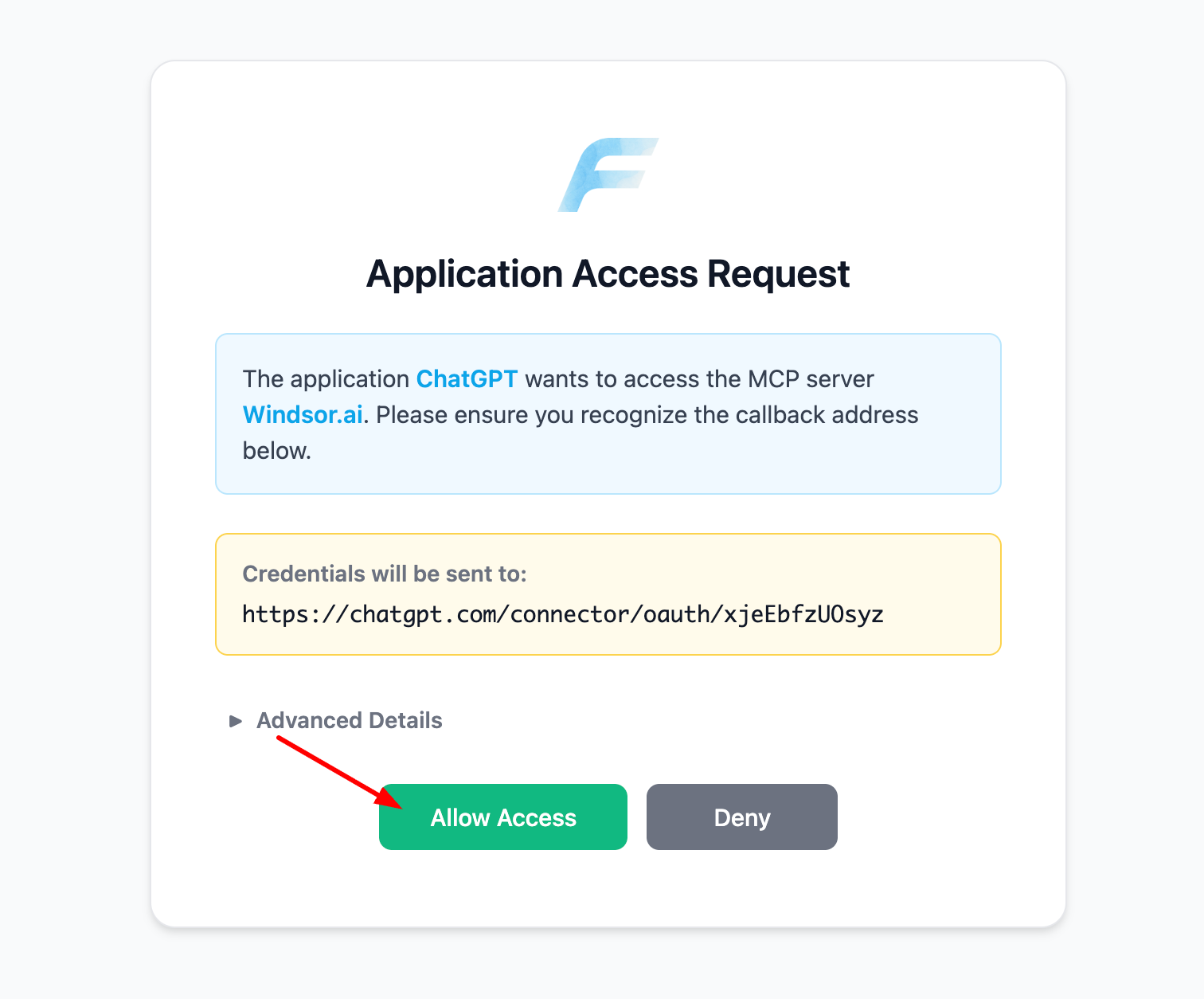
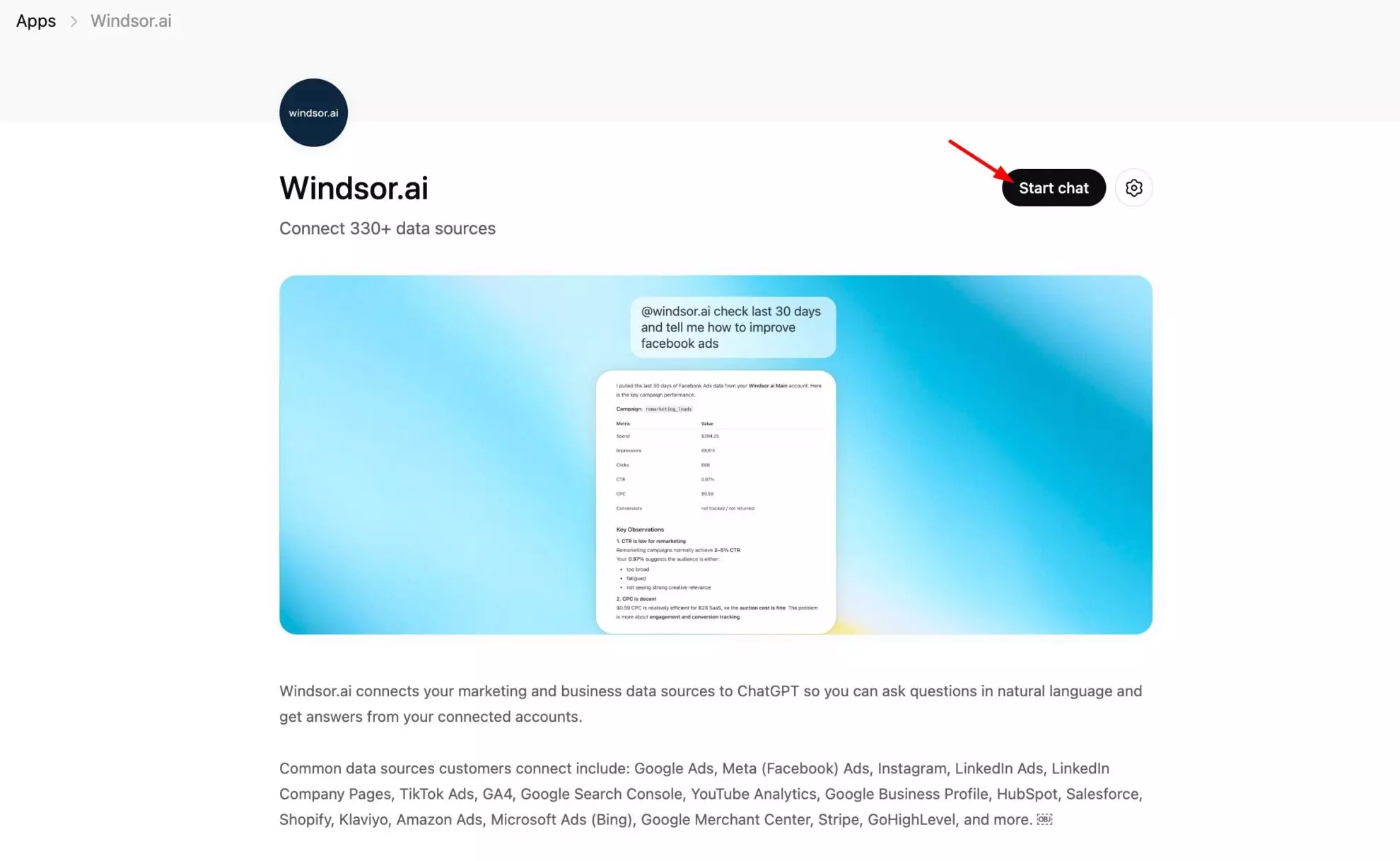
Confirm the connection is live by asking ChatGPT to check it:
List the data sources connected to my Windsor account. Do you see Square there?Once Square shows up in that list, you’re ready to query your point-of-sale and payments data in natural language.
The metrics that matter for Square
| Metric | What it tells you |
|---|---|
| Payment Total | The full amount charged to the customer on a payment, including tips and tax, your core per-transaction revenue number. |
| Payment Amount Requested | The base amount requested before any adjustments, the starting point for reconciling what a payment actually settled for. |
| Payment Amount Approved | What the card issuer or payment method actually approved, a gap against the requested amount flags declines or partial approvals. |
| Order Net Amount | The net value of an order after discounts and refunds are applied, the real revenue figure behind each sale. |
| Loyalty Balance | How many loyalty points a customer currently holds, a live read on active loyalty engagement. |
| Loyalty Lifetime Points | The total points a customer has ever earned, a proxy for long-term customer value and repeat visits. |
| Order State | Whether an order is open, completed, or canceled, showing where it sits in the fulfillment pipeline right now. |
| Order Location | Which store or location an order was placed at, essential for comparing performance across multiple sites. |
| Payment Status | Whether a payment completed, failed, or is still pending, the first signal to check for payment health issues. |
| Payment Source Type | How the customer paid, card, cash, or another tender type, showing which payment methods your customers actually use. |
| Inventory Quantity | The stock count for an item at a given location, useful for tracking sell-through and restocking needs. |
What to ask ChatGPT: prompt ideas
Sales and transaction performance
Show my total payment amount and order net amount by day for the last 30 days.
Compare requested versus approved payment amounts for the past week and flag any gaps.
Location comparison
Break down order net amount by location for this month and rank my top-performing stores.
Loyalty and customer engagement
Show me total loyalty balance and lifetime points across my customers, and flag anyone close to a reward threshold.
List orders with a canceled state this week so I can follow up on what went wrong.
The Square connection through Windsor.ai is read-only. It’s built for analysis, not for creating orders, issuing refunds, or changing loyalty balances from inside ChatGPT.
Bonus: analyze Square alongside your full stack
Windsor connects 350+ sources, so Square doesn’t have to live in its own silo. A few realistic blends:
- Blended ROAS across paid and in-person sales. Combine Square’s payment totals with Google Ads and Facebook Ads spend to see one cross-channel ROAS number instead of guessing how your ad budget is influencing walk-in and online sales separately.
- Online behavior tied to real sales. Pair Square’s order net amount with GA4 session and conversion data to see which online behavior actually turns into a completed sale, not just a checkout attempt.
- Single revenue view across channels. Blend Square’s payment and order data with your inventory or e-commerce platform for one blended revenue number across in-person and online sales, instead of reconciling two spreadsheets by hand.
Other ways to connect Square to ChatGPT
Manual CSV export
You can export sales, payment, or item reports from the Square dashboard as CSV files and upload them into a ChatGPT conversation. It works, but it’s a static snapshot the moment you export it, and you have to repeat the export and upload every time you want current numbers.
Zapier or Make
Zapier and Make can move Square data into other tools when a specific event happens, like a new order or payment. That’s a still-maintained workflow for automation, but it’s built for moving records between apps, not for open-ended analysis inside a chat.
Neither approach gives you the live, queryable view that the direct Windsor.ai connector does.
Conclusion
Connecting Square to ChatGPT through Windsor.ai’s native app takes two steps and no code: link Square to Windsor.ai, then install the Windsor.ai app in ChatGPT. From there, your point-of-sale and payments data is ready to query in plain language, alongside any other source you connect.
🚀 Ready to connect Square to ChatGPT? Connect Square to Windsor.ai free and start asking questions in minutes.
FAQs
What's the fastest way to connect Square to ChatGPT?
The native Windsor.ai app is the fastest route. It’s a two-step setup, connect Square to Windsor.ai, then add the Windsor.ai app in ChatGPT, and takes under a minute. Custom connector URLs or manual exports both take longer and require more upkeep.
Do I need any code to connect Square to ChatGPT?
No. Both steps are point-and-click: authorizing Square inside Windsor.ai, and installing the Windsor.ai app from ChatGPT’s apps menu. No API keys, scripts, or developer setup are required.
Can ChatGPT analyze my Square sales performance?
Yes. Once Square is connected, you can ask ChatGPT to summarize order net amounts, payment amounts, and loyalty activity in plain language, for a day, a week, or any date range you choose.
Can I connect multiple Square accounts or locations?
Yes. Windsor.ai supports connecting multiple Square accounts or locations, which is useful for agencies or multi-location retail and restaurant businesses that need to compare performance across sites.
Which metrics and dimensions does the Square connector include?
The connector returns 214 fields in total: 15 metrics and 199 dimensions. The metrics that matter for reporting are loyalty balance, loyalty lifetime points, order net amount, and payment amount (requested, approved, and total). The remaining metrics are record “version” numbers used for sync and change tracking, not business figures. Dimensions cover details like bank account information, cash drawer activity, and the standard account and date fields.
What are the Square "version" fields I see in the metric list?
Fields like orders.version or items.version are revision numbers Square assigns each time a record changes, used to keep systems in sync. They’re counted among the connector’s 15 metrics because they’re numeric, but they aren’t business metrics and shouldn’t be read as counts of anything.
Is connecting Square to Windsor.ai free?
Windsor.ai offers a free forever plan with no credit card required, which covers connecting Square to ChatGPT. Paid plans start from $19/month for higher usage and additional features.
Can I manage or update Square data from ChatGPT?
No. The Square connection through Windsor.ai is read-only. It’s built for analyzing sales, payments, and loyalty data, not for creating orders, processing refunds, or editing records from inside ChatGPT.
How does this compare to exporting CSVs from Square manually?
A CSV export is a static snapshot from the moment you download it, and you have to repeat the export every time you want current numbers. The Windsor.ai connection stays live, so ChatGPT always answers from up-to-date Square data.
Can I combine Square data with other sales or marketing channels?
Yes. Windsor.ai blends over 350+ sources, so you can bring Square alongside your ad platforms, e-commerce, or CRM data into the same conversation for blended, cross-channel reporting instead of checking each source separately.


