 Destinations
 Data sources
 AI insights
 About us
 Careers
 Security
 Customer reviews
 Contact us
 Affiliate program
 Solution partners
 Template gallery
 Looker Studio templates
 Power BI templates
 Excel templates
 Google Sheets templates
 Tableau templates
 Facebook Ads templates
 Google Ads templates
 Data fields & Metrics
 AI prompt library & Guides
 Product documentation
 API documentation
 Case studies
 Blog
Blog Data models
 Windsor vs Supermetrics
 Windsor vs Funnel.io
 Windsor vs Fivetran
 Windsor vs Rivery
 Windsor vs Portermetrics
 Windsor vs Coupler.io
 Last updated: 31 August 2026




The fastest way to connect Airtable to ChatGPT is to install Windsor.ai’s native ChatGPT app: connect your Airtable account to Windsor once, then add the Windsor.ai app inside ChatGPT so it can read your bases, tables, and records directly in the chat, no code required.
The alternative is exporting a view from Airtable as a CSV every time someone needs an answer, then rebuilding the same pivot table again a week later. That works for a one-off check, but it leaves your operational data siloed from the rest of your stack and stale the moment you close the spreadsheet. Connecting Airtable to Windsor keeps your bases live and queryable in ChatGPT instead.
2 steps to connect Airtable to ChatGPT
Takes under a minute, no code or manual CSV work required.
See the full walkthrough in the Windsor.ai documentation.
Prerequisites
- A Windsor.ai account (free forever plan, no credit card, or paid from $19/month)
- An Airtable account with at least one base set up
- A ChatGPT account that can install apps or connectors
Step 1. Connect Airtable to Windsor.ai
Start on the Windsor.ai side:
- Create a free Windsor.ai account, or log in if you already have one
- Go to onboard.windsor.ai/app/airtable and select Airtable
- Authorize Windsor to access your Airtable account
- Repeat the process to connect additional Airtable accounts if you manage bases across multiple workspaces or clients
Step 2. Connect the Windsor.ai app in ChatGPT
Now install the native app inside ChatGPT:
- Open ChatGPT and go to Settings > Connectors (or Apps)
- Search for “Windsor.ai” and install it
- Allow Windsor.ai access when prompted
- Confirm the app appears in your connected apps list
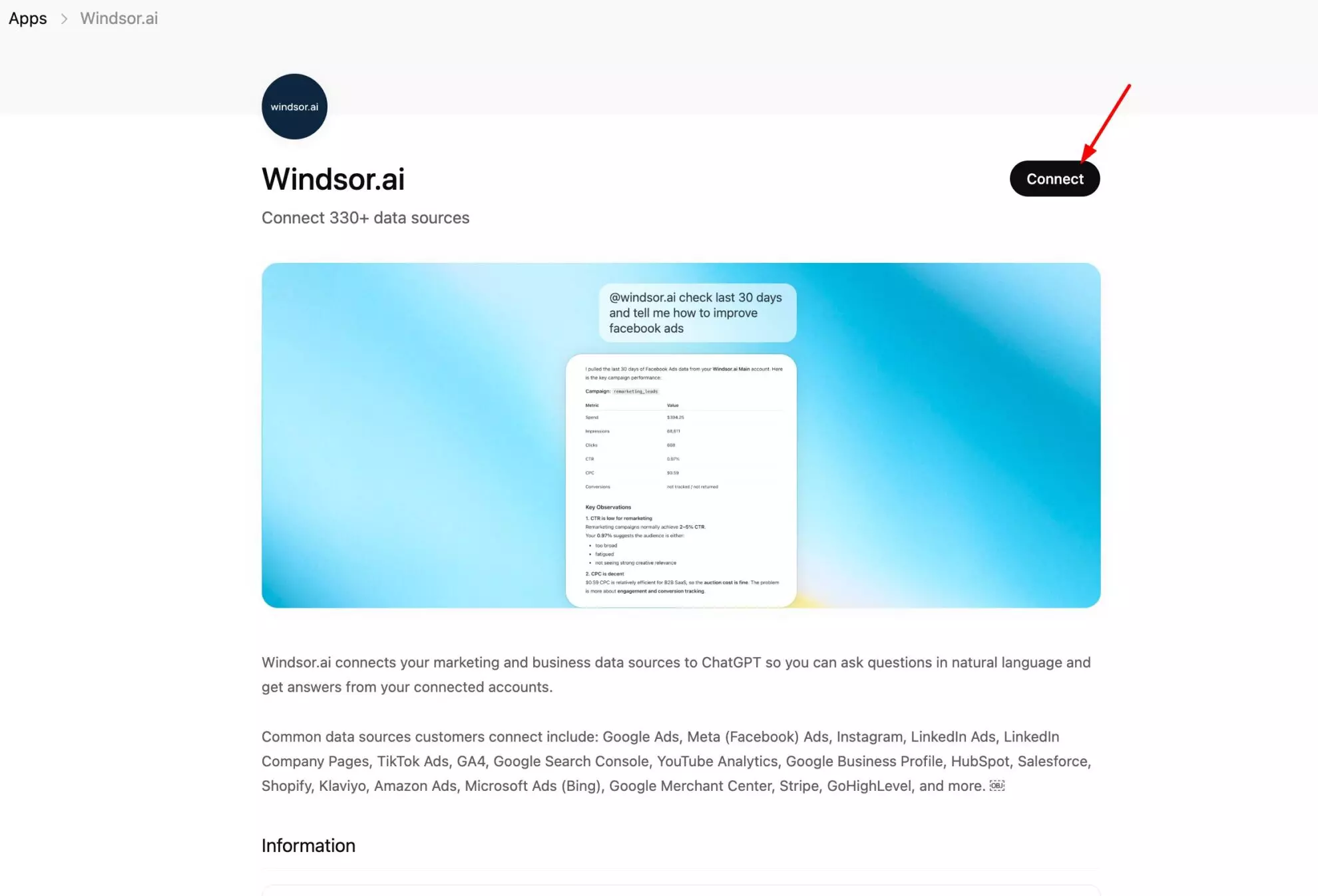
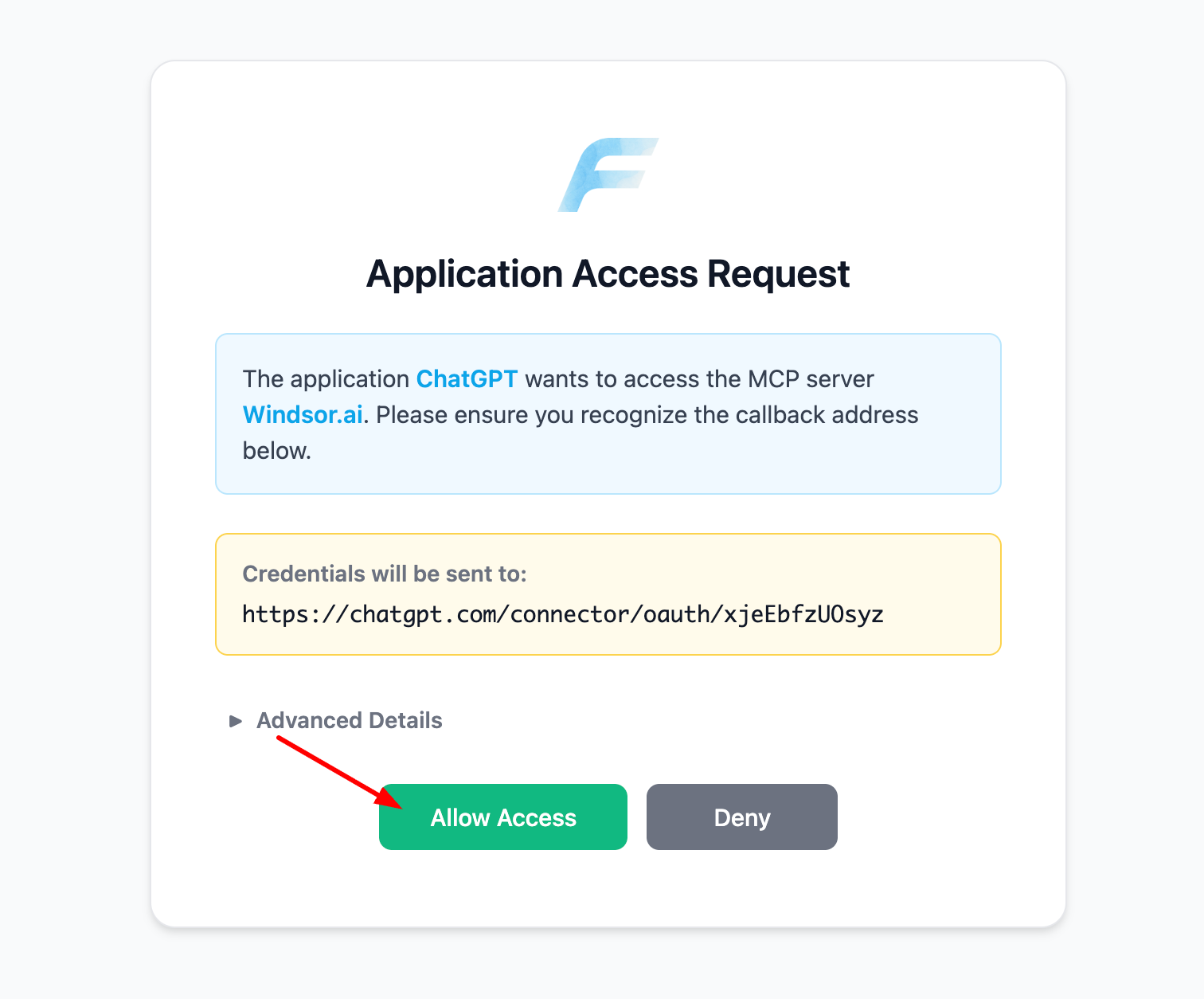
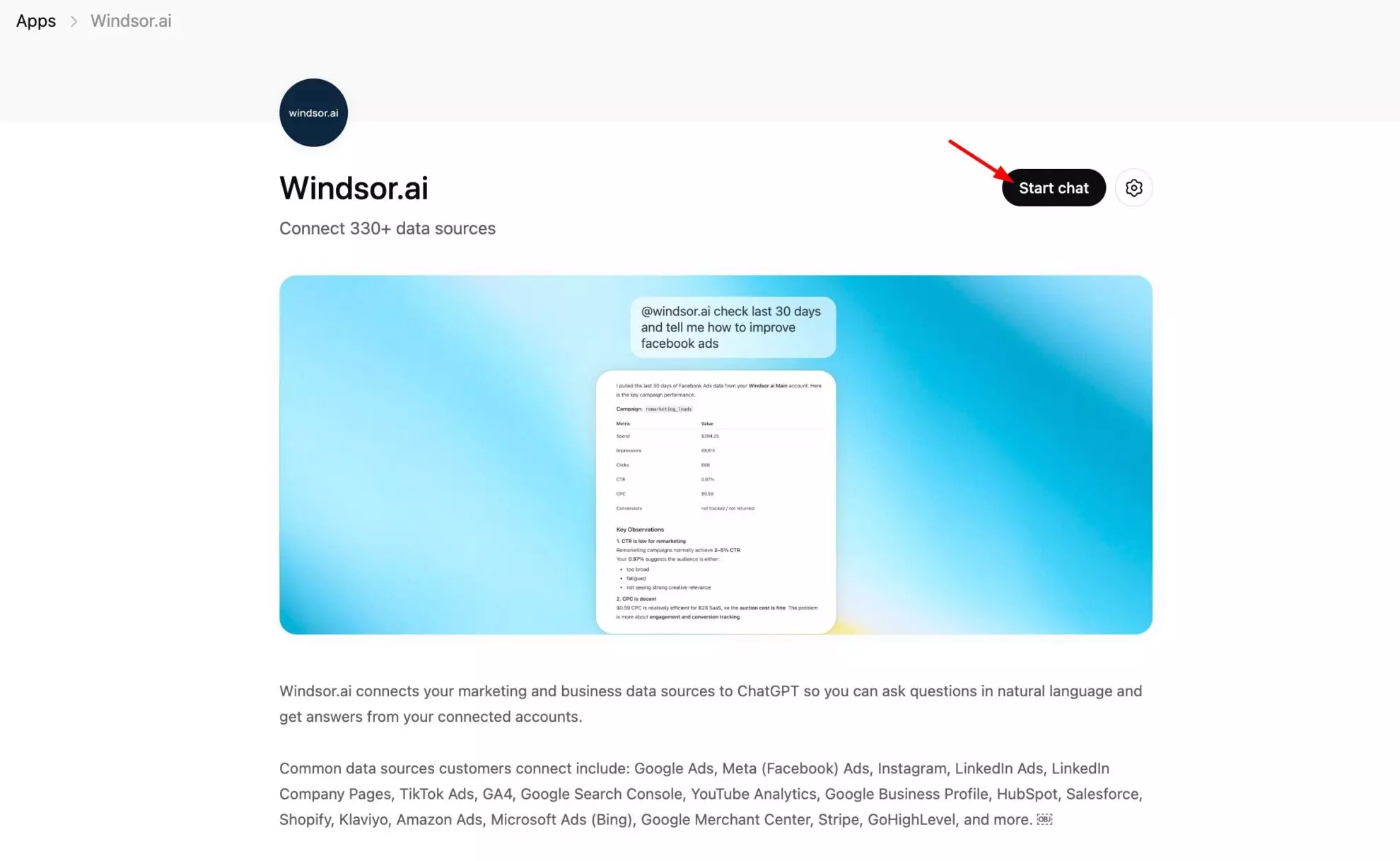
Confirm the connection is live by asking ChatGPT:
List the data sources connected to my Windsor account. Do you see Airtable there?If Airtable shows up, you’re ready to query your bases and records in plain English.
The metrics that matter for Airtable
| Field | What it tells you |
|---|---|
| Date | The date tied to a record’s activity, the field you’ll filter or trend by most often. |
| Data Source | Confirms which Windsor connector a row came from, useful once you’re blending Airtable with other sources in the same ChatGPT conversation. |
| Data fetched at | The exact UTC moment Windsor pulled that row into its cache, so you know how fresh a given result is before you trust it in a report. |
| Now | The current timestamp at the moment of the query, useful for calculating how long a record has been sitting in a given status. |
| Today | Today’s date, useful for filtering or comparing results against a fixed as-of day inside a prompt. |
| Week | Groups records into a Sunday-to-Saturday week, useful for weekly throughput or velocity comparisons. |
| Month | Groups records by calendar month, the basis for month-over-month trend questions. |
| Year | Groups records by year, useful once you’re comparing activity across longer stretches of time. |
| Year month name | A ready-made “Jan 2025”-style label, handy for building month-over-month charts without extra date math. |
| Day of week | Tells you which day of the week a record’s activity fell on, useful for spotting patterns like which day items usually change status. |
What to ask ChatGPT: prompt ideas
Base and table overview
List every base and table connected through Windsor.ai and how many records are in each.
Show me how record counts in my `Content Calendar` table have changed over the last 30 days.
Record-level analysis
Find every record in my `Deals` table where the `Status` field hasn't changed in the last 14 days, and group them by owner.
Workload and themes
Summarize the `Notes` or `Feedback` field across my Airtable records from the last 60 days and group the recurring themes.
The Airtable connection through Windsor is read-only. ChatGPT can analyze your bases, tables, and records, but it can’t create, edit, or delete anything inside Airtable itself.
Bonus: analyze Airtable alongside your full stack
Windsor connects 350+ sources, so Airtable doesn’t have to live in its own silo. A few realistic blends:
- Cross-channel reporting. Whatever you track in Airtable, a campaign tracker, a lead list, a content calendar, combine it with live performance data from Facebook Ads or Google Ads so your operational data and your ad performance sit in the same conversation instead of two separate tools.
- Single source of truth. Windsor connects 350+ sources, so your Airtable bases can sit alongside your CRM, ad platforms, and analytics tools like GA4 in one queryable location instead of being the one system nobody else checks.
- Blended ROAS. Pair the costs or results you track in an Airtable base with live ad spend from your connected platforms to see a real cross-channel ROAS instead of stitching two exports together by hand.
Other ways to connect Airtable to ChatGPT
Manual CSV export
You can export a table from Airtable as a CSV and upload it to ChatGPT for a one-off analysis. It works, but it’s a static snapshot: every time a record changes you have to re-export and re-upload the file by hand.
Zapier or Make
Zapier or Make can move Airtable records into a spreadsheet or database on a schedule. That’s a reasonable automated workflow, but it still needs to be built and maintained separately, and it doesn’t give ChatGPT a live, queryable connection to Airtable the way the native Windsor.ai app does.
Neither approach gives you the same live view as connecting Airtable to Windsor directly.
Conclusion
Connecting Airtable to ChatGPT through Windsor.ai takes two steps: link your Airtable account to Windsor, then install the Windsor.ai app in ChatGPT. From there you can ask plain-language questions about your bases, tables, and records, and blend that data with your other channels for a single source of truth, without exporting a single CSV.
🚀 Ready to connect Airtable to ChatGPT? Connect your Airtable account to Windsor.ai and start querying your bases in minutes.
FAQs
What's the fastest way to connect Airtable to ChatGPT?
The native Windsor.ai app is the fastest way. It takes under a minute, connects Airtable natively, and doesn’t require exporting or uploading any files.
Do I need any coding or technical setup?
No. Connecting Airtable to ChatGPT through Windsor.ai is a no-code process: authorize the Airtable connection, then install the app in ChatGPT.
Can ChatGPT actually analyze my Airtable data?
Yes. Once connected, you can ask ChatGPT plain-language questions about your bases, tables, and records, and it will pull the live data through Windsor.
Can I connect multiple Airtable accounts, for example for an agency?
Yes. You can connect multiple Airtable accounts to Windsor.ai, which is useful if you manage bases across several workspaces or client accounts and want to see them all from the same ChatGPT conversation.
Which Airtable fields are available in Windsor?
That depends entirely on your own bases. Airtable lets you build completely custom tables and fields, so Windsor doesn’t return a predetermined list of metrics the way it does for a fixed-schema ad platform. Once connected, it exposes whatever bases, tables, and records actually exist in your account, whether that’s a CRM, a content calendar, or a project tracker, along with standard fields like the record date, when the data was last fetched, and the connected data source.
How much does it cost to connect Airtable to Windsor.ai?
Windsor.ai has a free forever plan with no credit card required, which covers connecting Airtable to ChatGPT. Paid plans start from $19/month for higher usage needs.
Is this better than exporting Airtable data as a CSV?
A CSV export is a static snapshot that goes out of date as soon as a record changes. Connecting Airtable to Windsor keeps the data live, so ChatGPT is always working from current records instead of a manually re-exported file.
Can I combine Airtable with data from my other marketing channels?
Yes. Windsor connects to 350+ data sources, so you can blend Airtable alongside platforms like Google Ads and Facebook Ads in the same ChatGPT conversation for cross-channel, blended reporting instead of checking each tool on its own.
Is the connection secure, and can ChatGPT change anything in my Airtable account?
The Airtable connection through Windsor is read-only. ChatGPT can analyze your bases, tables, and records, but it cannot create, edit, or delete anything inside Airtable.


