 Destinations
 Data sources
 AI insights
 About us
 Careers
 Security
 Customer reviews
 Contact us
 Affiliate program
 Solution partners
 Template gallery
 Looker Studio templates
 Power BI templates
 Excel templates
 Google Sheets templates
 Tableau templates
 Facebook Ads templates
 Google Ads templates
 Data fields & Metrics
 AI prompt library & Guides
 Product documentation
 API documentation
 Case studies
 Blog
Blog Data models
 Windsor vs Supermetrics
 Windsor vs Funnel.io
 Windsor vs Fivetran
 Windsor vs Rivery
 Windsor vs Portermetrics
 Windsor vs Coupler.io
 Last updated: 31 August 2026




You can connect AppsFlyer to ChatGPT in two steps using Windsor.ai’s native ChatGPT app: link your AppsFlyer account to Windsor.ai, then install the Windsor.ai app inside ChatGPT so it can pull your mobile attribution data on request, in plain language.
AppsFlyer’s own dashboard is built for attribution reporting, not for quickly asking a natural-language question about installs, cost per install, or in-app events alongside the rest of your marketing stack. Exporting CSVs from AppsFlyer every time you want to compare it against your ad spend elsewhere is slow, and the result is a static snapshot that’s out of date the moment you save it. Connecting through Windsor.ai’s native app solves both problems: ChatGPT gets live access to your AppsFlyer data, and can blend it with 350+ other sources in the same conversation.
2 steps to connect AppsFlyer to ChatGPT
Takes under a minute, no code or manual CSV work required.
For the full walkthrough, see Windsor’s documentation on how to integrate data into ChatGPT.
Prerequisites
- A Windsor.ai account (free forever plan, no credit card, or paid from $19/month).
- An AppsFlyer account with at least one app tracked and reporting data.
- A ChatGPT account with access to install apps.
Step 1. Connect AppsFlyer to Windsor.ai
- Create a free Windsor.ai account, or log in if you already have one.
- Go to onboard.windsor.ai/app/appsflyer and select AppsFlyer from the connector list.
- Authorize the connection with your AppsFlyer credentials, and repeat the step for any additional apps you track.
Step 2. Connect the Windsor.ai app in ChatGPT
In ChatGPT, install Windsor’s native app to give it access to the AppsFlyer account you just connected.
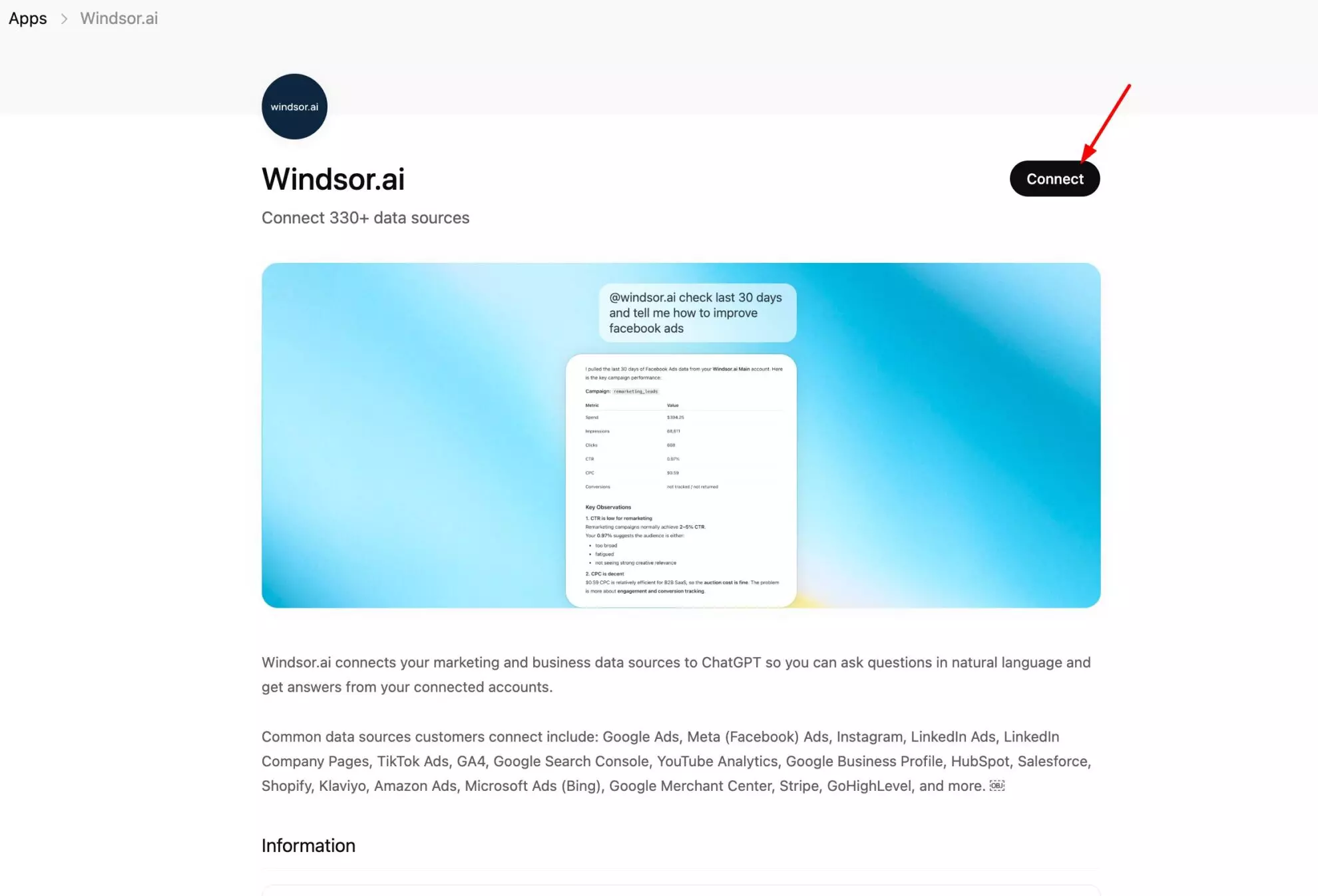
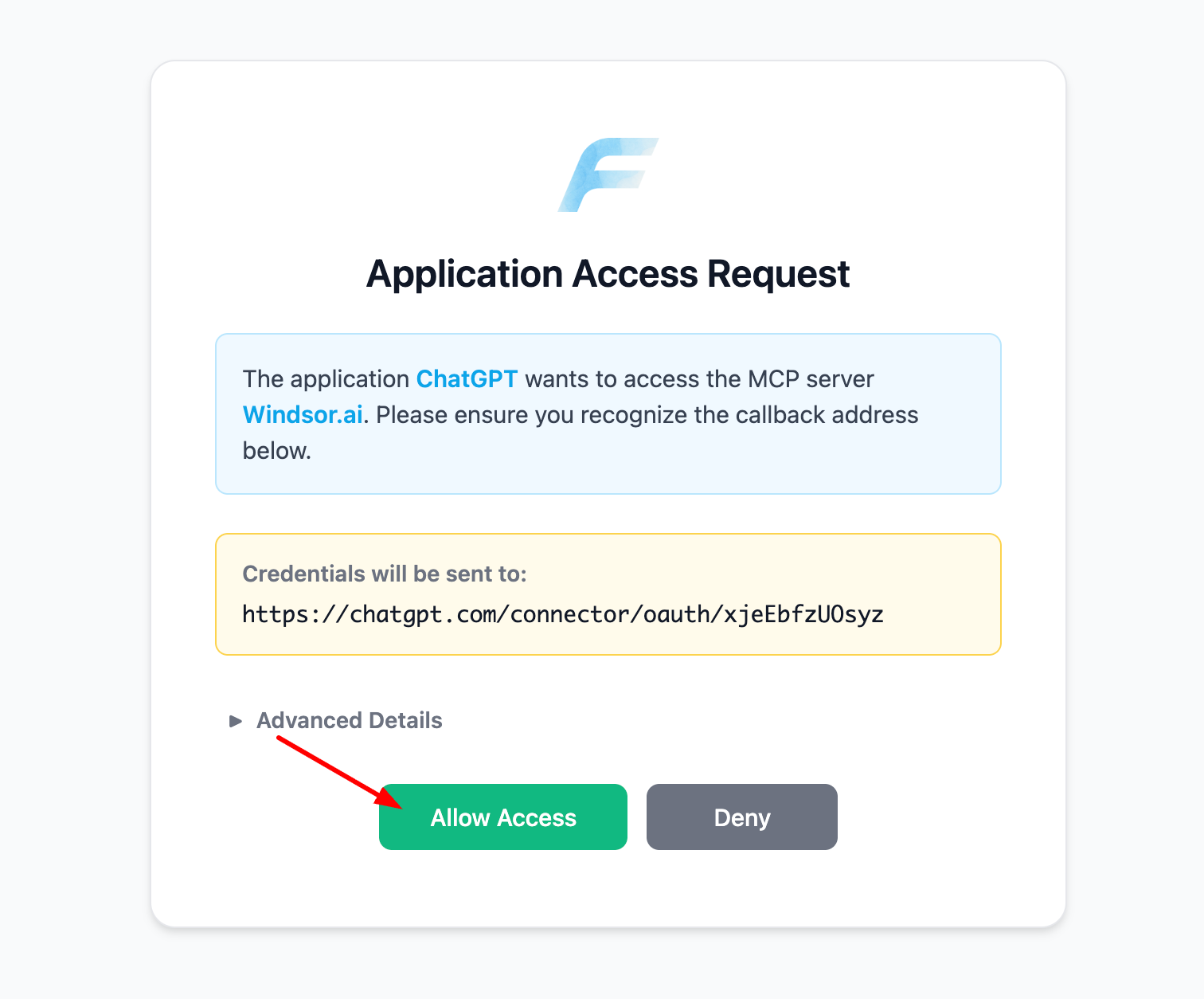
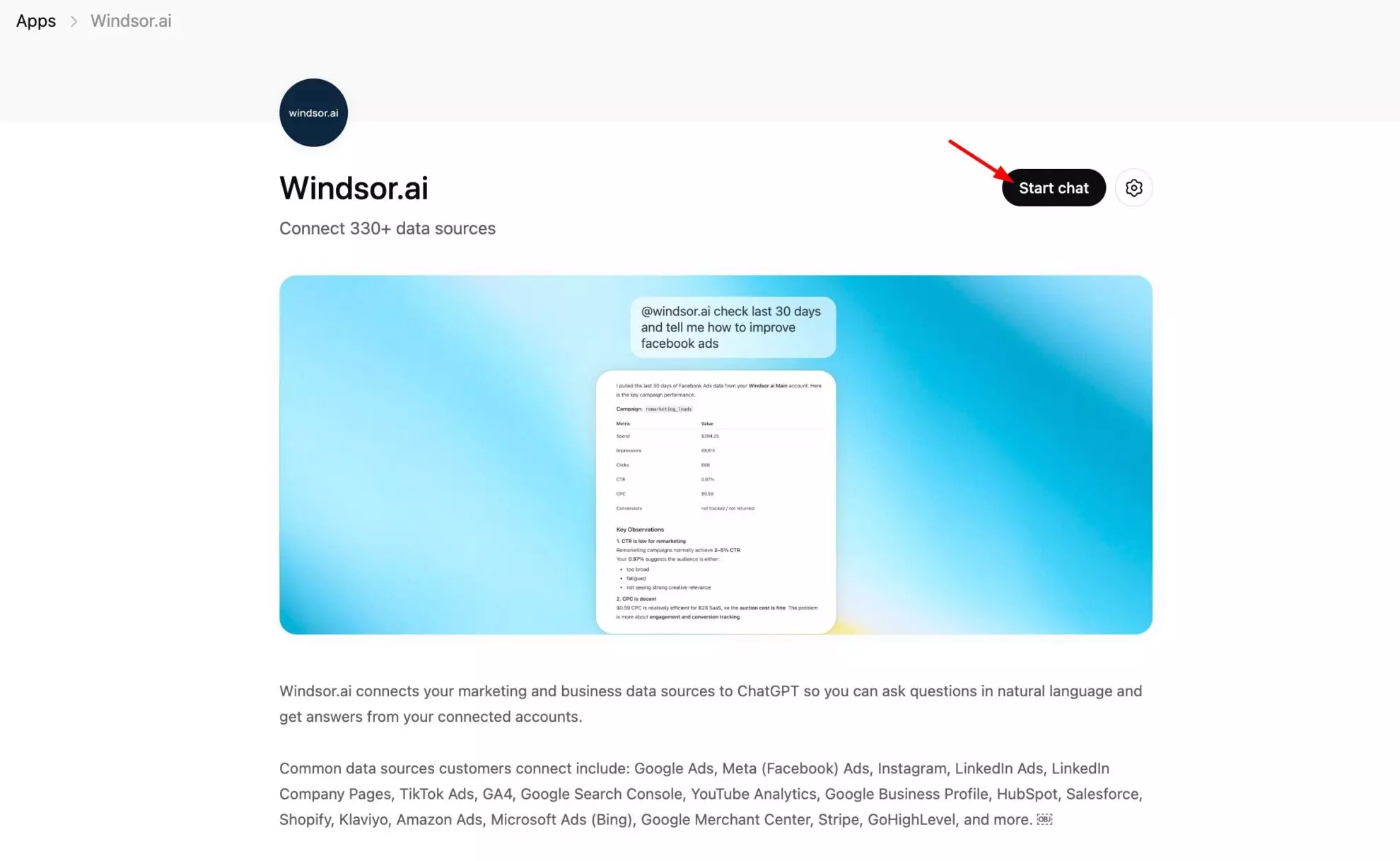
Once it’s installed, confirm the connection by asking ChatGPT:
List the data sources connected to my Windsor account. Do you see AppsFlyer there?If AppsFlyer shows up in the list, you’re ready to query your mobile attribution data in natural language.
The metrics that matter for AppsFlyer
| Metric | What it tells you |
|---|---|
| Installs | How many times your app was installed in the period, the base volume metric for measuring campaign reach. |
| Clicks | How many times people clicked an ad through to your app, a signal of how relevant your creative and targeting are. |
| Impressions | How many times your ads were shown, giving you the reach behind your clicks and installs. |
| CTR | What share of impressions turned into clicks, a read on how compelling your ad creative is. |
| Conversion rate | What share of clicks turned into installs, showing how well your targeting and store listing convert traffic. |
| Average eCPI | The effective cost you paid per install, letting you compare acquisition efficiency across partners and campaigns. |
| Cost Value | The media spend attributed to a partner, campaign, or adset, the basis for working out cost per install and ROI. |
| ARPU | The average revenue generated per installed user, useful for judging the long-term value of the users you’re acquiring. |
| Event Revenue | The total revenue tied to in-app events like purchases, showing which sources drive real monetization, not just installs. |
| Event Counter – af_purchase | How many purchase events were logged, a direct read on buying activity from the users you acquired. |
| Loyal Users | How many installed users came back to the app multiple times, an early signal of retention quality. |
| ROI | The return on investment for a given partner or campaign, telling you whether the ad spend is paying off. |
What to ask ChatGPT: prompt ideas
Attribution and install performance
Compare my AppsFlyer installs and average eCPI by partner for the last 30 days, and flag any partner where cost per install rose more than 20% week over week.
Break down my installs and conversion rate by campaign and adset for the last 7 days.
Cohort and retention analysis
Show my loyal users and ARPU by adset over the last quarter, and tell me which adsets are bringing back the most engaged users.
Media source and campaign efficiency
Show my af_purchase event revenue by partner for this month, and compare it against my Google Ads spend for the same period.
Calculate my clicks, impressions, and CTR by partner for the last 30 days, and rank partners from most to least efficient.
The AppsFlyer connection through Windsor is read-only. ChatGPT can analyze your installs, cost, and event data, but it can’t create, edit, or pause anything inside AppsFlyer itself.
Bonus: analyze AppsFlyer alongside your full stack
Windsor connects 350+ sources, so AppsFlyer doesn’t have to live in its own silo. A few realistic blends:
- Blended CPA across UA channels. Combine AppsFlyer installs and attribution with ad spend from Google Ads, Meta Ads, and TikTok Ads to see one true blended cost per install and ROAS across every paid UA channel you run.
- Installs vs. real engagement. Pair AppsFlyer installs with in-app event data from Amplitude or Mixpanel to see which channel brings users who actually open and use the app, not just tap install.
- Full LTV view. Blend AppsFlyer’s install and event revenue with your billing or CRM revenue data for a single lifetime-value picture across every channel driving users.
Other ways to connect AppsFlyer to ChatGPT
Manual CSV export
You can export a report from AppsFlyer as a CSV and upload it to ChatGPT for a one-off analysis. It works, but it’s a static snapshot that’s already outdated by the time you upload it, and you’ll need to repeat the export every time you want fresh numbers.
Zapier or Make
You can build a Zapier or Make workflow to move AppsFlyer data elsewhere on a schedule. It’s a workflow you have to build and keep maintaining, and it still doesn’t put the data directly into a ChatGPT conversation the way a native connector does.
Neither approach gives you the live, queryable view that connecting AppsFlyer directly to Windsor.ai does.
Conclusion
Connecting AppsFlyer to ChatGPT through Windsor.ai takes two steps and no code: link your AppsFlyer account to Windsor, then install the Windsor.ai app in ChatGPT. From there, you can ask questions about installs, cost per install, and in-app events in plain language, and blend them with data from every other channel you run.
🚀 Ready to connect AppsFlyer to ChatGPT? Connect AppsFlyer to Windsor.ai and start asking ChatGPT about your mobile app data today.
FAQs
What's the fastest way to connect AppsFlyer to ChatGPT?
The native Windsor.ai app is the fastest way. It takes about a minute and doesn’t require exporting files or writing any code.
Do I need to write any code to connect AppsFlyer to ChatGPT?
No. Connecting AppsFlyer through Windsor.ai’s native ChatGPT app is a no-code process: you authorize the connection once in Windsor, then install the app in ChatGPT.
Can ChatGPT analyze my AppsFlyer performance?
Yes. Once connected, ChatGPT can analyze metrics like installs, cost value, average eCPI, and in-app events such as af_purchase, and answer questions about trends, comparisons, and totals in plain language.
Can I connect more than one AppsFlyer app?
Yes. You can connect multiple AppsFlyer apps to Windsor.ai and ask ChatGPT to compare performance across them in the same conversation.
Which AppsFlyer metrics are available through Windsor.ai?
Windsor pulls AppsFlyer’s real reporting fields, including Clicks, Impressions, Installs, Cost Value, Average eCPI, ARPU, Conversion rate, Loyal Users, Event Revenue, and standard in-app events like af_add_to_cart, af_complete_registration, af_content_view, af_initiated_checkout, af_login, and af_purchase, broken down by dimensions like Ad ID, Adset, and Partner. A handful of deeper metrics require AppsFlyer’s Master API access tier.
How much does it cost to connect AppsFlyer to ChatGPT with Windsor.ai?
Windsor.ai has a free forever plan with no credit card required, and paid plans start from $19/month for more sources and higher usage.
Is connecting AppsFlyer to ChatGPT better than exporting CSVs manually?
Yes, for anything ongoing. A CSV export is a static snapshot that goes stale immediately, while the Windsor.ai connection gives ChatGPT live access to your AppsFlyer data whenever you ask.
Can I combine AppsFlyer data with other marketing channels?
Yes. Windsor connects to 350+ data sources, so you can ask ChatGPT to blend AppsFlyer installs and event revenue with ad spend from platforms like Google Ads and Facebook Ads in one cross-channel view.
Is the AppsFlyer connection secure, and can ChatGPT make changes in AppsFlyer?
The connection is read-only. ChatGPT can view and analyze your AppsFlyer data, but it cannot create, edit, or delete anything inside your AppsFlyer account.


