 Destinations
 Data sources
 AI insights
 About us
 Careers
 Security
 Customer reviews
 Contact us
 Affiliate program
 Solution partners
 Template gallery
 Looker Studio templates
 Power BI templates
 Excel templates
 Google Sheets templates
 Tableau templates
 Facebook Ads templates
 Google Ads templates
 Data fields & Metrics
 AI prompt library & Guides
 Product documentation
 API documentation
 Case studies
 Blog
Blog Data models
 Windsor vs Supermetrics
 Windsor vs Funnel.io
 Windsor vs Fivetran
 Windsor vs Rivery
 Windsor vs Portermetrics
 Windsor vs Coupler.io
 Last updated: 31 August 2026




You can connect Amplitude to ChatGPT in two steps by installing Windsor.ai’s native ChatGPT app: link your Amplitude project to Windsor.ai, then add the Windsor.ai app inside ChatGPT. Once connected, ChatGPT can read your session length, cohort, and custom event data straight from Amplitude and answer product questions in plain language, no exports required.
Amplitude’s own dashboards are built for exploring one project at a time, so answering a question that spans product usage and everything else usually means exporting a chart or CSV and rebuilding it by hand in a spreadsheet. The Windsor.ai app skips that step: it keeps a live connection to your Amplitude data inside ChatGPT, so you can ask about retention, feature adoption, or session behavior without leaving the chat, and blend it with other sources for a single source of truth.
2 steps to connect Amplitude to ChatGPT
Takes under a minute, no code or manual CSV work required.
For a full walkthrough of the install process, see the Windsor.ai documentation on integrating data into ChatGPT.
Prerequisites
- A Windsor.ai account (free forever plan, no credit card, or paid from $19/month)
- An Amplitude account with an active project tracking events
- A ChatGPT account that supports installing apps
Step 1. Connect Amplitude to Windsor.ai
Start by linking your Amplitude project to Windsor.ai so it has something to read from once it’s installed in ChatGPT.
- Create a free Windsor.ai account, or sign in, at onboard.windsor.ai/app/amplitude
- Select Amplitude from the connector list and authorize Windsor.ai to read your project’s data
- Repeat the authorization step for any additional Amplitude projects you want Windsor.ai to pull from
Step 2. Connect the Windsor.ai app in ChatGPT
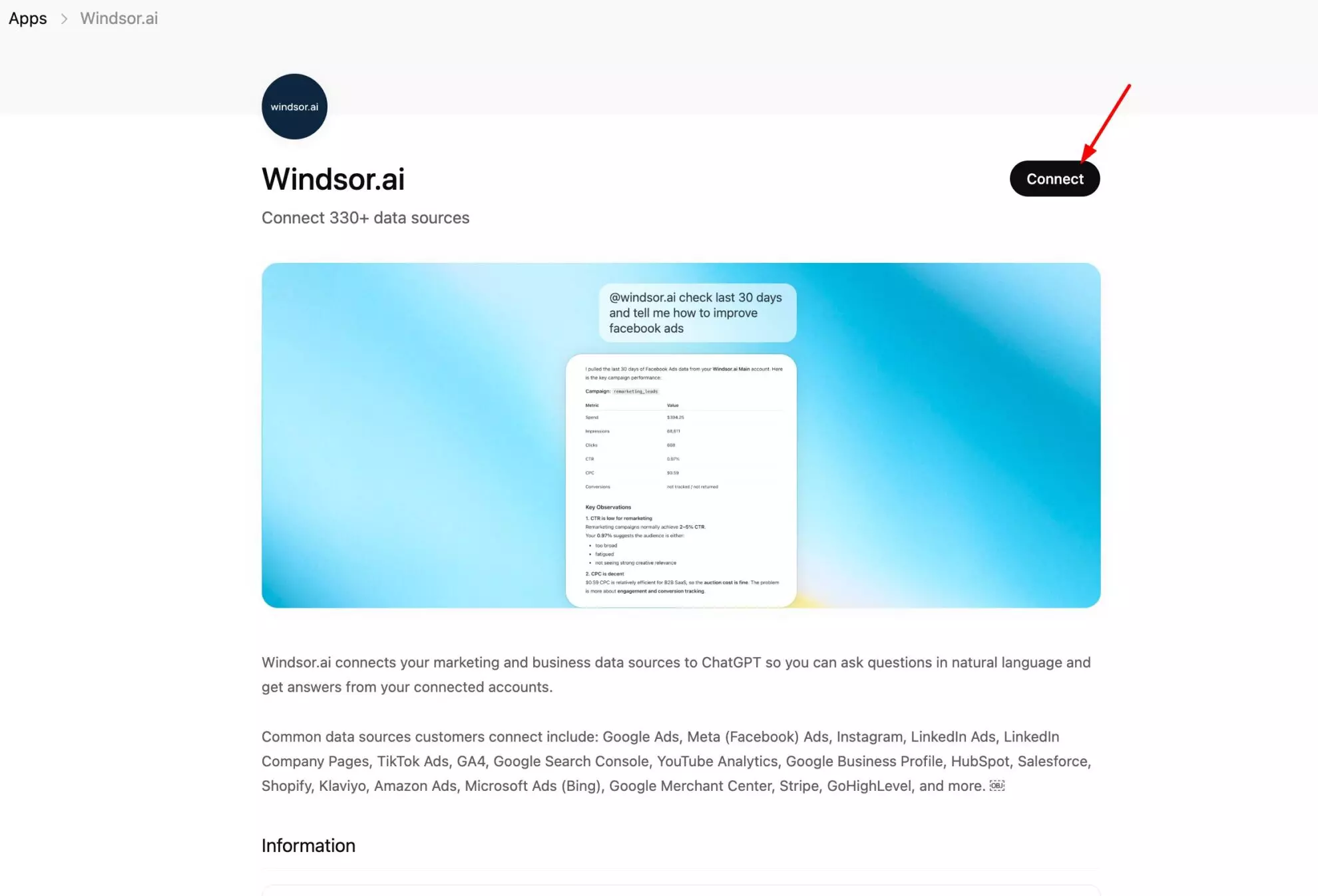
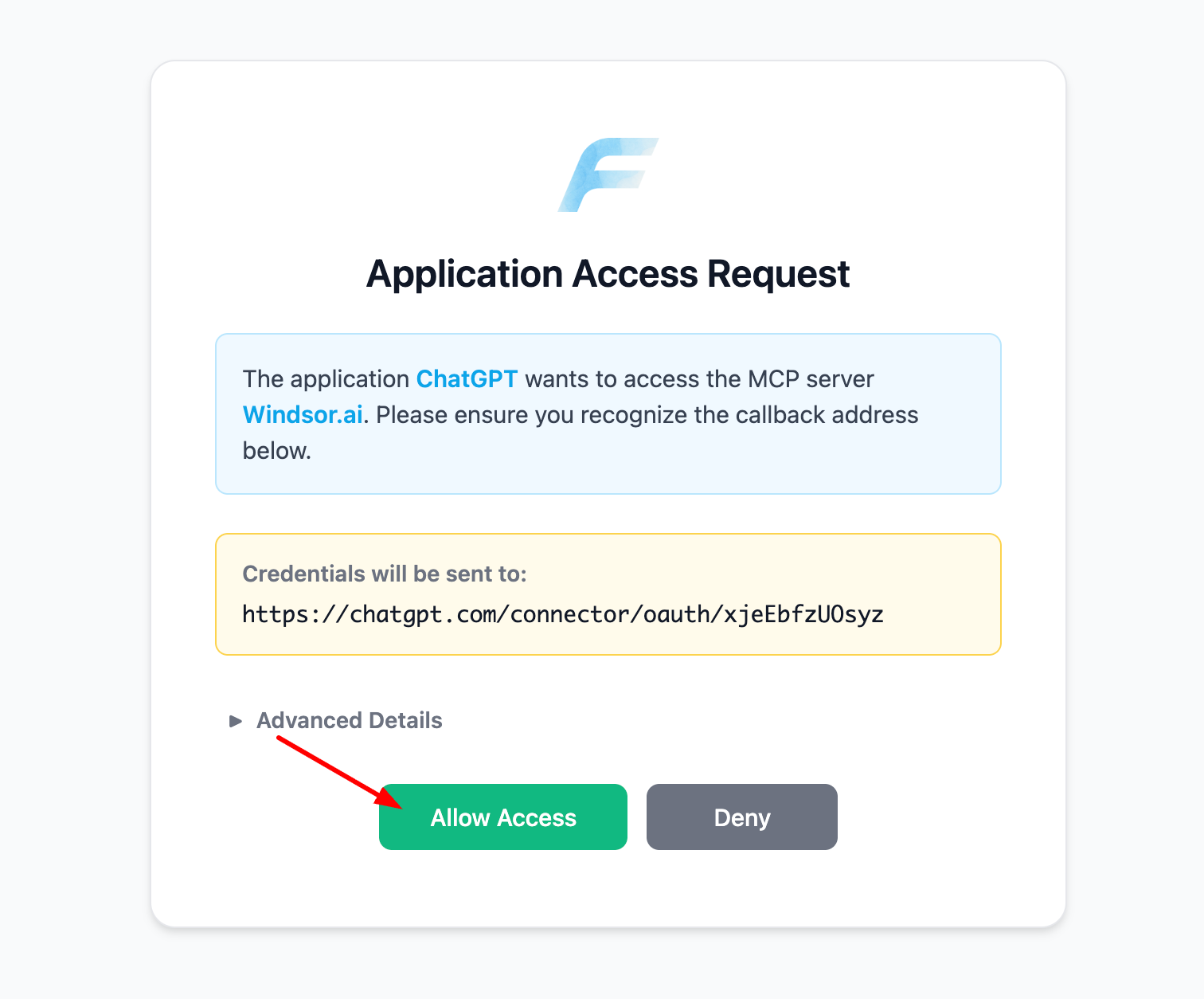
In ChatGPT, install Windsor’s native app rather than pasting a custom connector URL. It takes three clicks.
- In ChatGPT, open the apps or connectors menu and search for “Windsor.ai”
- Select Windsor.ai and install it as a native app
- Allow Windsor.ai access to your connected data sources, including Amplitude
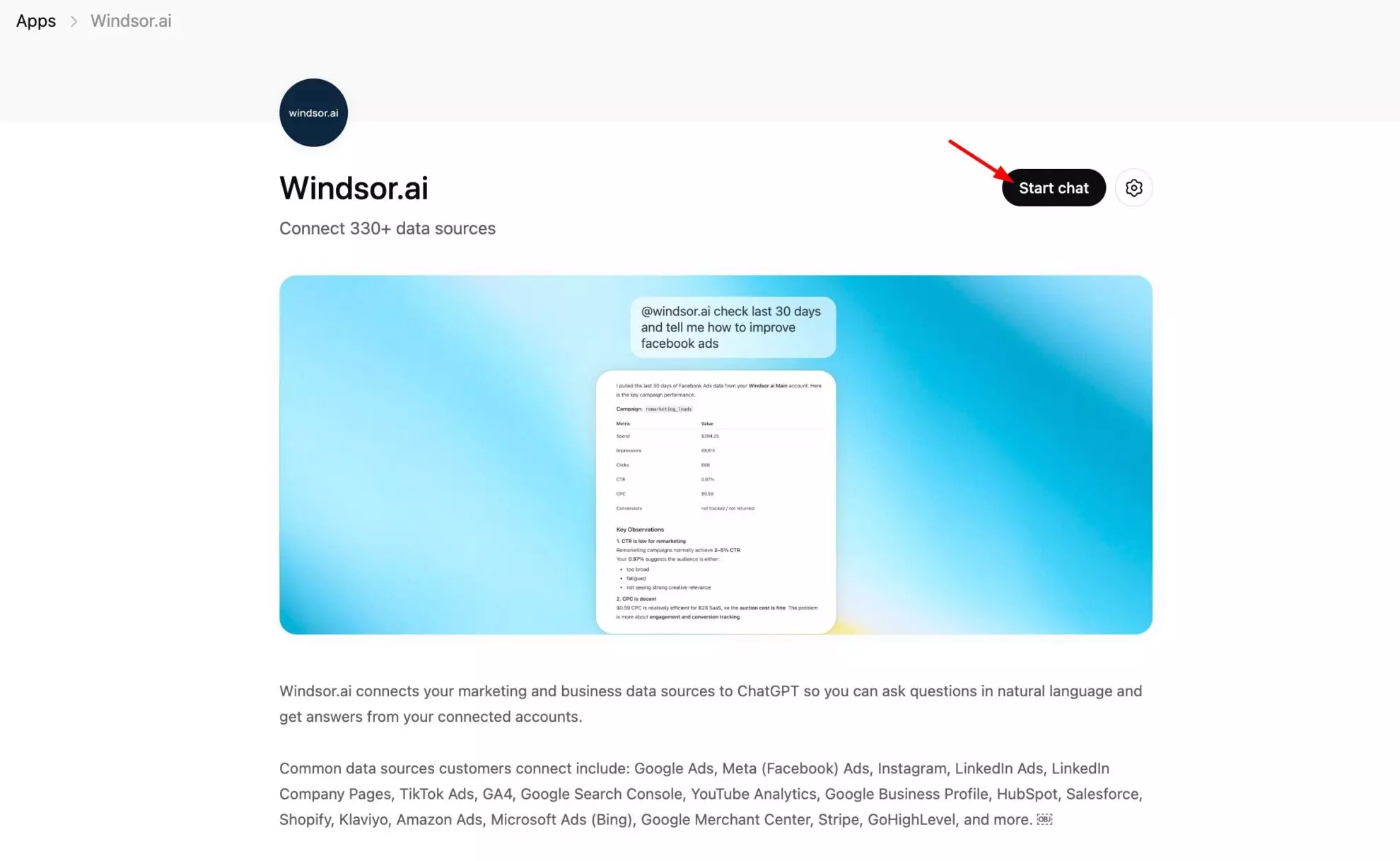
Confirm the connection is live by asking ChatGPT directly:
List the data sources connected to my Windsor account. Do you see Amplitude there?Once ChatGPT confirms Amplitude is listed, you’re ready to query it in natural language.
The metrics that matter for Amplitude
| Metric | What it tells you |
|---|---|
| Event type | The specific action a user performed, such as a button click or purchase, the core building block of every Amplitude report. |
| User ID | The persistent identifier for a signed-in user, so you can trace their activity across sessions and devices. |
| Session ID | Groups the sequence of events a user generated in one active session, the basis for session-length and engagement metrics. |
| Event time | The exact timestamp an event fired on the user’s device, used to build trends and time-based funnels. |
| Platform | Whether the event came from web, iOS, or Android, so you can compare behavior across platforms. |
| Country | The country the event originated from, for geographic breakdowns of usage. |
| Paying | Flags whether the user was a paying customer at the time of the event, useful for separating free vs. paid behavior. |
| Average session length | How long, on average, users stay active in a session, a core engagement signal that flags when a product is getting stickier or losing people faster. |
| Active users | The daily count of users active in your product, the base metric for tracking product-wide engagement over time. |
| Cohort size | How many users belong to a saved cohort, so you can track how a specific audience segment grows or shrinks. |
| Cohort popularity | How often a saved cohort gets used across your team’s charts and reports, a read on which audience segments people actually rely on. |
| Event properties | The custom properties attached to an event, such as a plan tier or button label, as instrumented in your own project. |
What to ask ChatGPT: prompt ideas
Retention and engagement
Show my average session length by week for the last two months.
Break down active users by date for the last quarter and flag any week with a drop.
Cohort and audience analysis
Compare the size and popularity of my saved cohorts over the last 30 days.
Which of my cohorts have grown the most in view count this quarter?
User behavior and event trends
List the event types firing most often in my Amplitude project this month, broken down by platform.
The Amplitude connection is read-only. ChatGPT can analyze and summarize your product data, but it can’t create, edit, or push anything back into Amplitude.
Bonus: analyze Amplitude alongside your full stack
Windsor connects 350+ sources, so Amplitude doesn’t have to live in its own silo. A few realistic blends:
- Cost per engaged user. Blend Amplitude’s active users and average session length with ad spend from Google Ads, Meta Ads, or TikTok Ads to see which acquisition channel brings in users who actually stick around, not just install and disappear.
- Full lifetime value view. Pair Amplitude’s paying-user and cohort data with revenue or subscription data from Stripe or your CRM to connect product engagement to what a user is actually worth over time.
- Install-to-engagement funnel. Blend Amplitude’s session and event data with attribution data from Adjust or AppsFlyer to trace the full path from ad click to install to real in-app engagement.
Other ways to connect Amplitude to ChatGPT
Manual CSV export
You can export a chart or cohort from Amplitude as a CSV and upload it to ChatGPT for analysis. It works for a one-off question, but it’s a static snapshot: the moment new sessions or events come in, the file is out of date, and you’re back to exporting again for the next question.
Zapier or Make
You can build a Zapier or Make workflow that pushes Amplitude events into a spreadsheet or database on a schedule, then have ChatGPT read from that. It’s a workflow you have to build and keep maintained yourself, and it still isn’t a live, ask-anything view of your Amplitude data the way a direct connector is.
Conclusion
Connecting Amplitude to ChatGPT through Windsor.ai’s native app takes two steps and no code: link Amplitude to Windsor.ai, then install the Windsor.ai app in ChatGPT. From there, you can ask about session length, cohorts, and whatever custom events your product tracks in plain language, and blend it with the rest of your stack for a single source of truth.
🚀 Ready to connect Amplitude to ChatGPT? Connect Amplitude to Windsor.ai now and start querying your product data from ChatGPT in minutes, on the free forever plan, no credit card required.
FAQs
What's the fastest, native way to connect Amplitude to ChatGPT?
Installing Windsor.ai’s native ChatGPT app is the fastest option. It takes under a minute: authorize Amplitude in Windsor.ai, then add the Windsor.ai app inside ChatGPT.
Do I need to write any code to connect Amplitude to ChatGPT?
No. Both steps, connecting Amplitude to Windsor.ai and installing the Windsor.ai app in ChatGPT, are done through menus and authorization screens. There are no API keys to wire up by hand and no scripts to maintain.
Can ChatGPT analyze my Amplitude performance?
Yes. Once connected, ChatGPT can pull your session length, cohort, and event data from Amplitude and answer questions about product usage, retention, and engagement in plain language.
Can I connect more than one Amplitude project?
Yes. You can authorize multiple Amplitude projects in Windsor.ai, which is useful for agencies or companies running separate projects per app or environment.
What Amplitude data is available once it's connected?
Amplitude doesn’t use a fixed universal metric set the way an ad platform does. Windsor surfaces the structural data every account has, average session length, cohort size, popularity and view count, event sample rate, active users, and annotations, plus whatever custom events and user properties your own project has instrumented. The exact event list is unique to each Amplitude account, so ask ChatGPT to list what’s available in yours.
Is there a free plan, or do I have to pay to connect Amplitude?
Windsor.ai has a free forever plan with no credit card required, which covers connecting Amplitude to ChatGPT. Paid plans start from $19/month for higher usage.
How does this compare to exporting Amplitude CSVs manually?
A CSV export is a static snapshot the moment you download it. The Windsor.ai connection stays live, so ChatGPT is always working from current Amplitude data instead of a file that goes stale as soon as new sessions come in.
Can I combine Amplitude data with other marketing channels?
Yes. Windsor connects to over 350+ sources, so you can blend Amplitude’s product data with sources like Google Ads or Facebook Ads for cross-channel reporting, all from a single ChatGPT conversation.
Is the Amplitude connection secure, and can ChatGPT change anything in Amplitude?
The connection is read-only. ChatGPT can read and analyze your Amplitude data through Windsor.ai, but it can’t create, edit, or push any changes back into your Amplitude project.


