 Destinations
 Data sources
 AI insights
 About us
 Careers
 Security
 Customer reviews
 Contact us
 Affiliate program
 Solution partners
 Template gallery
 Looker Studio templates
 Power BI templates
 Excel templates
 Google Sheets templates
 Tableau templates
 Facebook Ads templates
 Google Ads templates
 Data fields & Metrics
 AI prompt library & Guides
 Product documentation
 API documentation
 Case studies
 Blog
Blog Data models
 Windsor vs Supermetrics
 Windsor vs Funnel.io
 Windsor vs Fivetran
 Windsor vs Rivery
 Windsor vs Portermetrics
 Windsor vs Coupler.io
 Last updated: 1 September 2026




You connect ConvertKit to ChatGPT by installing Windsor’s native app inside ChatGPT and linking your ConvertKit account through Windsor.ai’s free onboarding flow. Once the two are linked, ChatGPT can read your ConvertKit forms, broadcasts, sequences, subscribers, and tags directly, so you can ask about your email setup in plain language instead of clicking through the ConvertKit dashboard tab by tab.
The native way is worth using instead of exporting CSVs or copying data by hand, because a manual export is a static snapshot the moment you download it, and it sits in a spreadsheet disconnected from everything else you run. Connecting through Windsor.ai keeps ChatGPT looking at your live ConvertKit setup, and lets you blend it with other tools in the same conversation instead of juggling separate exports.
2 steps to connect ConvertKit to ChatGPT
Takes under a minute, no code or manual CSV work required.
Full walkthrough in Windsor’s documentation on integrating data into ChatGPT.
Prerequisites
- A Windsor.ai account (free forever plan, no credit card, or paid from $19/month).
- A ConvertKit account with at least one form, broadcast, or sequence already set up.
- A ChatGPT account with access to connect apps.
Step 1. Connect ConvertKit to Windsor.ai
- Create your free account at onboard.windsor.ai/app/convertkit.
- Select ConvertKit as the data source.
- Authorize Windsor.ai to read your ConvertKit account.
- Repeat the authorization step if you manage more than one ConvertKit account, for example across multiple creator brands or client accounts.
Step 2. Connect the Windsor.ai app in ChatGPT
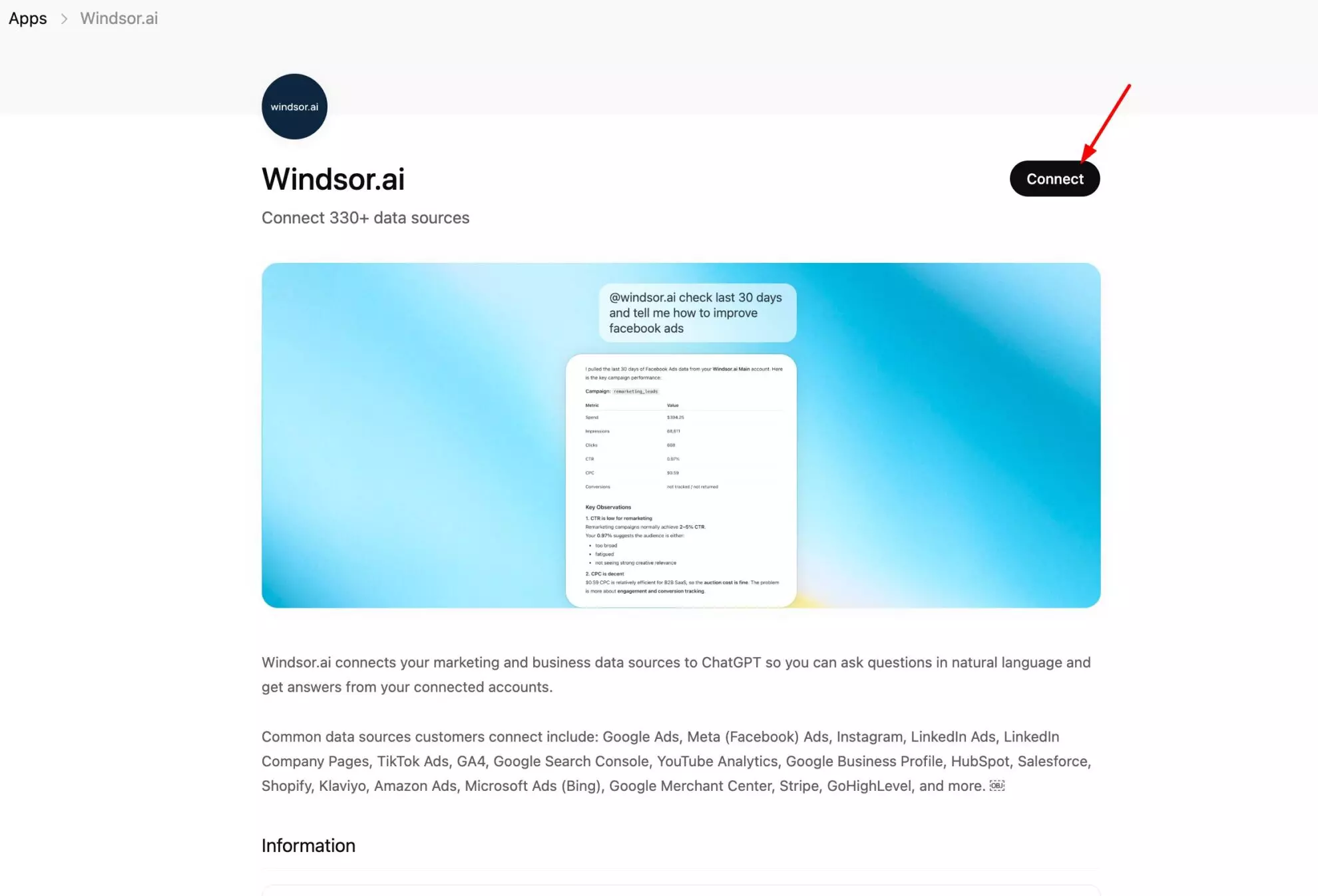
In ChatGPT, open the apps or connectors menu and search for Windsor.ai, then install it as a native app.
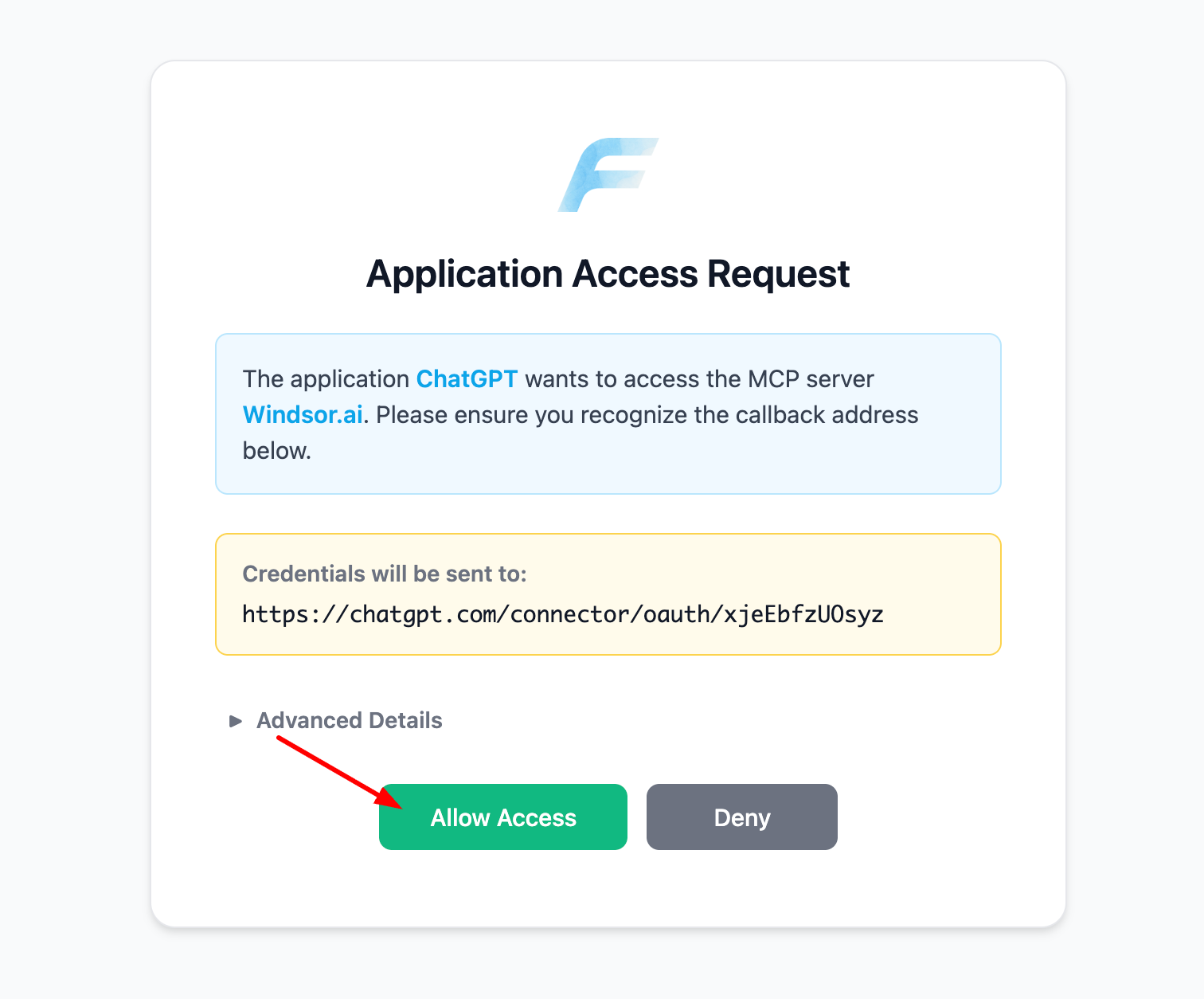
Approve the access request so ChatGPT can query your connected data sources.
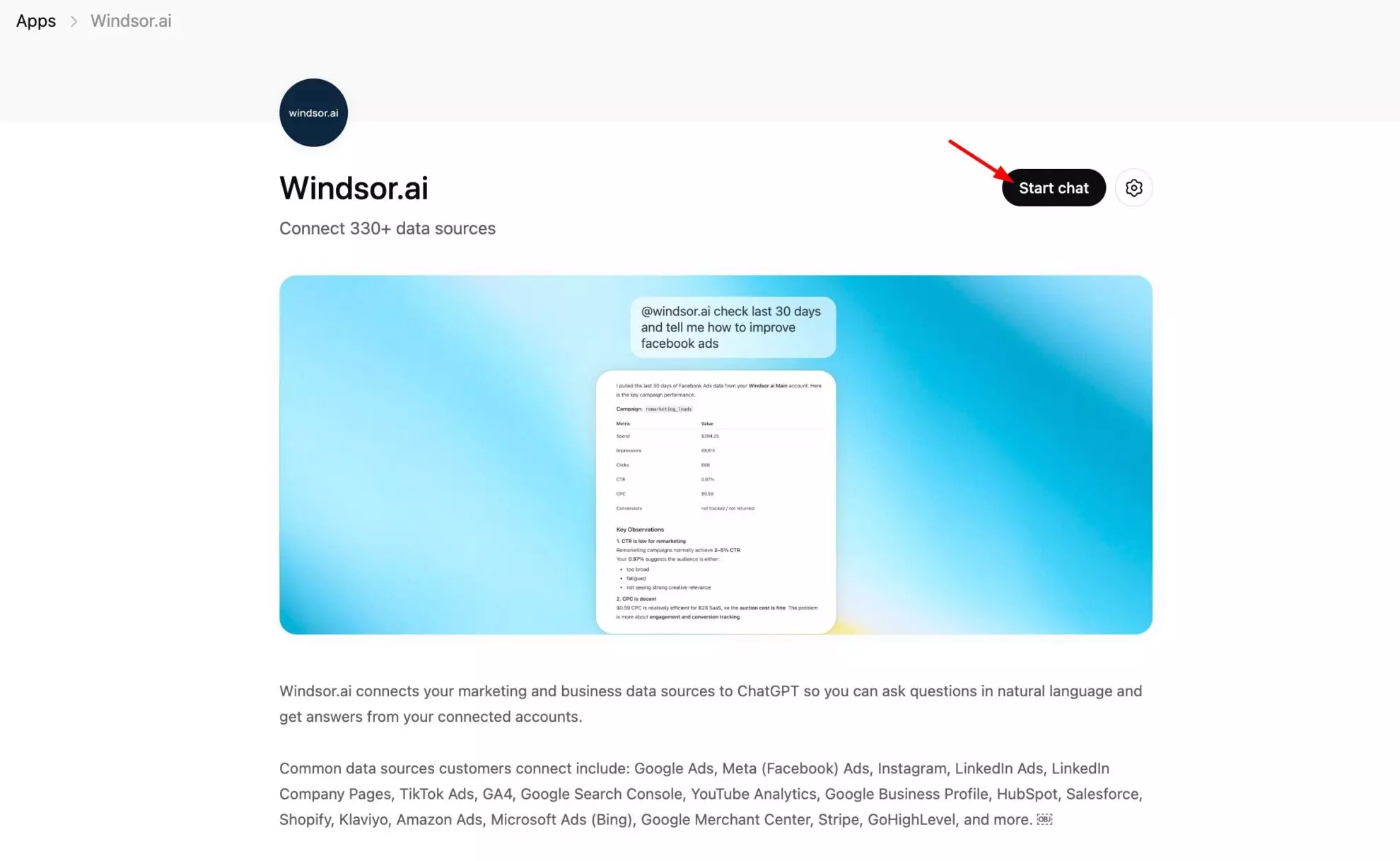
Once installed, the Windsor.ai app appears in your ChatGPT connectors list and is ready to use in any conversation.
Confirm the connection is live by asking ChatGPT to check it:
List the data sources connected to my Windsor account. Do you see ConvertKit there?If ConvertKit shows up in that list, you’re ready to query it in natural language.
The metrics that matter for ConvertKit
| Metric | What it tells you |
|---|---|
| Broadcast Subject | The subject line of each email you’ve sent, useful for auditing your send history and messaging themes at a glance. |
| Broadcast Created Date | When each broadcast was created, letting you build a timeline of your send cadence over any period. |
| Form Name | The label of each opt-in form, so you can tell which forms are live across your landing pages, pop-ups, and embeds. |
| Form Type | Whether a form is embedded, a pop-up, a hosted landing page, or another format, useful for auditing where and how people actually opt in. |
| Form Archived Status | Whether a form has been retired or is still active, helping you spot stale forms cluttering the account. |
| Form Sign-Up Button Text | The exact call-to-action copy on a form’s submit button, handy for auditing consistency across all your forms. |
| Sequence Name | The name of each automated email sequence, the backbone of your nurture and onboarding flows. |
| Sequence Hold Status | Whether a sequence is currently paused, so you can catch a nurture flow that stopped sending without anyone noticing. |
| Sequence Repeat Status | Whether a sequence re-triggers for returning subscribers, important for telling evergreen flows apart from one-time onboarding sequences. |
| Subscriber State | Whether a subscriber is active, cancelled, or bounced, the core health signal for the size and quality of your list. |
| Subscriber Created Date | When each subscriber joined your list, letting you track list growth over any time period. |
| Tag Name | The label applied to segment subscribers by behavior or interest, key to how you organize targeting across campaigns. |
What to ask ChatGPT: prompt ideas
Email campaign performance
List the subject lines and created dates of my last 15 ConvertKit broadcasts.
Group my ConvertKit broadcasts by month and show how many I sent each month this year.
Subscriber growth and engagement
Show me how many new ConvertKit subscribers joined each month for the last 6 months, broken down by subscriber state.
List my ConvertKit tags and tell me which ones were created most recently.
Sequence and automation performance
List all my ConvertKit sequences and flag any that are on hold so I can catch broken automations.
The ConvertKit connection through Windsor is read-only. ChatGPT can describe and inventory your forms, broadcasts, sequences, subscribers, and tags, but it can’t create, edit, or send anything back to ConvertKit.
Bonus: analyze ConvertKit alongside your full stack
Windsor connects 350+ sources, so ConvertKit doesn’t have to live in its own silo. A few realistic blends:
- Blended cost per subscriber. Combine ConvertKit’s subscriber growth with your Facebook Ads and Google Ads spend to get a real cross-channel cost-per-subscriber instead of judging list growth against each ad platform in isolation.
- On-site behavior after the email. Pair ConvertKit broadcast and sequence activity with GA4 to see what subscribers actually do on your site after they open a campaign or move through a sequence.
- List growth from organic content. Blend ConvertKit subscriber and tag data with your Instagram content performance to see which posts are actually pulling people onto your list.
Other ways to connect ConvertKit to ChatGPT
Manual CSV export
ConvertKit lets you export subscribers and some list data as a CSV, which you can then upload into a ChatGPT conversation. This works for a one-off question, but it’s a static snapshot from the moment you exported it, and you have to repeat the export by hand every time your forms, broadcasts, or tags change.
Zapier or Make
You can also wire ConvertKit into ChatGPT indirectly through a Zapier or Make automation, triggering on new subscribers, tags, or broadcasts. That’s a workflow worth maintaining if you already have one, but it still means building and keeping up a separate automation rather than asking ChatGPT directly.
Neither option gives ChatGPT the live, ask-anytime view that the direct Windsor.ai connection does.
Conclusion
Connecting ConvertKit to ChatGPT through Windsor.ai takes a couple of minutes and gives ChatGPT a live view of your forms, broadcasts, sequences, subscribers, and tags, so you can ask about your ConvertKit setup the same way you’d ask a colleague who has the dashboard open. It’s read-only today, so it’s best used for inventorying and describing your account rather than managing campaigns, but it’s the fastest native way to get ConvertKit’s structural data in front of ChatGPT.
🚀 Ready to connect ConvertKit to ChatGPT? Connect your ConvertKit account to Windsor.ai for free and start asking ChatGPT about your account.
FAQs
What's the fastest way to get ConvertKit data into ChatGPT?
The native Windsor.ai app is the fastest option. It takes under a minute to set up, and once it’s connected you can ask ChatGPT about your ConvertKit account at any time, without exporting or uploading anything.
Do I need to write any code to connect ConvertKit to ChatGPT?
No. Connecting ConvertKit to Windsor.ai and installing the Windsor.ai app in ChatGPT are both point-and-click steps. No API keys, scripts, or custom connectors are required.
What ConvertKit data can ChatGPT see once it's connected?
ChatGPT can see your broadcasts (subject line, created date), your forms (name, description, embed URL, embed JS, archived status, created date), plus your sequences, subscribers, and tags. It’s a structural and content view of your ConvertKit account.
Does the ConvertKit connector include open rates or click rates?
No. Windsor’s ConvertKit connector does not expose engagement metrics like open rate or click rate. It’s built around structural and content fields, broadcasts, forms, sequences, subscribers, and tags, so it’s better suited to inventorying and describing your ConvertKit setup than to deep engagement analysis.
Can ChatGPT manage or edit my ConvertKit forms and broadcasts?
No. The connection is read-only. ChatGPT can describe, list, and summarize what’s already in your ConvertKit account, but it can’t create, edit, or send anything back to ConvertKit.
Can I connect more than one ConvertKit account?
Yes. Repeat the authorization step in Windsor.ai for each ConvertKit account you manage, which is useful if you run more than one creator brand or manage ConvertKit for multiple clients.
Is Windsor.ai free to use for this?
Windsor.ai offers a free forever plan with no credit card required, which covers connecting ConvertKit to ChatGPT. Paid plans start from $19/month for higher usage and additional features.
How does this compare to exporting a CSV from ConvertKit?
A CSV export is a static snapshot from the moment you download it, and you have to redo it by hand every time your forms, broadcasts, or tags change. The Windsor.ai connection keeps ChatGPT looking at your live ConvertKit account instead.
Can I combine ConvertKit data with other marketing channels in ChatGPT?
Yes. Windsor connects 350+ data sources, so you can ask ChatGPT questions that blend your ConvertKit structure with data from other connected channels in the same conversation, without switching tools.


