 Destinations
 Data sources
 AI insights
 About us
 Careers
 Security
 Customer reviews
 Contact us
 Affiliate program
 Solution partners
 Template gallery
 Looker Studio templates
 Power BI templates
 Excel templates
 Google Sheets templates
 Tableau templates
 Facebook Ads templates
 Google Ads templates
 Data fields & Metrics
 AI prompt library & Guides
 Product documentation
 API documentation
 Case studies
 Blog
Blog Data models
 Windsor vs Supermetrics
 Windsor vs Funnel.io
 Windsor vs Fivetran
 Windsor vs Rivery
 Windsor vs Portermetrics
 Windsor vs Coupler.io
 Last updated: 31 August 2026




The fastest way to connect Gravity Forms to ChatGPT is to install Windsor.ai’s native ChatGPT app: connect your Gravity Forms account to Windsor once, then add the Windsor.ai app inside ChatGPT so it can read your form entries, submission details, and payment data directly in the chat, no code required.
The alternative is exporting entries from Gravity Forms as a CSV every time you want a fresh number, then pasting them into a spreadsheet to see how your forms are actually performing. That works for a one-off check, but it leaves your lead data siloed from the rest of your marketing stack and stale the moment you close the file. Connecting Gravity Forms to Windsor keeps the data live and queryable in ChatGPT instead.
2 steps to connect Gravity Forms to ChatGPT
Takes under a minute, no code or manual CSV work required.
See the full walkthrough in the Windsor.ai documentation.
Prerequisites
- A Windsor.ai account (free forever plan, no credit card, or paid from $19/month)
- A Gravity Forms account on your WordPress site, with at least one active form collecting entries
- A ChatGPT account that can install apps or connectors
Step 1. Connect Gravity Forms to Windsor.ai
Start on the Windsor.ai side:
- Create a free Windsor.ai account, or log in if you already have one
- Go to onboard.windsor.ai/app/gravity_forms and select Gravity Forms
- Authorize Windsor to access your Gravity Forms data
- Repeat the process to connect additional sites or forms if you manage more than one

Step 2. Connect the Windsor.ai app in ChatGPT
Now install the native app inside ChatGPT:
- Open ChatGPT and go to Settings > Connectors (or Apps)
- Search for “Windsor.ai” and install it
- Allow Windsor.ai access when prompted
- Confirm the app appears in your connected apps list
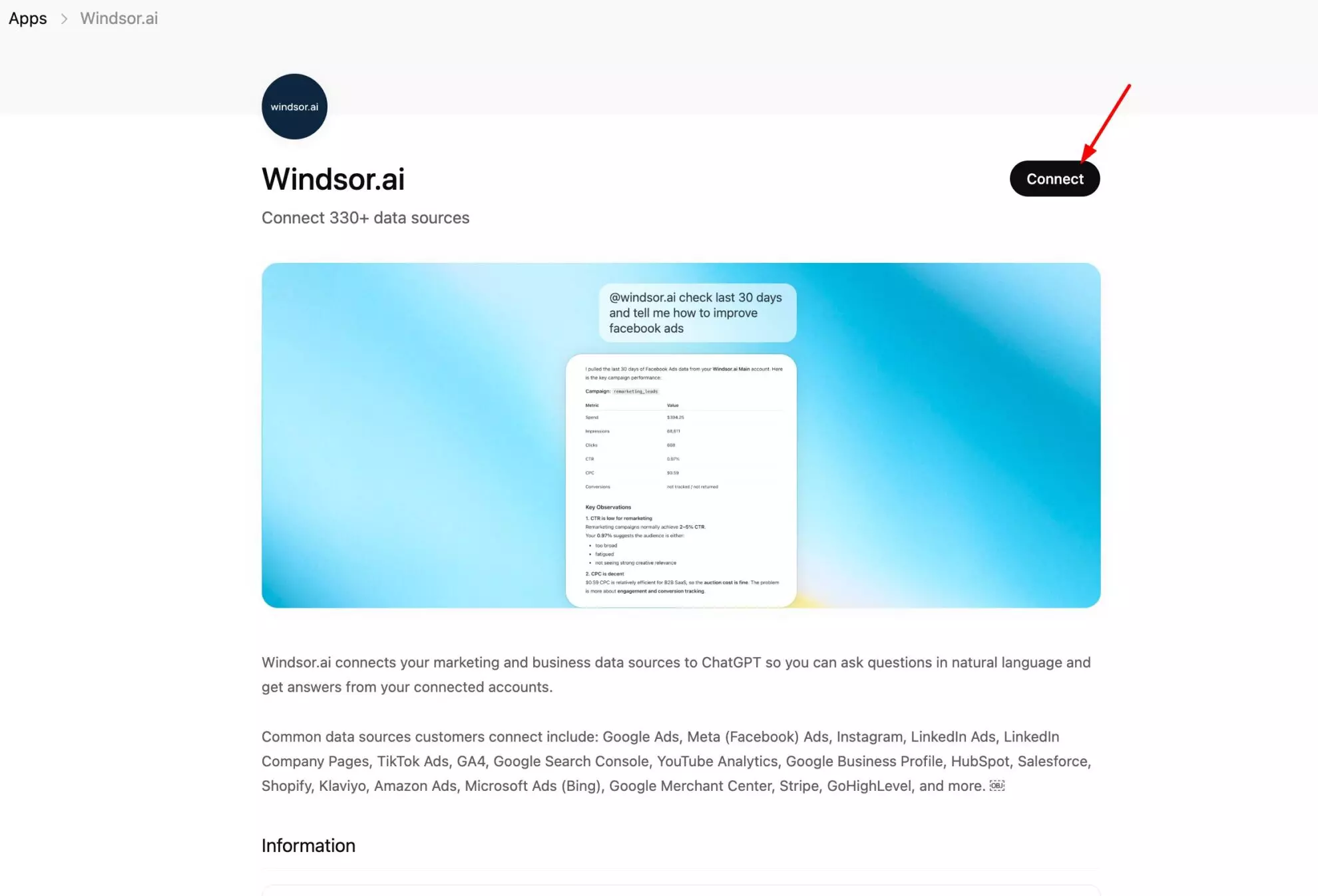
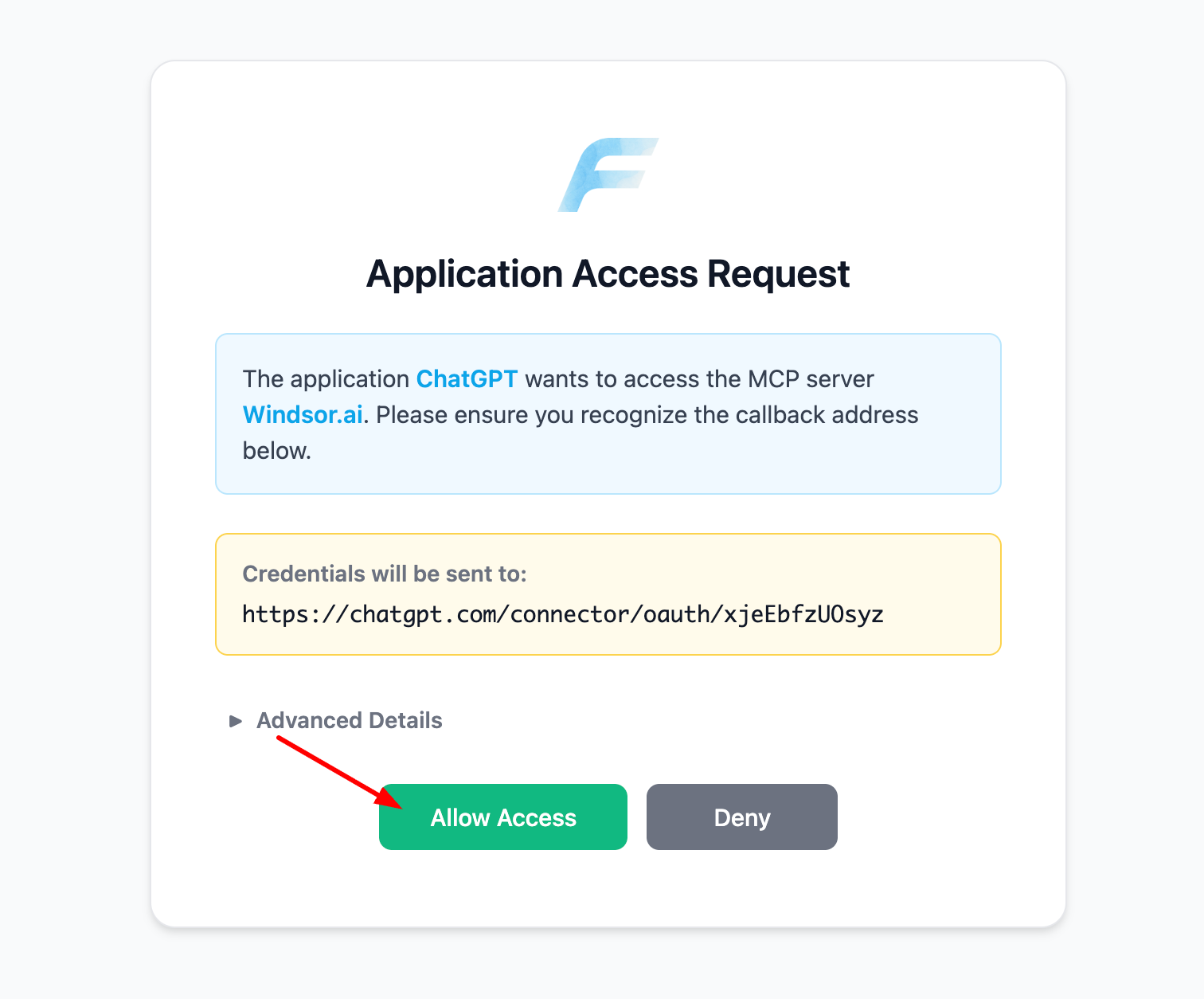
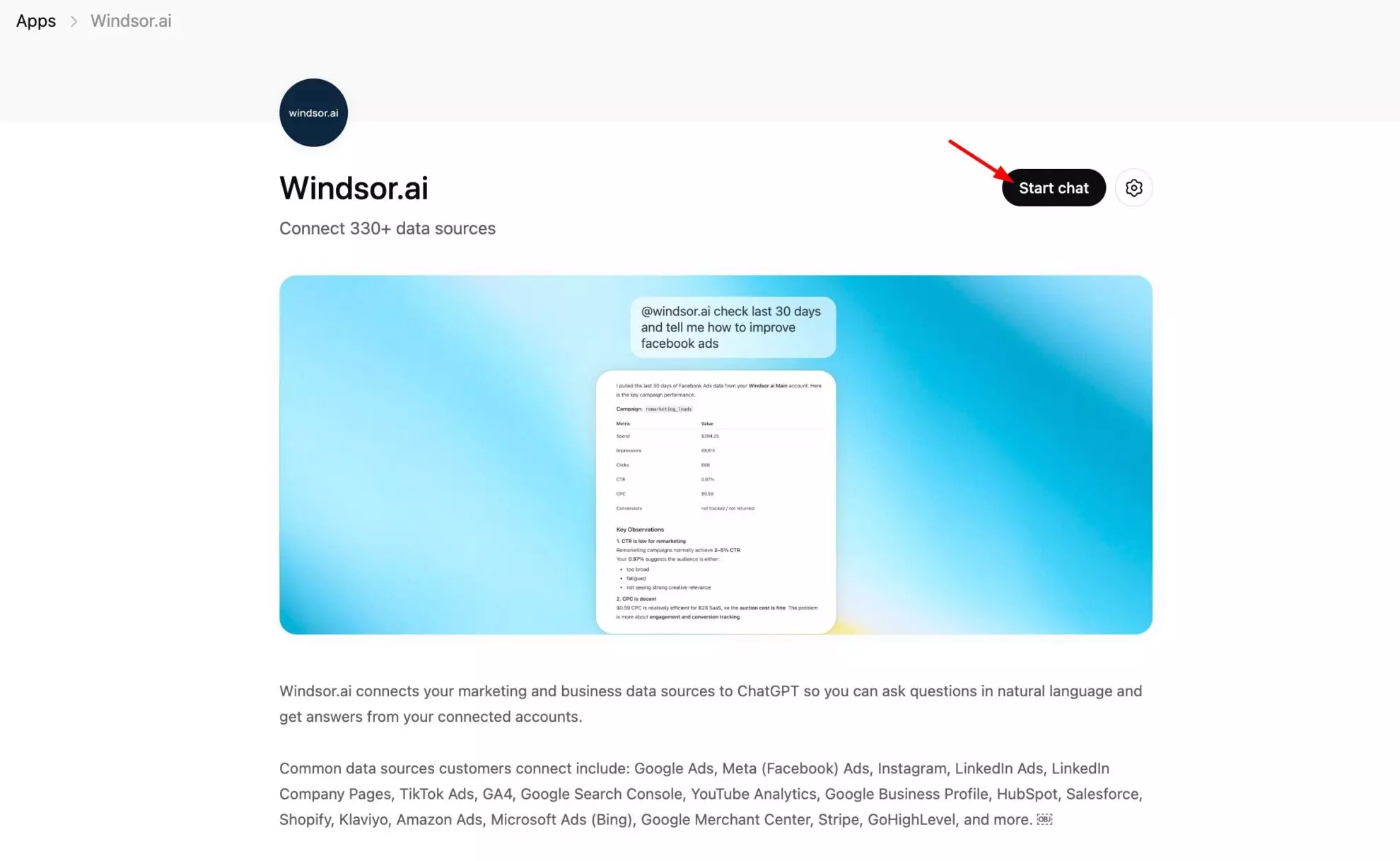
Confirm the connection is live by asking ChatGPT:
List the data sources connected to my Windsor account. Do you see Gravity Forms there?If Gravity Forms shows up, you’re ready to query your form data in plain English.
The metrics that matter for Gravity Forms
| Metric | What it tells you |
|---|---|
| Entry ID | A unique identifier for every form submission, the field you count to get total entries or leads for a given period. |
| Entry Date Created | The date and time a submission came in, the field for tracking entry volume by day, week, or month. |
| Entry Form ID | Which specific form an entry belongs to, essential once you’re running more than one form on your site. |
| Form Title | The human-readable name of a form, such as “Contact Us” or “Request a Quote,” so you can tell which form is actually generating entries. |
| Entry Source URL | The page a submitter was on when they filled out the form, showing which landing page or blog post is actually driving submissions. |
| Entry Status | Whether an entry is active, marked as spam, or trashed, so you can filter out junk before counting real leads. |
| Entry Is Read | Whether someone on your team has opened an entry yet, a quick way to spot a growing follow-up backlog. |
| Entry Value | A summary of what the submitter actually entered, useful for skimming real responses instead of raw field IDs. |
| Entry Payment Amount | The dollar amount tied to a submission when a form includes a payment add-on, the field for orders or paid signups collected through Gravity Forms. |
| Entry Payment Status | Whether a payment tied to an entry is paid, pending, or failed, separating completed transactions from ones still in progress. |
| Entry Created By | The ID of the logged-in WordPress user who submitted the form, if any, useful for separating member submissions from anonymous public ones. |
| Form Is Active | Whether a form is currently live on your site, so you can filter reporting down to the forms actually collecting entries today. |
What to ask ChatGPT: prompt ideas
Lead volume and form performance
How many form submissions did I get across all my Gravity Forms in the last 30 days, broken down by form title?
Which of my forms generated the most entries last month, and which ones got almost none?
Submission trends over time
Show me a week-over-week trend of Gravity Forms entries for the last two months.
Field-level response analysis
Pull the most recent entries from my contact form and summarize what people are actually writing in their messages.
The Gravity Forms connection through Windsor is read-only. ChatGPT can analyze your entries and form data, but it can’t create, edit, or submit forms on your site.
Bonus: analyze Gravity Forms alongside your full stack
Windsor connects 350+ sources, so Gravity Forms doesn’t have to live in its own silo. A few realistic blends:
- True cost per lead. Combine Gravity Forms entries with Google Ads and Facebook Ads spend to see a real cost-per-lead number instead of guessing at it from platform-reported conversions.
- Which pages actually drive form fills. Pair Gravity Forms entry source URLs with GA4 to see which pages, campaigns, or channels are actually sending people to your forms.
- Full pipeline view. Blend Gravity Forms entries with your CRM data for a single source of truth from form fill to closed deal, without leaving ChatGPT.
Other ways to connect Gravity Forms to ChatGPT
Manual CSV export
Gravity Forms lets you export entries as a CSV and upload it to ChatGPT for a one-off analysis. It works, but it’s a static snapshot: every time you want an updated number you have to re-export and re-upload the file by hand.
Zapier or Make
Zapier or Make can move Gravity Forms entries into a spreadsheet or CRM on a schedule. That’s a reasonable automated workflow, but it still needs to be built and maintained separately, and it doesn’t give ChatGPT a live, queryable connection to Gravity Forms the way the native Windsor.ai app does.
Neither approach gives you the same live view as connecting Gravity Forms to Windsor directly.
Conclusion
Connecting Gravity Forms to ChatGPT through Windsor.ai takes two steps: link your Gravity Forms account to Windsor, then install the Windsor.ai app in ChatGPT. From there you can ask plain-language questions about your form entries and submission trends, and blend that data with your other channels for a single source of truth, without exporting a single CSV.
🚀 Ready to connect Gravity Forms to ChatGPT? Connect your Gravity Forms account to Windsor.ai and start querying your form data in minutes.
FAQs
What's the fastest way to connect Gravity Forms to ChatGPT?
The native Windsor.ai app is the fastest way. It takes under a minute, connects Gravity Forms natively, and doesn’t require exporting or uploading any files.
Do I need any coding or technical setup?
No. Connecting Gravity Forms to ChatGPT through Windsor.ai is a no-code process: authorize the Gravity Forms connection, then install the app in ChatGPT.
Can ChatGPT actually analyze my Gravity Forms performance?
Yes. Once connected, you can ask ChatGPT plain-language questions about your form entries, submission trends, and payment data, and it will pull the live data through Windsor.
Can I connect multiple Gravity Forms accounts or WordPress sites?
Yes. You can connect multiple Gravity Forms accounts to Windsor.ai, which is useful if you manage forms across several client sites and want to see them all from the same ChatGPT conversation.
Which Gravity Forms fields are available in Windsor?
Windsor returns Gravity Forms fields including Entry ID, Entry Date Created, Entry Form ID, Form Title, Entry Source URL, Entry Status, Entry Is Read, Entry Value, Entry Payment Amount, Entry Payment Status, and Entry Created By, so you can report on submission volume, timing, source pages, and payment details.
How much does it cost to connect Gravity Forms to Windsor.ai?
Windsor.ai has a free forever plan with no credit card required, which covers connecting Gravity Forms to ChatGPT. Paid plans start from $19/month for higher usage needs.
Is this better than exporting Gravity Forms entries as a CSV?
A CSV export is a static snapshot that goes out of date as soon as new entries come in. Connecting Gravity Forms to Windsor keeps the data live, so ChatGPT is always working from current numbers instead of a manually re-exported file.
Can I combine Gravity Forms with data from my other marketing channels?
Yes. Windsor connects to 350+ data sources, so you can blend Gravity Forms alongside platforms like Google Ads, Facebook Ads, and GA4 in the same ChatGPT conversation for cross-channel, blended reporting instead of checking each platform on its own.
Is the connection secure, and can ChatGPT change anything in my Gravity Forms account?
The Gravity Forms connection through Windsor is read-only. ChatGPT can analyze your entries and form data, but it cannot create, edit, or submit forms on your site.


