 Destinations
 Data sources
 AI insights
 About us
 Careers
 Security
 Customer reviews
 Contact us
 Affiliate program
 Solution partners
 Template gallery
 Looker Studio templates
 Power BI templates
 Excel templates
 Google Sheets templates
 Tableau templates
 Facebook Ads templates
 Google Ads templates
 Data fields & Metrics
 AI prompt library & Guides
 Product documentation
 API documentation
 Case studies
 Blog
Blog Data models
 Windsor vs Supermetrics
 Windsor vs Funnel.io
 Windsor vs Fivetran
 Windsor vs Rivery
 Windsor vs Portermetrics
 Windsor vs Coupler.io
 Last updated: 31 August 2026




You can connect MongoDB to ChatGPT in two steps: install Windsor.ai’s native app in ChatGPT, then link your MongoDB database through Windsor’s onboarding page. No code, no manual exports, and no custom integration required.
Without a direct connection, ChatGPT has no visibility into what’s actually sitting in your MongoDB collections. Getting that data in front of it usually means running manual mongoexport jobs, converting documents to CSV, and re-uploading files every time something changes. Windsor.ai’s native app replaces that with a live connection, so ChatGPT can query your database directly, and you can blend it with the other 350+ sources Windsor connects.
2 steps to connect MongoDB to ChatGPT
Takes under a minute, no code or manual exports required.
For a full walkthrough, see Windsor’s documentation on integrating data into ChatGPT.
Prerequisites
- A Windsor.ai account (free forever plan, no credit card, or paid from $19/month)
- Your MongoDB connection string and credentials (username, password, host, or a full connection URI) ready to authorize the connection
- Access to ChatGPT with apps or connectors enabled
Step 1. Connect MongoDB to Windsor.ai
- Go to onboard.windsor.ai/app/mongodb and create a free Windsor.ai account, or sign in if you already have one
- Select MongoDB from the list of data sources
- Enter your MongoDB connection string and credentials to authorize Windsor to read your database
- Repeat the process if you want to connect more than one MongoDB database
Step 2. Connect the Windsor.ai app in ChatGPT
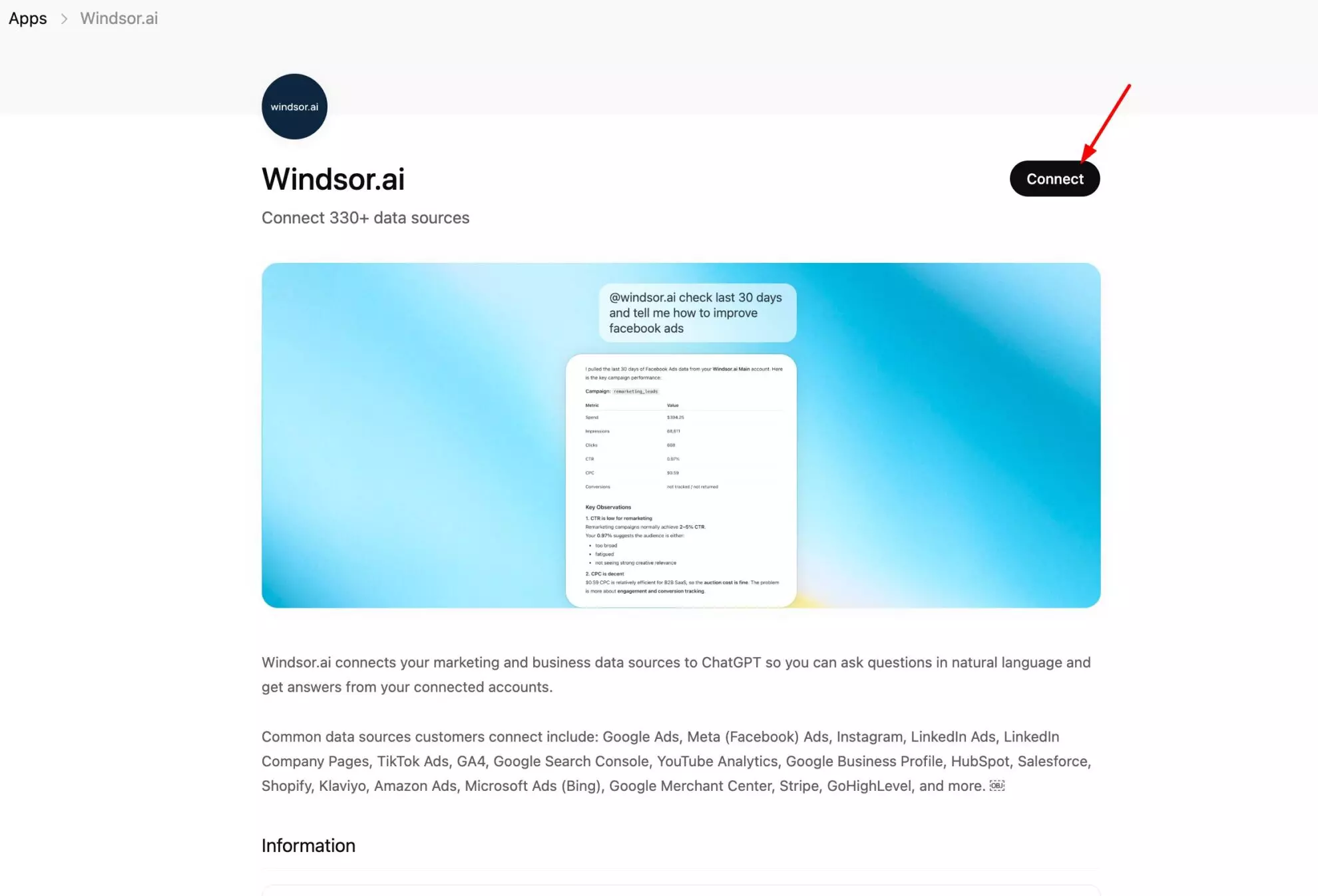
- In ChatGPT, open Settings, then Apps and Connectors (naming varies by plan)
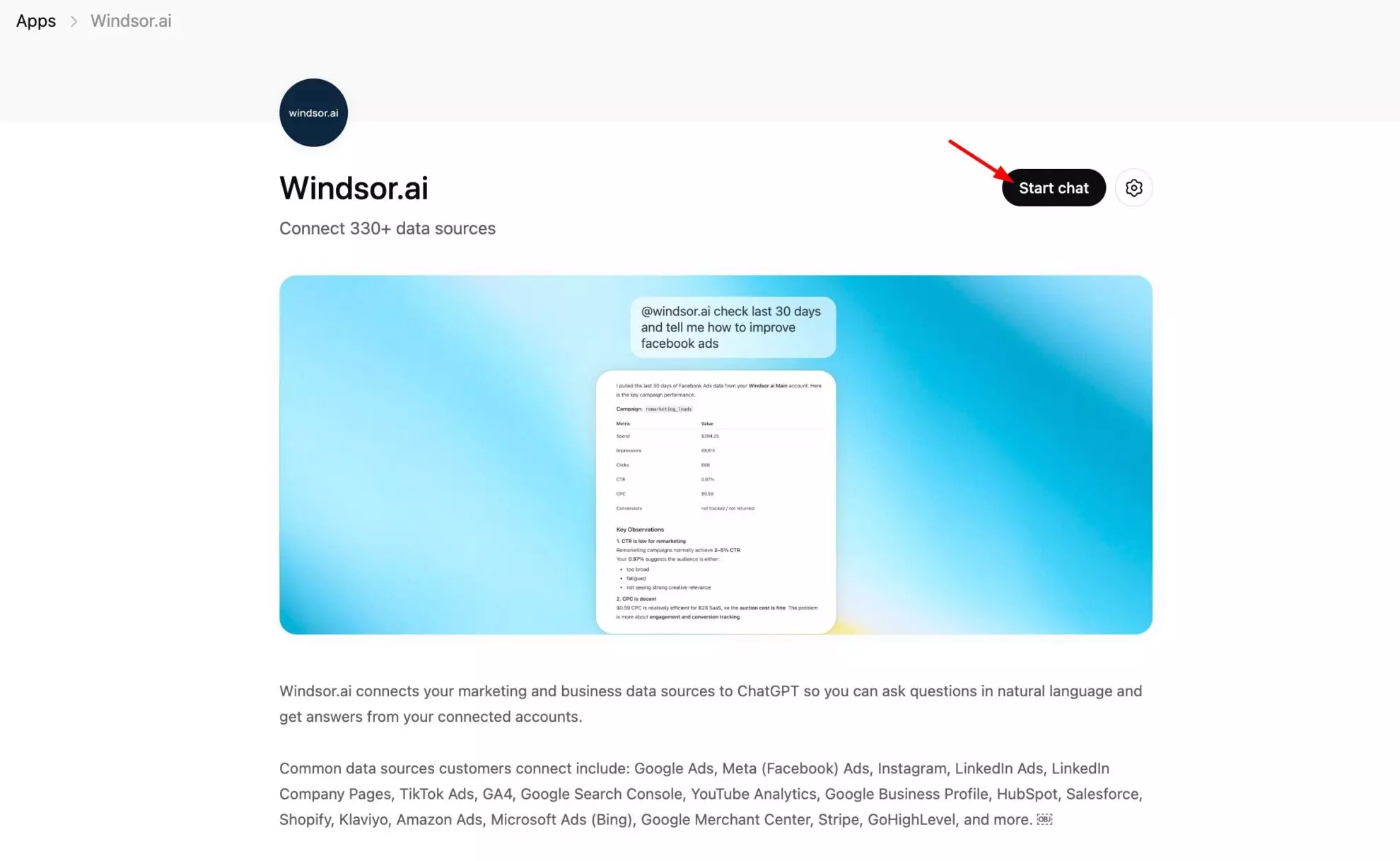
- Search for “Windsor.ai” and install the app
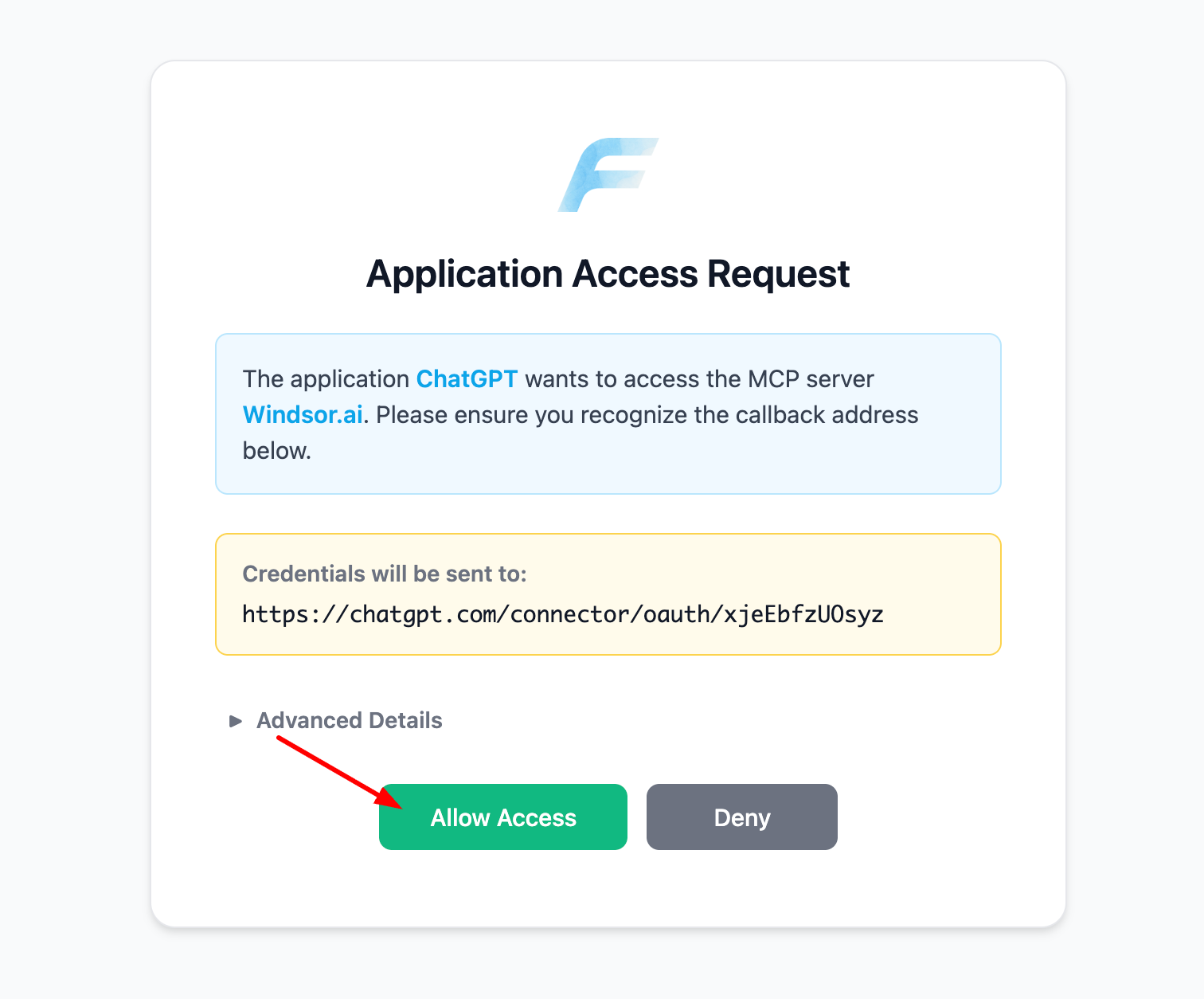
- Allow access when prompted, this authorizes ChatGPT to query the data sources you’ve connected in Windsor
- Once installed, the Windsor.ai app appears in your list of connected apps
List the data sources connected to my Windsor account. Do you see MongoDB there?If it shows up, you’re ready to start asking ChatGPT questions about your MongoDB data in plain language.
The metrics that matter for MongoDB
| Field | What it tells you |
|---|---|
| Data Source | Confirms which Windsor connector a row came from, useful once you’re blending MongoDB with other sources in the same ChatGPT conversation. |
| Source | The same connector-name signal as Data Source, exposed as its own field so it lines up with how other Windsor connectors label their rows. |
| Data fetched at | The exact UTC moment Windsor pulled that row into its cache, so you can tell how fresh a given result is before trusting it in a report. |
| Now | The current timestamp at the moment of the query, handy for calculating how old a document or result is relative to right now. |
| Today | Today’s date, useful for filtering or comparing results against a fixed as-of day inside a prompt. |
What to ask ChatGPT: prompt ideas
Collection overview
Show me what collections exist in my MongoDB database and how many documents are in each.
Summarize document counts by collection in my MongoDB database.
Document-level queries
Show me the most common values in the `status` field across my `orders` collection.
Find documents in my `customers` collection where the `email` field matches a specific value.
Cross-collection comparisons
Compare document counts between my `orders` and `customers` collections over the last 30 days.
The connection is read-only. ChatGPT can query and analyze what’s in your MongoDB collections, but it can’t create, update, or delete documents in your database.
Bonus: analyze MongoDB alongside your full stack
Windsor connects 350+ sources, so MongoDB doesn’t have to live in its own silo. A few realistic blends:
- Cross-channel reporting. Pull your ad platforms, like Facebook Ads or Google Ads, along with your CRM and e-commerce data, into ChatGPT alongside what’s already stored in MongoDB, for one unified view instead of switching between your database and separate reporting tools.
- Single source of truth. Treat MongoDB plus Windsor’s other connectors, including analytics platforms like GA4, as the one place every team queries, instead of juggling separate dashboards for product data and marketing data.
- Blended ROAS. Combine the app or product data stored in MongoDB with live ad spend pulled from Windsor’s other connectors to calculate a true blended return on ad spend that reflects what’s actually happening in your product, not just what an ad platform reports on its own.
Other ways to connect MongoDB to ChatGPT
Manual export with mongoexport
You can use MongoDB’s mongoexport command-line tool to export a collection to CSV or JSON, then upload the file into a ChatGPT conversation. This works for a one-off look at your data, but it’s a static snapshot, any change to your database means running the export again and re-uploading the file.
Zapier or Make
Automation platforms like Zapier or Make can move MongoDB documents into other tools as part of a workflow. That still requires building and maintaining the workflow yourself, and it moves data between apps rather than giving ChatGPT a live view of your database.
Neither approach gives ChatGPT the same live, queryable view of your MongoDB data as the direct Windsor.ai connection.
Conclusion
Connecting MongoDB to ChatGPT through Windsor.ai takes two steps and no code: install the native app, then link your database. From there, ChatGPT can query whatever collections and fields exist in your own MongoDB database, and you can blend that with the other sources you’ve already connected in Windsor.
🚀 Ready to connect MongoDB to ChatGPT? Connect your MongoDB database to Windsor.ai and start querying your data from ChatGPT in minutes.
FAQs
What's the fastest way to send MongoDB data to ChatGPT?
The Windsor.ai native app is the fastest option, since it sets up a live connection in two steps with no manual exports. Alternatives like mongoexport or a Zapier or Make workflow require more manual work and only produce static snapshots.
Do I need to write any code to connect MongoDB to ChatGPT?
No. Connecting through Windsor.ai only requires your MongoDB connection string and credentials, entered through the onboarding page. No scripts or custom integration code are needed.
How do I confirm the connection worked?
Ask ChatGPT to list the data sources connected to your Windsor account. If MongoDB appears in that list, the connection is live and you can start asking questions about your data.
Can ChatGPT analyze my MongoDB data once it's connected?
Yes. Once connected, you can ask ChatGPT questions about your collections and documents in plain language, and it will query your database directly through Windsor.
What fields will be available once I connect my MongoDB database?
That depends entirely on your own database. MongoDB is a flexible document database rather than a fixed-schema API, so Windsor doesn’t return a predetermined list of metrics. Once connected, it exposes whatever collections and fields actually exist in your database, whether that’s user records, product catalogs, custom app data, or event logs.
Can I connect more than one MongoDB database?
Yes, you can repeat the connection process in Windsor for each additional MongoDB database you want ChatGPT to have access to.
Is connecting MongoDB to ChatGPT through Windsor.ai free?
Windsor.ai has a free forever plan with no credit card required, and paid plans starting from $19/month for higher usage.
Can ChatGPT write data back to my MongoDB database through Windsor?
No. The connection is read-only. ChatGPT can query and analyze the data in your MongoDB collections, but it can’t create, update, or delete documents in your database.
How does this compare to manually exporting MongoDB data as CSV or JSON?
A manual export with mongoexport gives ChatGPT a one-time, static snapshot of your data. The Windsor.ai connection stays live, so ChatGPT always sees the current state of your collections without you having to re-export and re-upload files.
Can I combine my MongoDB data with other sources in ChatGPT?
Yes. Windsor connects 350+ data sources, so you can blend your MongoDB data with advertising, analytics, or CRM data already connected, all in the same ChatGPT conversation.


