 Destinations
 Data sources
 AI insights
 About us
 Careers
 Security
 Customer reviews
 Contact us
 Affiliate program
 Solution partners
 Template gallery
 Looker Studio templates
 Power BI templates
 Excel templates
 Google Sheets templates
 Tableau templates
 Facebook Ads templates
 Google Ads templates
 Data fields & Metrics
 AI prompt library & Guides
 Product documentation
 API documentation
 Case studies
 Blog
Blog Data models
 Windsor vs Supermetrics
 Windsor vs Funnel.io
 Windsor vs Fivetran
 Windsor vs Rivery
 Windsor vs Portermetrics
 Windsor vs Coupler.io
 Last updated: 31 August 2026




You can connect ShipHero to ChatGPT in two steps: install Windsor.ai’s native ChatGPT app, then link your ShipHero account through Windsor’s ShipHero connector. No code, no CSV exports, and you can start asking ChatGPT about your inventory and orders within a couple of minutes.
Without a direct connection, checking on stock levels or order status means logging into the ShipHero dashboard, exporting reports, and manually pulling numbers together every time you want a plain-language answer. Connecting ShipHero to ChatGPT through Windsor.ai removes that step, so you can ask about warehouse inventory, order and return activity, or your ShipHero bill in natural language instead.
2 steps to connect ShipHero to ChatGPT
Takes under a minute, no code or manual CSV work required.
Full setup walkthrough: How to integrate data into ChatGPT with Windsor.ai
Prerequisites
- A Windsor.ai account (free forever plan, no credit card, or paid from $19/month for higher limits).
- A ShipHero account with warehouse, order, or fulfillment data.
- A ChatGPT account with access to apps (Plus, Pro, Team, or Enterprise).
Step 1. Connect ShipHero to Windsor.ai
- Create a free Windsor.ai account, or log in if you already have one.
- Open the ShipHero connector and select ShipHero from the list of data sources.
- Authorize Windsor.ai to access your ShipHero account.
- Connect additional ShipHero accounts too, if you manage more than one warehouse or store.
Step 2. Connect the Windsor.ai app in ChatGPT
In ChatGPT, open the apps menu, search for Windsor.ai, and install it as a native app.
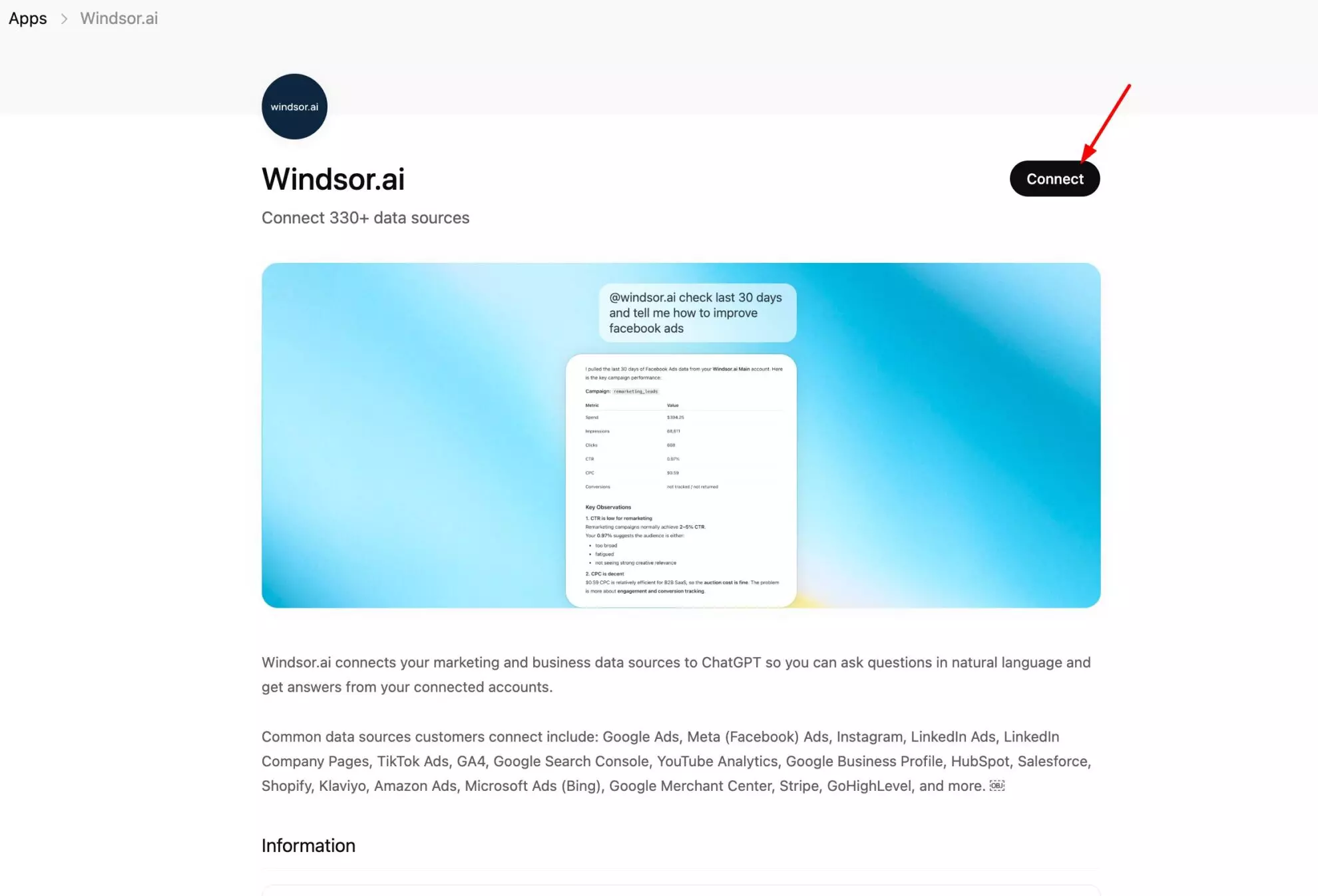
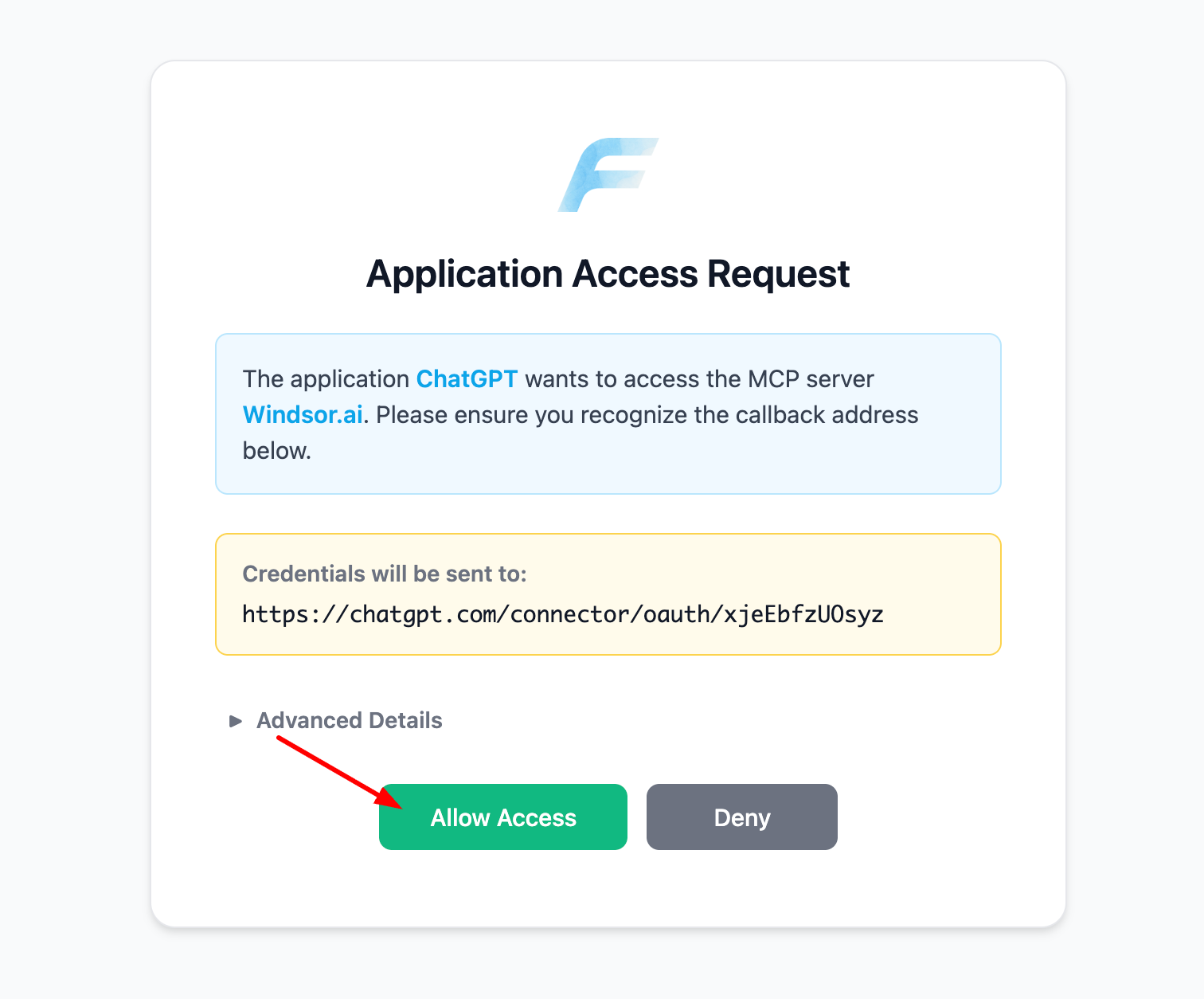
Allow ChatGPT to access your Windsor.ai account when prompted.
Once installed, the Windsor.ai app appears in ChatGPT and can pull in your connected ShipHero data on request.
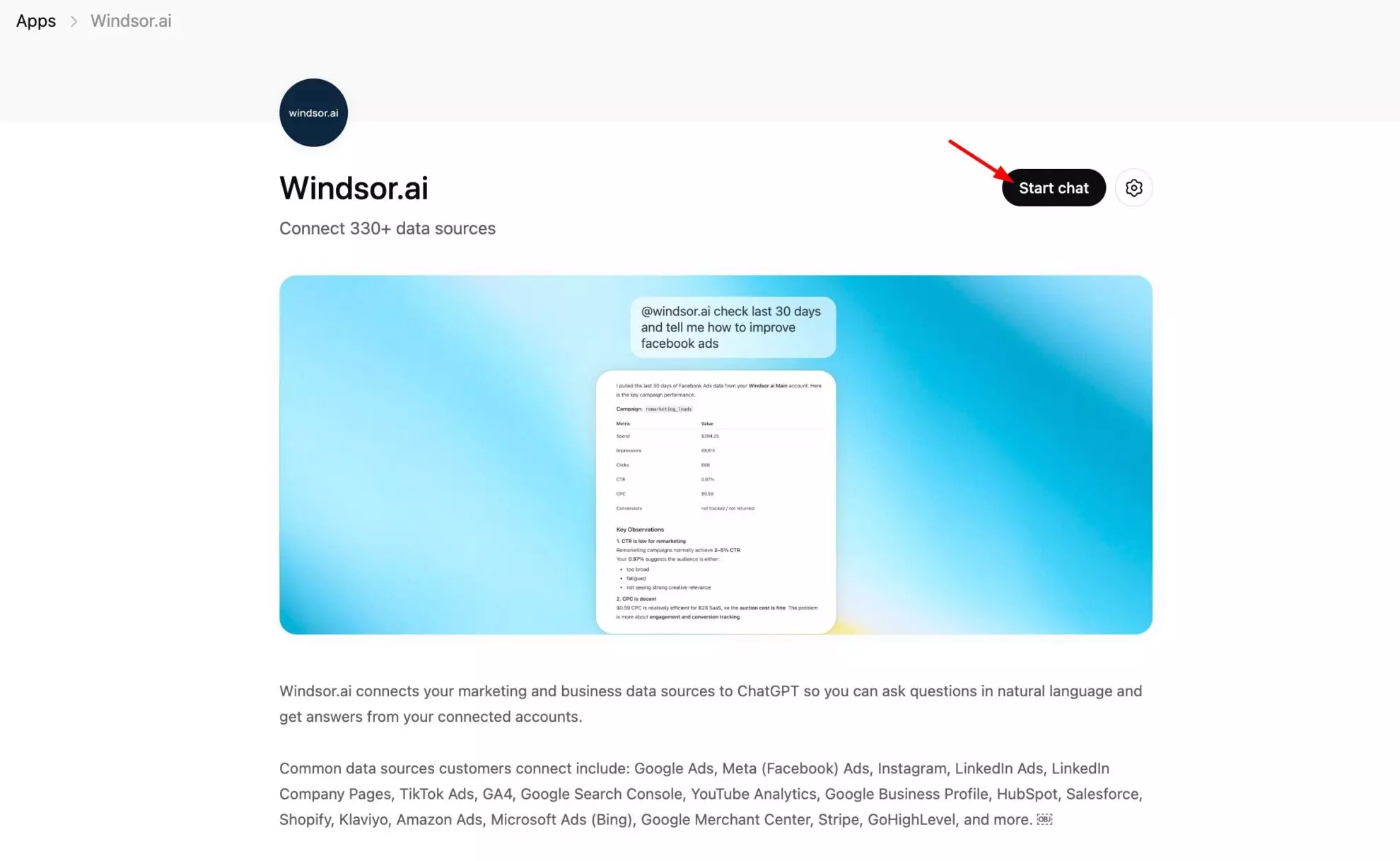
Confirm the connection is live by asking ChatGPT:
List the data sources connected to my Windsor account. Do you see ShipHero there?If ShipHero shows up in the list, you’re ready to query your warehouse and order data in plain language.
The metrics that matter for ShipHero
| Metric | What it tells you |
|---|---|
| Warehouse Product On Hand | The total count of a SKU physically sitting in the warehouse right now, the raw inventory number before any orders are subtracted. |
| Warehouse Product Available | Stock actually free to sell, on hand minus what’s already allocated to open orders, the number that should match what your sales channels show. |
| Warehouse Product Allocated | Units already reserved against open orders, useful for spotting stock that’s spoken for even though it’s still sitting on the shelf. |
| Warehouse Product Backorder | Units you owe customers on open orders but don’t currently have in stock, a direct read on unfulfillable demand. |
| Warehouse Product Reorder Level | The available-quantity threshold that should trigger a new purchase order for a SKU before you run out. |
| Order Fulfillment Status | Where an order sits in the fulfillment pipeline (pending, fulfilled, cancelled), the field to filter on for backlog or exception tracking. |
| Order Total Price | The full amount billed for an order, the top-line revenue figure for anything ShipHero fulfilled. |
| Return Total Items Restocked | How many returned items actually made it back into sellable inventory, versus scrapped or damaged goods. |
| Shipment Total Packages | How many packages a shipment was split into, a signal for split-shipment rates and the packaging cost that comes with them. |
| Bill Amount | A line-item cost on your ShipHero invoice, the field to total up for fulfillment cost per billing period. |
What to ask ChatGPT: prompt ideas
Order fulfillment performance
Show me all ShipHero orders with a fulfillment status of pending right now, sorted by order date.
Summarize this month's order total price by fulfillment status.
Inventory and warehouse tracking
Which warehouse products are below their reorder level today, and what's the backorder count for each?
Shipping cost and speed
Show me shipment total packages by warehouse for the last 30 days.
Break down my ShipHero bill amount by billing period for the last quarter.
The ShipHero connection through Windsor.ai is read-only. ChatGPT can analyze your fulfillment, inventory, and billing data, but it can’t create orders, adjust stock levels, or push any changes back into ShipHero.
Bonus: analyze ShipHero alongside your full stack
Windsor connects 350+ sources, so ShipHero doesn’t have to live in its own silo. A few realistic blends:
- True margin per order. Pair ShipHero’s order total price and bill amount with your ad spend from Google Ads to see real profit per order once fulfillment cost is factored in, not just top-line revenue.
- Single order-to-ship view. Blend ShipHero’s order fulfillment status and shipment data with your Shopify or WooCommerce order data for one timeline from checkout to delivery instead of switching between two systems.
- True landed CAC. Combine ShipHero’s fulfillment and shipping costs with ad spend from Facebook Ads and site conversions from GA4 to calculate customer acquisition cost that includes what it actually cost to pack and ship the order, not just media spend.
Other ways to connect ShipHero to ChatGPT
Manual CSV export
You can export inventory, order, or billing reports from ShipHero as CSV files and upload them to ChatGPT for analysis. This works for a one-off question, but it’s a static snapshot the moment you export it, and you have to repeat the export every time your stock or order data changes.
Zapier or Make
Zapier or Make can move ShipHero data into a spreadsheet or another tool on a trigger, which is a reasonable workflow to maintain if you already use one of these platforms for automation. It still isn’t a live, queryable connection inside ChatGPT itself.
Neither approach gives you the same live, ask-and-answer view of your ShipHero data as connecting directly through Windsor.ai.
Conclusion
Connecting ShipHero to ChatGPT through Windsor.ai turns your warehouse and fulfillment data into something you can ask about directly, instead of pulling reports by hand. Set it up once, and ChatGPT can check inventory, orders, returns, and billing whenever you need an answer.
🚀 Ready to connect ShipHero to ChatGPT? Connect your ShipHero account to Windsor.ai and start asking ChatGPT about your fulfillment data today.
FAQs
What's the fastest, native way to connect ShipHero to ChatGPT?
Installing Windsor.ai’s native ChatGPT app and linking ShipHero through Windsor’s onboarding page is the fastest route. It takes under a minute and doesn’t require a custom connector or pasting any URLs.
Do I need to write code or set up a custom connector?
No. Windsor.ai’s ChatGPT app is a native, one-click install. You authorize ShipHero on Windsor.ai’s side and install the app on ChatGPT’s side, with no code and no custom connector configuration.
Can ChatGPT analyze my ShipHero inventory and order data?
Yes. Once connected, you can ask ChatGPT plain-language questions about warehouse stock levels, order totals, returns, shipments, and billing, and it will pull the answer from your live ShipHero data through Windsor.ai.
Can I connect multiple ShipHero accounts or warehouses?
Yes. You can connect more than one ShipHero account through Windsor.ai, which is useful if you manage several warehouses or storefronts and want to compare them in the same ChatGPT conversation.
What metrics and dimensions does the ShipHero connector include?
The ShipHero connector returns 258 fields in total: 24 metrics and 234 dimensions. Metrics cover warehouse inventory (on hand, available, allocated, backorder, reorder level), orders (subtotal, total price, discounts), returns and shipments, and billing (bill amount, status, due date). The 234 dimensions, such as Account Name, Bill Profile Name, and Date, let you filter and break those metrics down by warehouse, account, or billing period.
How much does it cost to connect ShipHero to ChatGPT with Windsor.ai?
Windsor.ai has a free forever plan with no credit card required, and paid plans start from $19 a month for higher usage limits. There’s no trial period to worry about.
How does this compare to exporting CSVs from ShipHero manually?
A CSV export is a static snapshot the moment you download it, and you have to repeat the process every time your inventory or orders change. Connecting through Windsor.ai gives ChatGPT a live view of your ShipHero data instead, with no repeated exports.
Can ChatGPT update inventory or create orders in ShipHero through this connection?
No. The ShipHero connection through Windsor.ai is read-only. ChatGPT can analyze your warehouse and order data, but it can’t create orders, adjust stock levels, or push any changes back into ShipHero.
Can I combine ShipHero with other data sources in the same ChatGPT conversation?
Yes. Windsor.ai connects more than 350+ sources, so you can blend ShipHero’s fulfillment data with other platforms already connected to your Windsor.ai account for a single, cross-channel view inside ChatGPT.


