 Destinations
 Data sources
 AI insights
 About us
 Careers
 Security
 Customer reviews
 Contact us
 Affiliate program
 Solution partners
 Template gallery
 Looker Studio templates
 Power BI templates
 Excel templates
 Google Sheets templates
 Tableau templates
 Facebook Ads templates
 Google Ads templates
 Data fields & Metrics
 AI prompt library & Guides
 Product documentation
 API documentation
 Case studies
 Blog
Blog Data models
 Windsor vs Supermetrics
 Windsor vs Funnel.io
 Windsor vs Fivetran
 Windsor vs Rivery
 Windsor vs Portermetrics
 Windsor vs Coupler.io
 Last updated: 31 August 2026




The fastest way to connect Amazon Redshift to ChatGPT is to install Windsor.ai’s native ChatGPT app and link your Redshift cluster once at onboard.windsor.ai/app/redshift. After that one-time setup, you can ask ChatGPT questions about the tables and columns in your own warehouse in plain English, with no CSV exports and no pasting query results into the chat by hand.
Without a direct connection, getting an answer out of Redshift usually means writing a SQL query, exporting the result to a spreadsheet, and copying it into ChatGPT every time a new question comes up, a process that goes stale the moment the underlying data changes. Connecting Amazon Redshift to Windsor.ai turns your cluster into a live source ChatGPT can query on demand, alongside any of Windsor’s other 350+ connected data sources.
2 steps to connect Amazon Redshift to ChatGPT
Takes under a minute to set up, no code or manual CSV work required.
See the official Windsor.ai MCP documentation for ChatGPT for the full setup walkthrough.
Prerequisites
- A Windsor.ai account on a plan that includes data warehouse connectors (Amazon Redshift is available from the entry paid plan)
- Your Amazon Redshift cluster connection credentials ready (host, port, database name, and login details for a user with read access)
- A ChatGPT account that supports installing apps
Step 1. Connect Amazon Redshift to Windsor.ai
- Create an account (or log in) at onboard.windsor.ai/app/redshift
- Select Amazon Redshift from the list of data sources
- Enter your cluster’s connection details and authorize Windsor.ai to read from it
- Repeat the process if you report on more than one Redshift cluster or database
Step 2. Connect the Windsor.ai app in ChatGPT
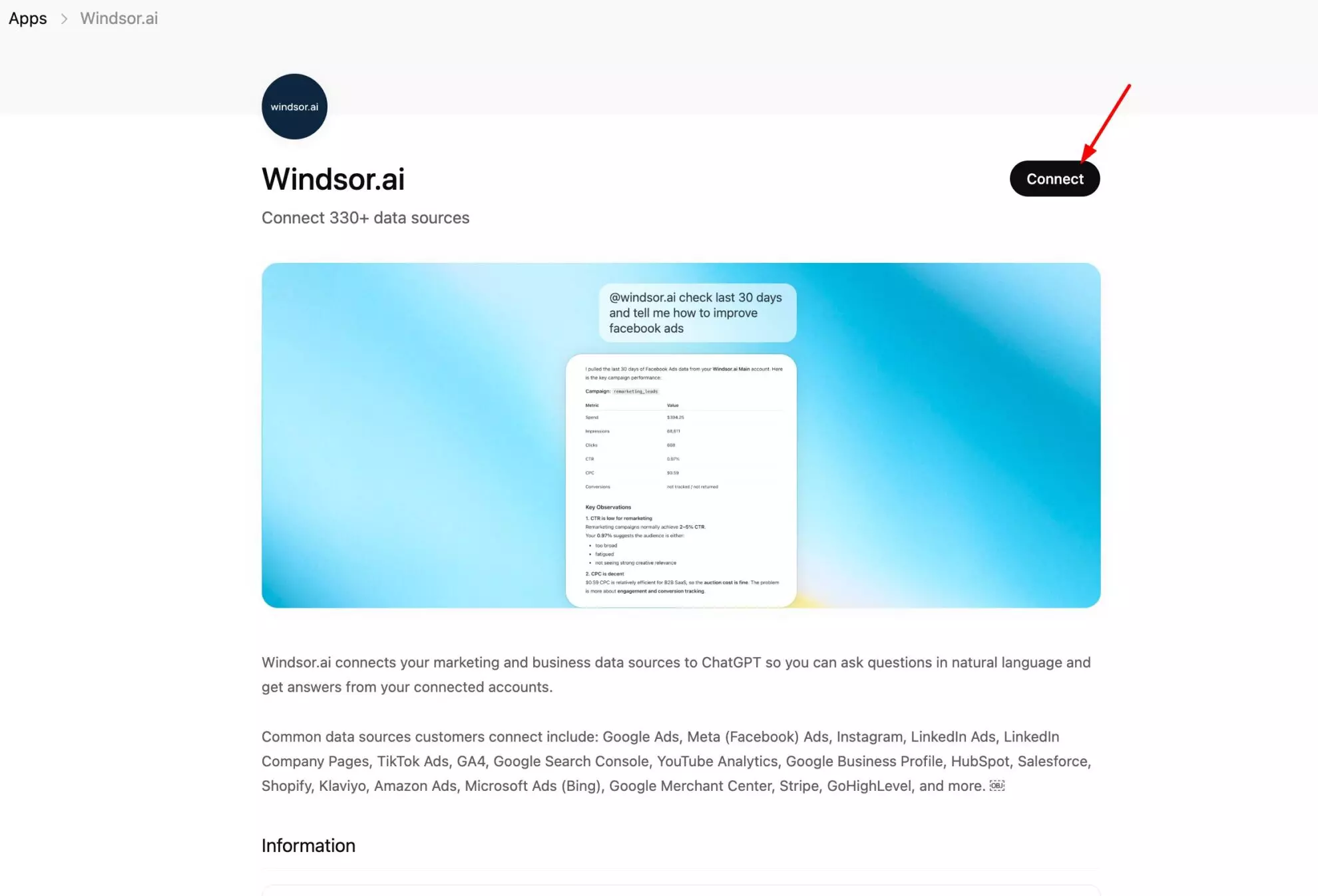
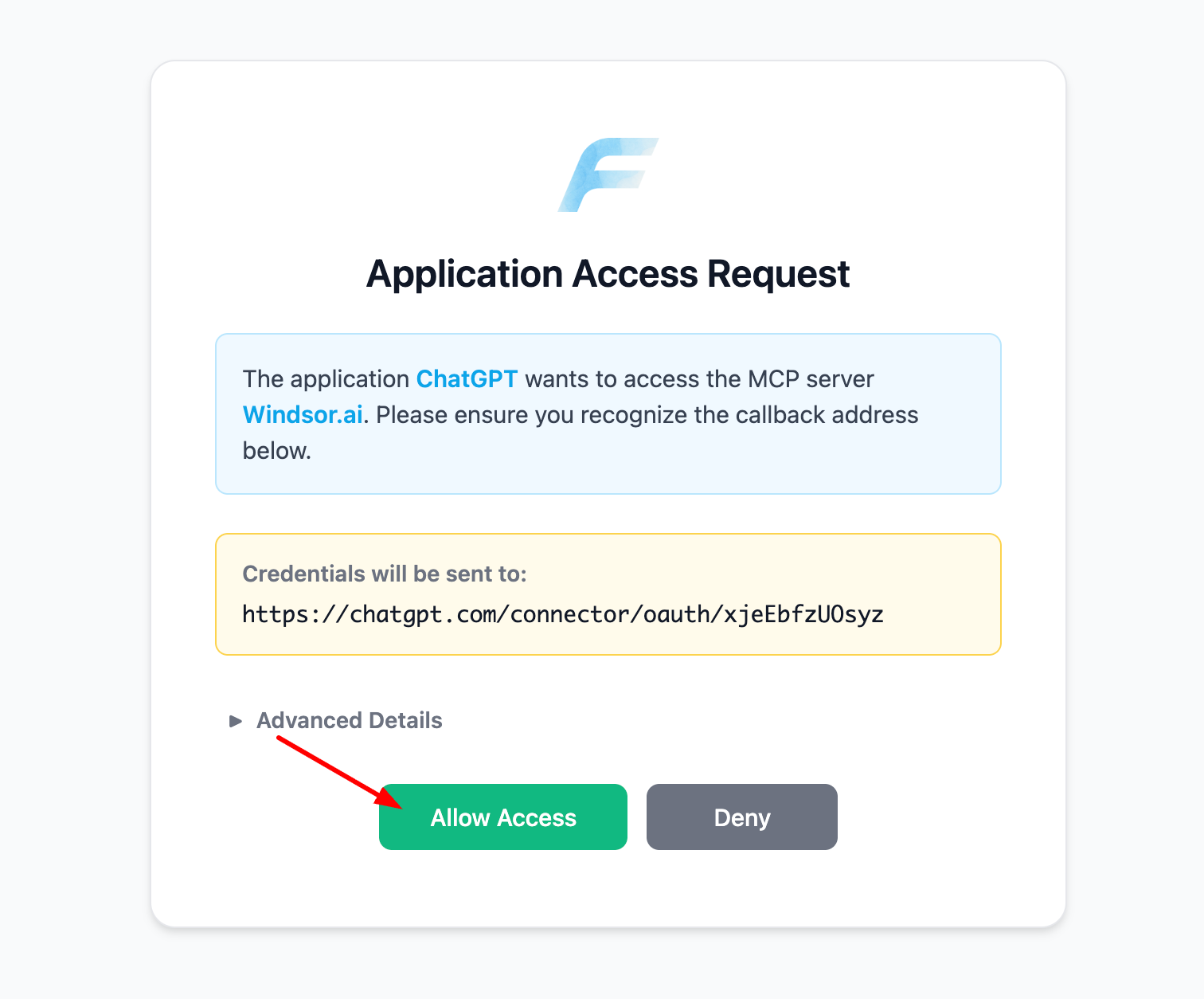
In ChatGPT, open the apps menu, search for Windsor.ai, and install it with one click.
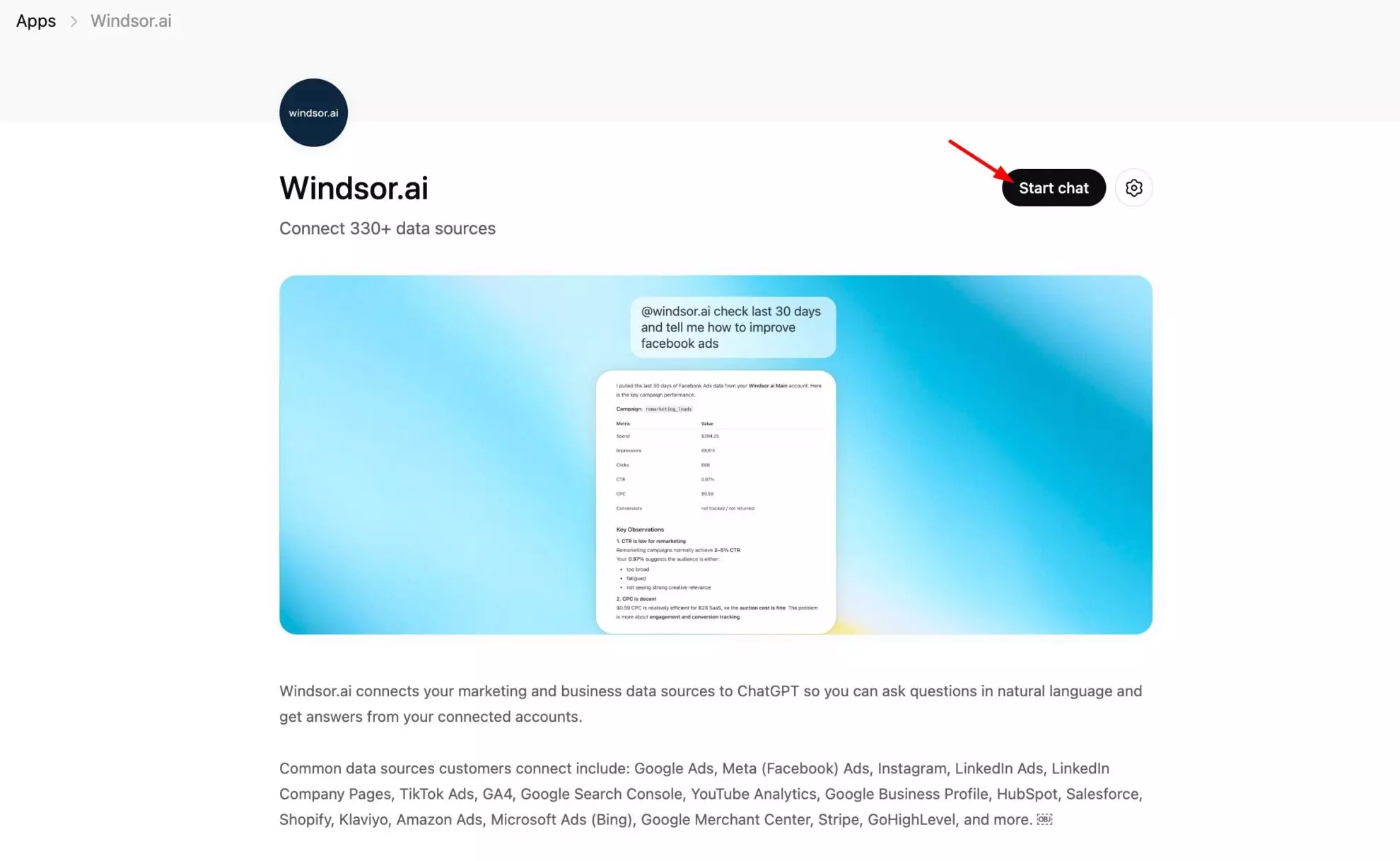
List the data sources connected to my Windsor account. Do you see Redshift there?Once you see it listed, your Redshift warehouse is ready to query in natural language.
The metrics that matter for Amazon Redshift
| Field | What it tells you |
|---|---|
| datasource | Which Windsor connector a row came from, so you can tell Redshift rows apart the moment you start blending them with other sources in the same chat. |
| source | The same connector-identifying value as datasource, exposed under the name Redshift’s own upstream request and response use internally. |
| data_fetched_at | The exact UTC moment Windsor pulled that row from your cluster into its cache, so you know how fresh a given answer actually is. |
| now | The current timestamp at the moment of query, useful when you ask ChatGPT to work out how old a row is relative to right now. |
| today | Today’s date, handy as a fixed reference point when filtering or comparing rows against “as of today.” |
Redshift is a general-purpose warehouse, not a fixed-metric API, so these are the connector-level fields Windsor exposes on every row. The tables, columns, and business data you can actually ask about, orders, customers, a marketing data mart, whatever your team has built, come entirely from your own database schema rather than a predetermined list.
What to ask ChatGPT: prompt ideas
The Windsor.ai connection to Amazon Redshift is read-only. ChatGPT can read and summarize the tables in your warehouse, but it cannot create, update, or push data back into your cluster.
Exploring your warehouse
Show me what tables and columns are available in my Redshift connection.
Summarize row counts by table in my Redshift warehouse.
Understanding a specific table
Show me the schema for the `orders` table and flag any recently added columns.
Compare a few tables in my Redshift warehouse and tell me how they relate to each other.
Confirming the connection
List the data sources connected to my Windsor account. Do you see Redshift there?
Bonus: analyze Amazon Redshift alongside your full stack
Windsor connects 350+ sources, so Amazon Redshift doesn’t have to live in its own silo. A few realistic blends:
- Cross-channel reporting. Pull your ad platforms, CRM, and e-commerce data into ChatGPT alongside whatever is already sitting in Redshift, for one unified view instead of switching between your warehouse and separate dashboards.
- Single source of truth. Treat Redshift plus Windsor’s other connectors as the one place every team queries, so marketing, sales, and finance stop maintaining separate copies of the same numbers.
- Blended ROAS. Combine cost and revenue data already sitting in Redshift with live ad spend from platforms like Facebook Ads or Google Ads for a true blended return on ad spend, without exporting either side by hand.
Other ways to connect Amazon Redshift to ChatGPT
Manual SQL export
You can run a query in a SQL client or BI tool connected to your cluster, export the result to a CSV, and upload the file into ChatGPT. This works for a one-off question, but it’s a static snapshot, you have to repeat the whole process by hand every time the underlying data changes.
Zapier or Make
Zapier and Make both offer Redshift connectors that can move query results into other apps on a schedule or trigger. It’s a maintained workflow, but it’s built to move rows between tools, not to answer an ad hoc question inside a chat.
Neither approach gives ChatGPT the same live, queryable view into your warehouse as the direct Windsor.ai connection.
Conclusion
Connecting Amazon Redshift to ChatGPT with Windsor.ai’s native app takes two steps and turns your warehouse into a source you can ask questions of directly, instead of exporting CSVs or writing SQL every time you need an answer.
🚀 Ready to connect Amazon Redshift to ChatGPT? Connect your Amazon Redshift cluster to Windsor.ai and start querying it from ChatGPT.
FAQs
What's the fastest, native way to connect Redshift to ChatGPT?
The native Windsor.ai app inside ChatGPT. It’s a one-click install, not the older custom-connector, paste-a-URL flow, and the whole setup takes under a minute once your cluster credentials are ready.
Do I need to write any code to connect Redshift to ChatGPT?
No. You enter your cluster’s connection details once during setup at onboard.windsor.ai/app/redshift, and Windsor.ai handles the rest. No scripts, no custom SQL pipelines.
How do I know the connection worked?
Ask ChatGPT to list the data sources connected to your Windsor account. If Redshift appears in that list, the connection is live and ready to query.
Can ChatGPT analyze my Redshift data once it's connected?
Yes. Once connected, you can ask ChatGPT in plain language to summarize tables, spot trends, or pull specific rows from your warehouse, the same way you’d ask a colleague who had SQL access.
What fields or tables are available once I connect my Redshift cluster?
It depends entirely on your own database. Redshift is a general-purpose warehouse, not a fixed-schema API, so Windsor.ai exposes whatever tables and columns actually exist in your cluster, orders tables, customer tables, a custom marketing data mart, whatever your team has built, rather than a predetermined list of metrics.
Can I connect more than one Redshift cluster, or an agency's multiple client warehouses?
Yes. You can repeat the connection step for each additional Redshift cluster or database you need, and switch between them or blend them inside the same ChatGPT conversation.
Can ChatGPT make changes back to my Redshift warehouse?
No. The Windsor.ai connection to Amazon Redshift is read-only. ChatGPT can read and summarize your data, but it cannot create, update, or delete anything in your cluster.
What does connecting Redshift to Windsor.ai cost?
Windsor.ai runs on a freemium model with no credit card required to start. Data warehouse connectors like Amazon Redshift are included starting from the entry paid plan, from $19 a month, since querying a live cluster takes more resources than a fixed API.
How does this compare to exporting a CSV or writing SQL scripts manually?
A manual export or script gives you a static snapshot of your data at one point in time, and you have to redo it by hand whenever something changes. The direct Windsor.ai connection stays live, so ChatGPT can query current data on demand.
Can I combine Redshift data with other channels in ChatGPT?
Yes. Windsor.ai connects 350+ data sources, so you can blend your Redshift warehouse with ad platforms, CRMs, and analytics tools in the same conversation for cross-channel, blended reporting.


