 Destinations
 Data sources
 AI insights
 About us
 Careers
 Security
 Customer reviews
 Contact us
 Affiliate program
 Solution partners
 Template gallery
 Looker Studio templates
 Power BI templates
 Excel templates
 Google Sheets templates
 Tableau templates
 Facebook Ads templates
 Google Ads templates
 Data fields & Metrics
 AI prompt library & Guides
 Product documentation
 API documentation
 Case studies
 Blog
Blog Data models
 Windsor vs Supermetrics
 Windsor vs Funnel.io
 Windsor vs Fivetran
 Windsor vs Rivery
 Windsor vs Portermetrics
 Windsor vs Coupler.io
 Last updated: 1 September 2026




When it comes to data integration platforms, Adverity has established itself as a comprehensive solution for marketing teams and data professionals. However, its complexity, pricing structure, and specific feature set may not align with every organization’s needs.
Whether you’re looking for more marketing-focused automation, simpler implementation, or stronger data warehouse support, several powerful alternatives deserve your attention.
Why look for Adverity alternatives?
Adverity is a formidable data integration platform with almost ten years of market experience. It has 600+ data source connectors, making it the most significant data integration service in the market. With the platform, you can sync almost any data source and destination. But how easy is it to capitalize on so many available integrations?
We talked to companies that have tested and used Adverity. Organizations easily find the connectors they need due to the large number of supported data sources and destinations. The problem is that the platform has core and non-core connectors that must be differentiated. You can use the core connectors for $500/month, and all connectors start at $2000/month.
With that considerable difference in the pricing, why does the entity not differentiate between core and non-core connectors? That’s not the only concern.
Here are more reasons why users are looking for Adverity alternatives:
- Loading one additional data source connector can shoot up the cost to levels the business is unwilling to pay, especially if the additional connector is premium or non-core.
- You can’t build custom data source connectors fast enough.
- You must keep contacting support, yet data integration is supposed to be easy when using an automated connector.
- The platform lacks price transparency, so you must contact sales for a custom quotation.
- It’s just too expensive to connect to a database destination.
When we look at the reasons for seeking an Adverity alternative like Windsor.ai, the pain point for many businesses is the lack of pricing transparency. The difference in pricing for core and non-core connectors makes the tool expensive compared to its competitors. We, therefore, identified competitors who offer pricing transparency and more flexibility in accessing data source connectors and destinations.
This list explores seven top Adverity alternatives that can help you automate data pipelines, unify multi-source analytics, and gain actionable insights without the steep learning curve or enterprise-level investment.
General overview of the top Adverity competitors
We identified eight key Adverity competitors: Windsor.ai, Airbyte, Fivetran, Funnel.io, Improvado, Supermetrics, Hevo Data, and Talend.
Adverity beats all the competitors in the number of data source connectors. That is undoubtedly why many customers go for the platform. However, what is the use of 600+ data source connectors when a massive chunk of them is marked non-core? Do you know that the price of non-core connectors has a 4X premium on the price of core connectors?
The inaccessibility of data source connectors affects the database destinations as well. The platform’s base price lets you connect up to 10 core data sources to business intelligence destinations like Looker Studio, Power BI, Tableau, Google Sheets, and Microsoft Excel.
Notice that Adverity’s base price does not allow you to send data to a database. To connect a database such as Snowflake or BigQuery, the price increases fourfold. None of Adverity’s competitors will charge you such a high base price without transparency.
The following table gives you a general overview of Adverity’s competitors.
| Platform | Adverity | Windsor.ai | Airbyte | Fivetran | Funnel.io | Improvado |
| Data Sources | 600+ | 350+ | 600+ | 600+ | 500+ | 500+ |
| Data Destinations | 28 | 20+ | 30 | 20+ | 39 | 34 |
| Business Intelligence Tools | Yes | Yes | Yes | Through data warehouses for Looker Studio, Excel, & Tableau.
Yes – Google Sheets. No connector for Power BI destination |
Yes | Through data warehouses (But Excel and Google Sheets are available upon request) |
| Looker Studio | Yes | Yes | Yes | Through data warehouses | Yes | Through data warehouses |
| Power BI | Yes | Yes | Yes | No | Yes | Through data warehouses |
| Tableau | Yes | Yes | Yes | Through data warehouses | Yes | Through data warehouses |
| Google Sheets | Yes | Yes | Yes | Yes | Yes | No |
| Microsoft Excel | Yes | Yes | Yes | Through data warehouses | Yes | No |
| Database Destinations | Starting from $2000/month | Starting from $19/month | Starting from $10 per 10 GB | $500 per million rows | Starting from $1000/month | Talk to sales |
| Price | $500 for core connectors and $2,000 for non-core connectors and database destinations. You must talk to sales | Starts from $19 in the Basic plan, $99 in the Standard plan, $249 in the Plus plan, and $499 in the Professional plan | Pricing starts from $10 for every 10 GB or $15 per million active data rows | Pricing ranges from $400 to $900 per million monthly average rows (MAR) | Pricing is about $150 on the Starter Plan and $1100 on the Business Plan based on Flexpoints. | Pricing is yet to be published, but Google Search shows it can be between $2,000 and $5,000. You must talk to sales. |
1. Windsor.ai – Top Adverity сompetitor

The best Adverity alternative is Windsor.ai. Windsor.ai is cheaper and, hence, more value for money. We do not have premium data source connectors or destinations, so you can access all at every pricing level.
Windsor.ai stands out as a powerful no-code ETL/ELT platform designed specifically for data engineers and marketers who need rapid, reliable data integration across marketing channels. With connectors to over 350+ data sources, Windsor.ai eliminates the manual data wrangling that typically consumes valuable hours in fast-paced environments.
What makes Windsor.ai particularly valuable is its focus on creating a single source of truth for business performance. The platform’s automated normalization and schema mapping ensure data consistency across disparate sources, while its seamless integration with popular BI tools like Power BI, Looker Studio, and Google Sheets enables quick visualization and reporting. For teams working under tight deadlines with multiple clients or business units, Windsor.ai’s no-code approach significantly accelerates the time-to-insight without requiring extensive technical resources.
The platform’s strength lies in its balance of power and accessibility, sophisticated enough for complex data engineering tasks while remaining approachable for marketing professionals who need to set up automated reporting workflows quickly.
Adverity vs Windsor.ai
- Data sources and destinations
Adverity has more data source connectors than Windsor.ai. However, since the platform has core and non-core connectors, you can’t access all the data sources at all pricing levels.
Windsor.ai gives you access to all 350+ connectors. Since there are no premium data sources, all platforms are accessible at all pricing levels, subject to the number of connectors you subscribe to in your pricing plan.
Focusing on data destinations, Windsor.ai has 20+ that include business intelligence tools and databases. Windsor.ai will not charge you extra for selecting a database destination, which proves why it is a formidable competitor to Adverity.
- Price and value for money
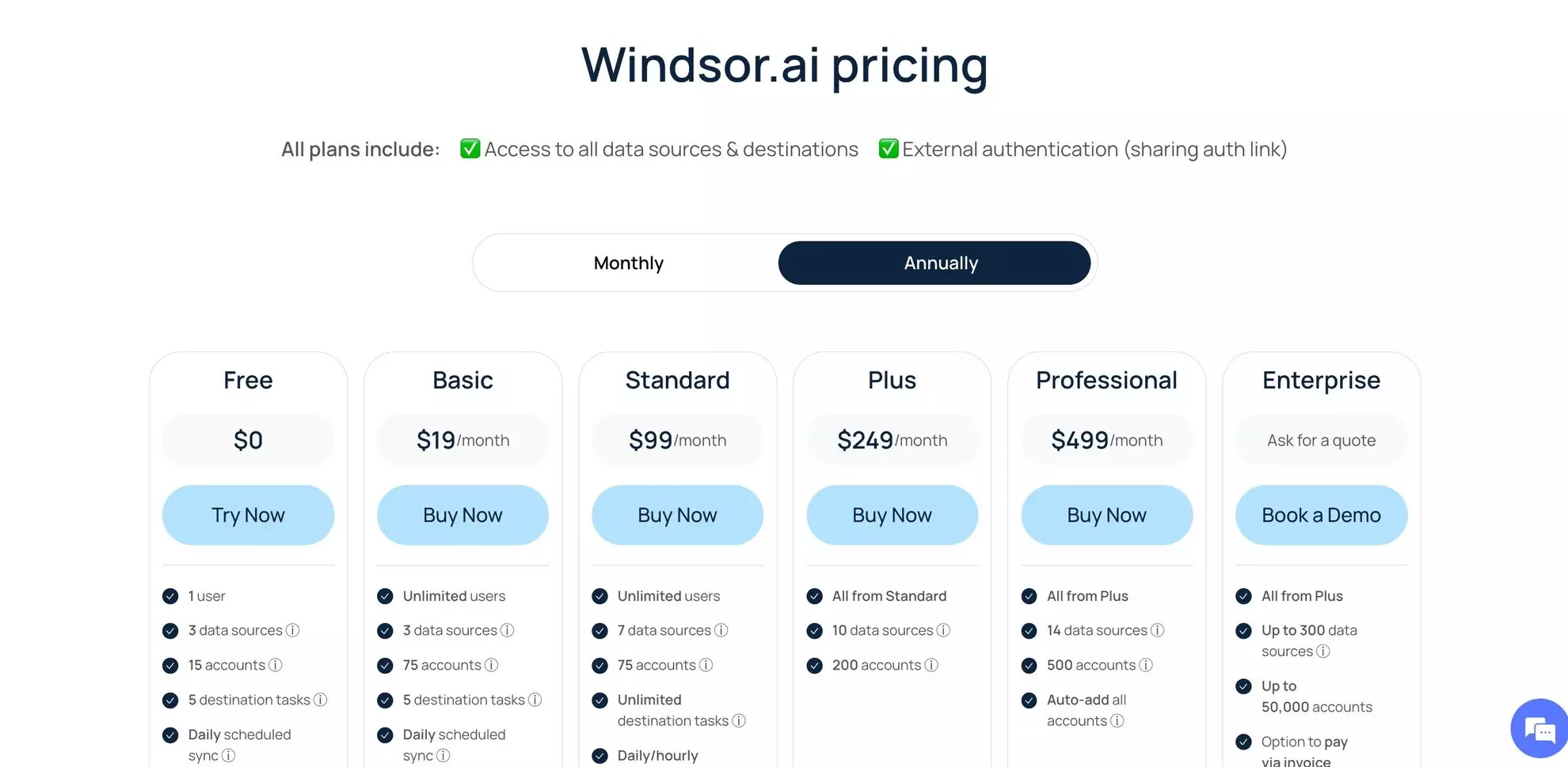
Windsor.ai pricing starts at $19 for the Basic plan. The Standard plan costs $99, while the Plus plan costs $249. The professional plan costs $499. The prices are as presented below. Note that the highest pricing plan on Windsor.ai is lower than the base price on Adverity. Besides, Windsor gives you 14 data source connectors on the Professional plan, which means you get more connectors than you would get for $500 at Adverity. Windsor.ai offers more value for money.
- Customer experience
Customers rate Windsor.ai 4.6 out of 5 stars at G2. Comparatively, Adverity is rated 4.5. That shows Windsor.ai as the better competitor in data integrations. Customers say that Windsor.ai is fast, easy, and has great customer support.
To summarize, here is why we think Windsor.ai is the best Adverity alternative:
- Lower prices considering Windsor.ai starts at $19, while the competition starts at $500.
- A higher value for money since Windsor.ai gives you more data source connectors and destinations for the same price.
- No premium connectors; all data sources are available for all pricing levels.
- Database destinations are available at lower prices. While the competition charges you more for selecting a database destination, Windsor.ai does not discriminate.
2. Fivetran
The second top Adverity competitor is Fivetran. While the number of data connectors is approximately the same on the two platforms, there are differences in how you access the connectors, making Fivetran the better alternative.
Fivetran has built its reputation as a highly reliable automated ETL platform that excels at delivering data to cloud data warehouses. The platform emphasizes “set it and forget it” functionality, with pre-built connectors that automatically adapt to source schema changes, reducing maintenance overhead for data teams.
Where Fivetran truly shines is in its robust support for modern data stack architectures. Data engineers appreciate the platform’s reliability, comprehensive error handling, and detailed logging capabilities. The connector library spans databases, SaaS applications, event streams, and file storage systems, making it versatile for enterprises with diverse data ecosystems.
However, Fivetran’s pricing model is usage-based, which can become expensive for organizations processing large data volumes. It’s best suited for teams prioritizing reliability and warehouse-centric workflows over marketing-specific use cases.
Adverity vs Fivetran
- Data sources and destinations
Fivetran has 600+ connectors, demonstrating why the two are direct rivals. All data source connectors are available at all pricing levels, so Fivetran has no premium data source connectors. Selecting an additional data source connector will not incur further costs.
Focusing on data destinations, Fivetran has 20+, and you can access all of them without extra charges. Database destination pricing on Fivetran is not independent of data rows since you are charged based on active data rows.
- Price and value for money
Fivetran charges per million active rows, starting from around $500/month. Fivetran’s weakness is that businesses with lower data volumes can incur more costs than those with higher volumes. However, the pricing is generally lower, making Fivetran a worthy Adverity competitor.
- Customer experience
Fivetran has a 4.2 rating. While lower than Adverity’s, Fivetran has been lauded as an easy-to-use tool. The only reason why customers give a lower rating is finding the tool expensive and have pricing issues.
In summary, here is why we rate Fivetran as the second-best Adverity alternative:
- All data source connectors are available at all pricing levels.
- You can access database destinations without extra charges.
- Data integration costs reduce with an increase in data volumes, measured in millions of active data rows.
3. Airbyte
Airbyte is the top Adverity alternative for open-source applications. As a leading competitor, Airbyte gives you more choices regarding where to export your data. More importantly, you can access all connectors on Airbyte at any pricing level.
Adverity vs Airbyte
- Data sources and destinations
Airbyte has 600+ data source connectors, a number smaller than the competitor’s. However, Airbyte does not have premium connectors. The data destinations or storage options include cloud-hosting by Airbyte or self-hosting.
Self-hosting enables you to transfer data to your database for only $10 per GB under the Enterprise plan. The database storage proves Airbyte is a worthy Adverity competitor.
- Price and value for money
Airbyte pricing starts from $15 per million active data rows or $10 per 10 GB of data sent to database destinations. That makes Airbyte the competitor with the best value for money because the price per volume of data is the lowest among the competitors.
- Customer experience
Customers give Airbyte a rating of 4.5. Users view Airbyte as an agnostic and versatile tool, with on-cloud and on-premises options, while they criticize its customer support. That shows Airbyte as a strong Adverity competitor.
Here is a summary of why Airbyte is still better than Adverity:
- Lower prices at $10 per 10GB of data transferred to a database or $15 per million active rows.
- No premium data source connectors since all connectors are available at all price levels.
- Database destination is independent of row count because it is charged based on the GB of data transferred.
4. Funnel.io
The fourth-best Adverity alternative is Funnel.io. The platform focuses squarely on marketing data collection and consolidation, offering a no-code approach that prioritizes accessibility for marketing teams. With over 600 connector integrations, Funnel automates the collection of advertising, analytics, and CRM data into a unified data warehouse or visualization tool.
The platform’s strength lies in its marketing-specific data transformations, including automated currency conversions, naming standardization across platforms, and dimension mapping that makes cross-channel analysis straightforward. Funnel’s data explorer interface allows marketers to query and visualize data without writing SQL, democratizing data access across organizations.
Funnel.io works particularly well for performance marketing teams and agencies that manage multiple client accounts and need consistent, reliable reporting frameworks. The platform’s pricing reflects its enterprise marketing focus, making it a significant investment for smaller teams.
In addition, Funnel shares many similarities with Adverity, including a relatively large number of data source connectors, somewhat unclear pricing, having premium data source connectors, and charging different prices for database destinations.
Adverity vs Funnel.io
- Data sources and destinations
Funnel.io has 500+ data source connectors. Similar to Adverity, Funnel also has premium connectors in three tiers: it offers 121 core connectors that you can access in the Starter Plan, 381 Business connectors, and 11 Enterprise Connectors. Similarly, there are premium destinations, so the pricing differs for the various destinations. For instance, the Starter Plan allows you to transfer data to Looker Studio, Google Sheets, and Excel only. BigQuery, Power BI, and Tableau, among others, are accessible from the Business Plan. You can send data to Snowflake only on the Enterprise Plan. You must be keen about your data sources and destinations, as the choices influence your pricing.
- Pricing and value for money
Funnel.io uses Flexpoints in pricing. That means you pay for the connectors and destinations you use. Funnel.io has pricing complexities, but it still gives you more pricing clarity, so we prefer it as an Adverity alternative.
- Customer experience
Customers give Funnel.io a rating of 4.5, similar to Adverity, and feel pleased with the platform. However, new users may have difficulties with managing data and loading connectors they may not be using. Considering that pricing is based on connectors and destinations as some of the pricing factors, having connectors that one is not using can make the platform feel quite expensive.
In summary, here is why we find Funnel.io to be the fourth-best Adverity alternative:
- More transparent pricing compared to the competitor.
- Clear specification of the various tiers of data connectors.
- Transparent specification of data destinations allowed at each pricing level. For instance, Snowflake is only available to Enterprise customers, but you can access other databases at lower pricing levels.
5. Improvado
The next Adverity competitor is Improvado. It positions itself as an enterprise-grade marketing analytics platform that handles complex, large-scale data unification projects. The platform supports over 500 marketing and sales data sources and provides advanced transformation capabilities to normalize data across platforms with different naming conventions and structures.
What distinguishes Improvado is its white-glove service approach, with dedicated data engineers helping clients build custom pipelines and transformations. This makes it an excellent choice for enterprises with sophisticated analytics requirements and the budget to support a premium solution.
The platform’s robust data governance features and ability to handle high data volumes make it suitable for Fortune 500 companies and large marketing organizations. However, this enterprise focus means higher costs and potentially longer implementation timelines compared to more self-service alternatives.
Adverity vs Improvado
- Data sources and destinations
Suppose the price is not a problem, and you process enormous datasets. In that case, you can consider Improvado as the Adverity alternative because the number of connectors won’t limit you. Improvado has 500+ data source connectors and 34 destinations.
- Price and value for money
Pricing on Improvado is based on the data volume; hence, you have more control over your pricing. The pricing for Improvado can be anywhere between $2000 and $5000, which means that Improvado is a big-ticket data connection platform. We know this because Improvado targets businesses with hundreds of millions of data rows. For instance, the Starter plan is for companies with up to 200 million yearly data rows. The enterprise plan is for businesses with up to 1 billion unique annual rows.
- Customer experience
Customers give Improvado a rating of 4.5. The key factor in that rating is good customer support. The real challenge, however, is that Improvado demands a steep learning curve. Other than that, Improvado is a great Adverity alternative.
To summarize our findings, here is why Improvado is the best Adverity alternative for organizations with vast data requirements:
- Ability to handle extremely large datasets.
- Good customer support and onboarding.
- A large number of supported data sources and database destinations.
6. Supermetrics
Supermetrics has carved out a strong niche among marketing teams that need straightforward data delivery from advertising and analytics platforms to reporting tools. With over 100 marketing platform connectors, Supermetrics specializes in moving data into Google Sheets, Excel, Looker Studio, and other visualization tools that marketers already use daily.
The platform’s user-friendly interface makes it accessible for non-technical users, allowing marketing teams to set up automated data refreshes without IT involvement. Supermetrics offers flexible pricing tiers and is particularly popular among agencies and small-to-medium marketing teams who need quick setup and immediate value.
The trade-off is that Supermetrics focuses primarily on marketing data sources and may not provide the depth of transformation capabilities or enterprise-scale data warehouse integration that larger organizations require.
Adverity vs Supermetrics
- Data sources and destinations
Supermetrics focuses primarily on marketing and sales data, with roughly 150 prebuilt connectors covering the major ad, analytics, and e-commerce platforms.
Compared to Adverity’s broader, more omnichannel library, Supermetrics is intentionally narrower and more marketing-centric. It shines when you need to move campaign data into a few familiar tools rather than orchestrate a full enterprise data estate.
Destinations are where the biggest differences appear. Supermetrics offers direct integrations to BI tools like Looker Studio, Google Sheets, Excel, and Power BI on its lower plans, while database, warehouse, and data lake destinations (such as BigQuery, Snowflake, or Amazon S3) are generally reserved for higher-tier or Enterprise contracts. In practice, this means Supermetrics can feel similar to Adverity in having premium destinations that require bigger commitments.
- Pricing and value for money
Supermetrics uses a destination-based pricing model: you buy a product for a specific destination (e.g., Looker Studio, Google Sheets, Excel, or a data warehouse), then pay more as you add data sources, users, or destinations. Entry-level plans for popular destinations start around €29 per month, while higher tiers with more sources, refresh frequency, and advanced features climb into the hundreds per month.
For teams that only need a few marketing sources piped into a single reporting tool, Supermetrics can be significantly cheaper and easier to start with than Adverity’s enterprise-style licensing. However, as you add more destinations, accounts, and connectors, the true cost can rise quickly and become comparable to other enterprise marketing data tools. Several independent reviews call out this complexity and the potential for “hidden” costs around extra connectors and users.
- Customer experience
Supermetrics has an overall rating of about 4.4 on G2 and Capterra. Users consistently praise its ease of use, quick setup, and the breadth of marketing connectors, especially for teams living in Sheets/Excel and Looker Studio.
On the downside, customers frequently mention concerns about pricing, connector reliability, and support responsiveness, especially as their usage scales or when relying on more complex setups. Compared to Adverity, users tend to view Supermetrics as more marketer-friendly and self-service, while Adverity is seen as more robust but also more complex and technical.
In summary, here is why we see Supermetrics as a strong Adverity alternative for marketing-led teams:
- Lower entry-level pricing and simpler onboarding for teams that just need to feed a few marketing sources into reporting tools.
- Strong coverage of core marketing connectors and tight integrations with Google Sheets, Excel, and Looker Studio.
- A more marketer-centric, self-service experience compared to Adverity’s heavier enterprise implementation requirements.
7. Hevo Data
Hevo Data offers a reliable, no-code data pipeline platform that bridges the gap between marketing-focused tools and full-scale enterprise ETL solutions. With over 150 pre-built integrations and real-time data sync capabilities, Hevo provides a balanced approach for teams that need both ease of use and technical flexibility.
The platform’s automated schema mapping and data transformation features reduce the technical expertise required to maintain pipelines, while its support for custom transformations using Python allows data engineers to address complex requirements when needed. Hevo’s pricing model is more accessible than enterprise platforms while still offering the reliability and features mid-market companies require.
Hevo works well for growing organizations that have outgrown basic marketing tools but aren’t ready for the complexity and cost of enterprise-grade solutions. Its customer support and documentation make it approachable for teams without dedicated data engineering resources.
Adverity vs Hevo Data
- Data sources and destinations
Hevo Data supports 150+ prebuilt connectors spanning SaaS apps, databases, and flat files, plus support for custom sources via REST APIs.
Where Supermetrics focuses on spreadsheets and BI tools, Hevo is designed to land data directly into modern cloud databases and warehouses. It offers a more limited but deep set of roughly 15+ destinations, heavily oriented around platforms like Snowflake, BigQuery, Redshift, Databricks, Azure Synapse, and popular relational databases.
This warehouse-first design makes Hevo feel closer to Adverity’s architecture than to spreadsheet-centric tools. However, Hevo does not typically push data straight into Google Sheets; instead, you connect tools like Looker Studio, Excel, and Power BI via the warehouse layer.
- Pricing and value for money
Hevo’s pricing is primarily based on data volume, measured as the number of events or new/updated records loaded into your destination:
- A free tier with up to ~1M events per month and a subset of connectors.
- Paid plans starting around $239/month for several million rows and access to the full connector set.
- Higher-tier and enterprise plans for tens or hundreds of millions of events, with per-million-event overage charges.
This volume-based model generally makes costs more predictable and transparent than fully custom enterprise pricing. For mid-market organizations loading significant volumes into a warehouse, Hevo often ends up cheaper than platforms that require enterprise contracts for similar capabilities. However, smaller teams may find it pricey once they move beyond the free tier, and some reviews note overage surprises if usage spikes.
- Customer experience
Hevo typically scores around 4.4 on review platforms, with users highlighting its ease of setup, reliability, and responsive support, especially compared to more DIY or open-source options.
Negative feedback tends to focus on:
- Pricing is less attractive for very small organizations.
- Historical syncs and very large backfills are taking longer.
Compared to Adverity, Hevo is often perceived as simpler and more opinionated: it focuses on getting data reliably into a warehouse with reasonable transformation capabilities, while Adverity offers more advanced analytics, exploration, and governance features at the cost of greater complexity.
In summary, here is why Hevo Data is a compelling Adverity alternative for growing, warehouse-centric teams:
- Warehouse-first architecture with 150+ sources and a focused set of modern database and warehouse destinations.
- Transparent, volume-based pricing with a usable free tier and mid-market-friendly paid plans.
- Strong balance between no-code usability for most tasks and deeper transformation options via SQL/Python for technical users.
8. Talend
Talend represents the open-source approach to data integration, offering both a free Open Studio version and enterprise-grade paid platforms. Talend provides comprehensive ETL, ELT, data quality, and master data management capabilities in a single platform, making it suitable for complex enterprise data environments.
The platform’s visual interface for designing data pipelines appeals to technical users who want control over every aspect of their integrations. Talend’s extensive transformation library and ability to handle batch and real-time processing make it versatile for organizations with diverse data integration needs beyond marketing analytics.
The trade-off with Talend is the steeper learning curve and the technical expertise required for implementation and maintenance. It’s best suited for organizations with dedicated data engineering teams who need comprehensive control over their data integration infrastructure.
Adverity vs Talend
- Data sources and destinations
Talend takes a broad, enterprise-grade approach to integration. Across Talend Data Integration and Talend Data Fabric, it offers 1,000+ connectors and components, spanning databases, files, SaaS systems, messaging platforms, APIs, big-data engines, and more.
Like Adverity, Talend can connect to virtually any major database, data warehouse, or cloud platform (e.g., AWS, Azure, Google Cloud, Snowflake, Databricks), as well as on-prem systems. Unlike marketing-focused tools such as Supermetrics or Improvado, Talend is designed for general-purpose ETL/ELT, application integration, data quality, and API workflows across the entire organization—not just marketing and analytics.
In practice, Adverity is usually a better fit when marketing and commercial data are your main focus, while Talend is more appropriate when you need to orchestrate data flows across many business domains (finance, operations, core transactional systems) in addition to marketing.
- Pricing and value for money
Talend follows a classic enterprise pricing model:
- Historically, there was a free Open Studio edition, but most new customers now evaluate Talend Data Fabric / Qlik Talend Cloud on subscription licenses.
- Public estimates place entry-level Talend subscriptions in the ~$12k–$30k per year range for small teams, scaling up to six-figure annual contracts for full Data Fabric deployments in large enterprises.
- Pricing depends on factors like users, deployment model (cloud vs on-prem), data volumes, and which specific modules (integration, quality, MDM, API integration) you license.
For organizations that fully leverage its capabilities—ETL/ELT, data quality, governance, and API integration in one platform, Talend can represent strong value. But for purely marketing analytics use cases, it will usually be overkill compared to Adverity or more specialized tools.
- Customer experience
Talend Data Integration and Talend Data Fabric generally score around 4.0 on review sites. Users consistently appreciate:
- The breadth of connectors and integration options.
- Powerful transformation capabilities and flexibility.
- The ability to standardize on a single platform for integration, quality, and governance.
Common pain points include:
- A steeper learning curve and more complex UI compared to lighter-weight tools.
- Performance and troubleshooting challenges for very large jobs, given its Java-based architecture.
- Support quality is rated as adequate but slightly below some modern competitors (e.g., a support score around 7.1/10 vs higher industry averages).
Compared with Adverity, Talend is typically perceived as more technical and engineering-heavy. Adverity’s strengths lie in marketing analytics, out-of-the-box reporting, and business-friendly workflows; Talend excels when a data engineering team wants fine-grained control over pipelines across the entire enterprise stack.
To summarize, here is why Talend is best positioned as an Adverity alternative for technically mature enterprises:
- Extremely broad connector and component library (1,000+), suitable for complex, heterogeneous data landscapes.
- A unified platform that combines ETL/ELT, data quality, governance, and API integration beyond marketing analytics alone.
- Highly flexible, developer-friendly environment for teams that are comfortable with more technical tooling and willing to invest in a steeper learning curve.
Adverity competitors: What is the best pick?
Selecting the right Adverity alternative depends on your specific requirements, technical resources, and budget constraints.
Marketing teams prioritizing ease of use and rapid setup may gravitate toward Windsor.ai or Funnel.io, while data engineers building comprehensive data infrastructure might prefer Windsor.ai or Fivetran for their robust automation and warehouse-first approaches.
Consider your data source requirements, transformation complexity, team technical skills, and scalability needs when evaluating these alternatives. Most platforms offer free trials or demos, allowing you to test their fit within your specific workflow before committing to a subscription.
The right choice will balance accessibility with power, delivering the data integration capabilities your organization needs to make informed, data-driven decisions efficiently.
🚀 Try Windsor.ai today: https://onboard.windsor.ai/ and access all your data from your favorite sources in one place.
Get started for free, no credit card required.
FAQs
Why do teams look for Adverity alternatives?
Teams look for Adverity alternatives mainly because of pricing complexity and connector restrictions. Key reasons include:
- Large price gap between core and non-core connectors
- Extra cost for each additional or premium connector
- Higher pricing to send data to database destinations
- Limited pricing transparency and the need to speak with sales
- Difficulty building custom connectors and over-reliance on support
What is Windsor.ai?
Windsor.ai is a no-code ETL and ELT platform that connects more than 350+ data sources to 20+ destinations, including BI tools, spreadsheets, databases, and cloud data warehouses. It’s designed for marketers and data teams who want to automate data pipelines, create a single source of truth, and avoid complex enterprise-grade setups.
How is Windsor.ai different from Adverity?
Windsor.ai differs from Adverity in a few important ways:
- All data sources are available on every plan, with no premium or non-core connectors
- Database destinations like BigQuery or Snowflake are included in every plan, even in Free
- Pricing starts at $19 per month and scales by number of connectors rather than by connector type
- The focus is on fast setup, no code configuration, and direct access for marketers as well as data engineers
Is Windsor.ai cheaper than Adverity?
Yes. Adverity’s pricing typically starts at around $500 per month for core connectors and about $2,000 per month when you include non-core connectors and database destinations. Windsor.ai plans start at $19 and go up to $499, with all connectors and destinations available on every tier, subject only to the connector count.
Which Adverity alternative is best for cloud data warehouses?
If your main goal is to feed a warehouse like Snowflake, BigQuery, Redshift, or Databricks, the strongest Adverity competitors are:
- Windsor.ai – warehouse plus BI focus and flat pricing
- Fivetran – reliable, warehouse-first, usage-based pricing by active rows
- Airbyte – open source and cloud options with volume-based pricing
- Hevo Data – a warehouse-centric platform with volume-based pricing
Which alternatives give access to all connectors on every plan?
These ELT/ETL platforms do not split connectors into core and non-core categories:
- Windsor.ai
- Fivetran
- Airbyte
- Hevo Data
In contrast, Adverity, Supermetrics, and Funnel.io use premium tiers for some connectors and destinations.
Which Adverity competitor is open-source friendly?
Airbyte and Talend are open-source tools:
- Airbyte provides open-source connectors plus a cloud version, with database storage priced at around $10 per 10 GB.
- Talend originated as an open source ETL platform and now offers enterprise subscriptions under the Qlik Talend brand.
Which Adverity alternative is best for marketing teams without strong technical resources?
For marketing-led teams that want a quick setup and minimal engineering involvement, the best tools are:
- Windsor.ai – no-code interface, marketing + sales + analytics connectors, no premium data sources
- Funnel.io – marketing-specific transformations and currency mapping, though with more complex pricing
- Supermetrics – a marketer-friendly platform for sending campaign data to Sheets, Excel, and Looker Studio
How should I choose the right Adverity alternative for my company?
Follow these steps:
1. List your sources and destinations – e.g., ads, analytics, CRM, finance, warehouses, BI tools.
2. Decide who will use the tool – marketers, data engineers, or a mixed team.
3. Check connector availability – verify that required sources and destinations are included on your target plan without premium upsells.
4. Compare pricing models – flat per connector (Windsor.ai), per active row (Fivetran, Airbyte, Hevo), or enterprise contracts (Adverity, Improvado, Talend).
5. Evaluate complexity vs control – choose simpler tools if you lack engineering capacity, and more technical platforms if you need deep customization.
6. Start with trials or demos – connect a few sources, run a test pipeline, and check reliability, latency, and support before committing.
When does Windsor.ai make the most sense as an Adverity replacement?
Windsor.ai is usually the best fit when you:
- Need transparent, predictable pricing starting far below typical Adverity contracts
- Want access to all connectors and destinations without premium tiers
- Care about both marketing and non-marketing data sources in a single platform
- Prefer a no-code interface that marketers and data teams can share
In those cases, Windsor.ai gives you most of the power of an enterprise data integration platform with less cost and complexity.


