 Destinations
 Data sources
 AI insights
 About us
 Careers
 Security
 Customer reviews
 Contact us
 Affiliate program
 Solution partners
 Template gallery
 Looker Studio templates
 Power BI templates
 Excel templates
 Google Sheets templates
 Tableau templates
 Facebook Ads templates
 Google Ads templates
 Data fields & Metrics
 AI prompt library & Guides
 Product documentation
 API documentation
 Case studies
 Blog
Blog Data models
 Windsor vs Supermetrics
 Windsor vs Funnel.io
 Windsor vs Fivetran
 Windsor vs Rivery
 Windsor vs Portermetrics
 Windsor vs Coupler.io
 Last updated: 1 October 2026




You can connect Google Search Console to Claude in three ways. The Windsor.ai connector takes about a minute and works in the Claude apps and in Claude Code. An open-source MCP server runs on your own computer with your own Google Cloud credentials. A CSV export works for one question about one period.
For a full comparison of the MCP options and the data checks I run before trusting an answer, see Google Search Console MCP.
Three ways to connect Search Console to Claude
| Method | Setup | Works in | Best for |
|---|---|---|---|
| Windsor.ai connector | Sign in, pick the property, add Windsor in Claude | Claude web, desktop and mobile apps, Claude Code | Daily analysis, and Search Console next to GA4 or ad data |
| Open-source MCP server | Google Cloud project, OAuth client, uv | Claude Desktop, Claude Code | URL inspection and sitemap management |
| CSV export and upload | Export from the Performance report | Any Claude chat | One question about one period |
Method 1: the Windsor.ai connector
Before you start
- A Windsor.ai account. The free forever plan covers one data source, with no credit card.
- A Google account with access to the Search Console property.
- A Claude account on any plan.
Step 1: connect Search Console to Windsor.ai
Go to onboard.windsor.ai, choose Google Search Console, sign in with Google and select the properties you want to use in Claude. Pick the property type you use in Search Console: a domain property (sc-domain:example.com) includes every subdomain and protocol, a URL-prefix property only the URLs under that prefix. I always pick the domain property for windsor.ai, because a cannibalization check needs every URL that gets impressions for a query, and a URL-prefix property shows only part of them.

Step 2: add Windsor.ai in Claude
In Claude, open Customize, then Connectors, search for Windsor and click Add. Sign in to your Windsor.ai account when prompted. You can also open the Windsor.ai listing in Claude’s directory and click Connect. The connector you add on claude.ai is also available in the Claude desktop and mobile apps.
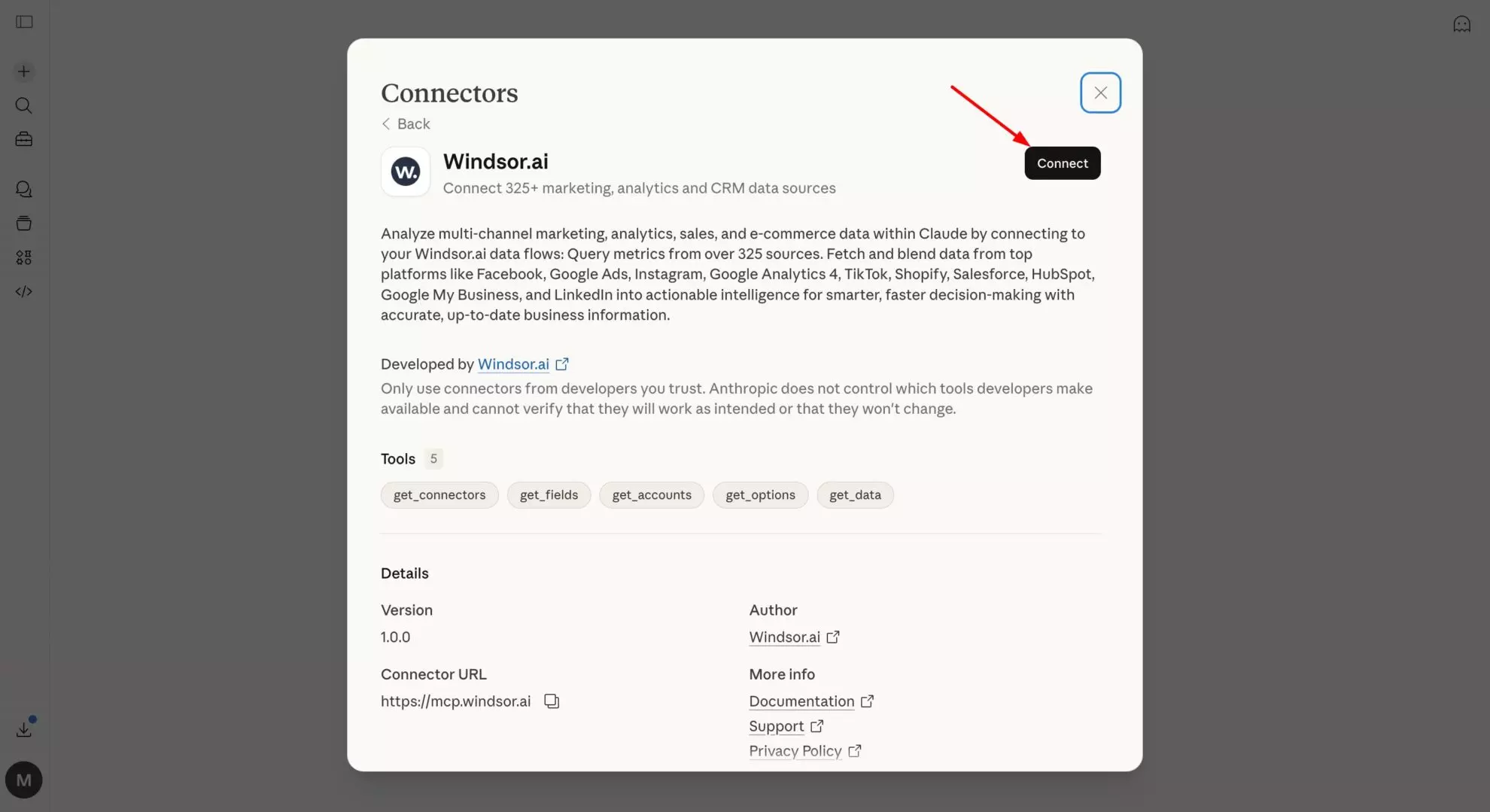
The first time Claude calls the connector in a chat, it asks for permission. Allow once approves that call only; Always allow stops the question for that tool. I use Allow once when I want to see every request Claude makes, for example when I am checking how it built a number.

Step 3: check the connection with a number you know
Using Windsor, show clicks and impressions for [property] for the last 28 days. Tell me the latest date in the data.
Compare the answer with the Performance report for the same dates. Search Console data is usually 2 to 3 days behind, and the delay can be longer during reporting incidents, so ask for the latest date every time.

Claude’s answer on windsor.ai, 1 October 2026. A calendar “last 7 days” held only four days with data, so Claude said so and used the seven most recent days.
In Claude Code
Install the Windsor.ai plugin from Anthropic’s official plugin marketplace, which Claude Code includes by default:
claude plugin install windsor-ai@claude-plugins-officialOr add Windsor’s MCP server directly from your terminal:
claude mcp add --transport http windsor https://mcp.windsor.aiEither way, Claude Code asks you to sign in to Windsor.ai the first time, and every Search Console property you connected in Step 1 is available. The prompts in this guide work the same in the terminal.
Method 2: an open-source MCP server
Google does not publish a Search Console MCP server, so this route uses community code. It needs a Google Cloud project with the Search Console API enabled, an OAuth Desktop client, and uv to run the server. The server asks for full read and write access to Search Console, so add it only for people who should be able to change Search Console settings.
Use this route if you need URL inspection from Claude (index status, last crawl, canonical), which the Windsor connector does not have. The full setup for Claude Code and Claude Desktop, with the configuration and the scope warning, is in Google Search Console MCP.
Method 3: CSV export and upload
- In Search Console, open Performance, then Search results.
- Set the date range and search type.
- Click Export, then Download CSV. The download is a ZIP with one file per tab (Queries, Pages, Countries, Devices, Search appearance, Dates) plus the chart and filter settings.
- Upload the files you need to a Claude chat and say what each one is.
The interface exports at most 1,000 rows per table, and each file is a snapshot of one period. For a site with many queries, the long tail is missing, and comparing two periods means two exports.
I measured what that leaves out on windsor.ai for 2 to 28 September. The Performance report table stops at 1,000 queries (“1-10 of 1000”), the same limit as the export. Through the Windsor connector, the same dates held 54,577 queries once the request was split by device; a single request returned 21,228, because Google returns only its top rows. Sorted by clicks, as the export is, the 1,000 queries in the export brought most of the clicks but only 55% of the impressions. The other 45% came from more than 50,000 smaller queries, about 1,750 of which also brought clicks. For a report on clicks the export is close; for long-tail or impression work it is not.

The Performance report for windsor.ai, 2 to 28 September 2026. The query rows are not shown.
What Claude can analyze through Windsor
| Data | Fields |
|---|---|
| Search performance | Clicks, impressions, CTR and average position by query, page, date, country, device, search type and search appearance |
| Fields Windsor adds | Branded or non-branded (domain name in the query), words in the query, results page number, URL path levels (pathlevel1 to pathlevel4), page path, hostname |
| Sitemaps | Submitted URLs, errors, warnings, last download and last submission per sitemap |
The connector does not include URL Inspection or the Page indexing report, so Claude cannot tell you why a specific URL is not indexed. It is read-only: Claude can analyze Search Console and draft changes, and you make them in Search Console. The full list is in the Search Console field reference.
Prompts to start with
Queries close to page one
Using Windsor, list queries with an average position between 11 and 20 and at least 1,000 impressions in the last 28 days, ending three days ago. Show clicks, CTR and the page that ranks for each. For each query, tell me whether another of our pages also gets impressions for it.
On windsor.ai in September this returned 19 queries with 36,214 impressions and 17 clicks between them. I ask the second half because when two of our pages share a query, the fix is usually to update or merge the weaker page, and a new article would add a third.
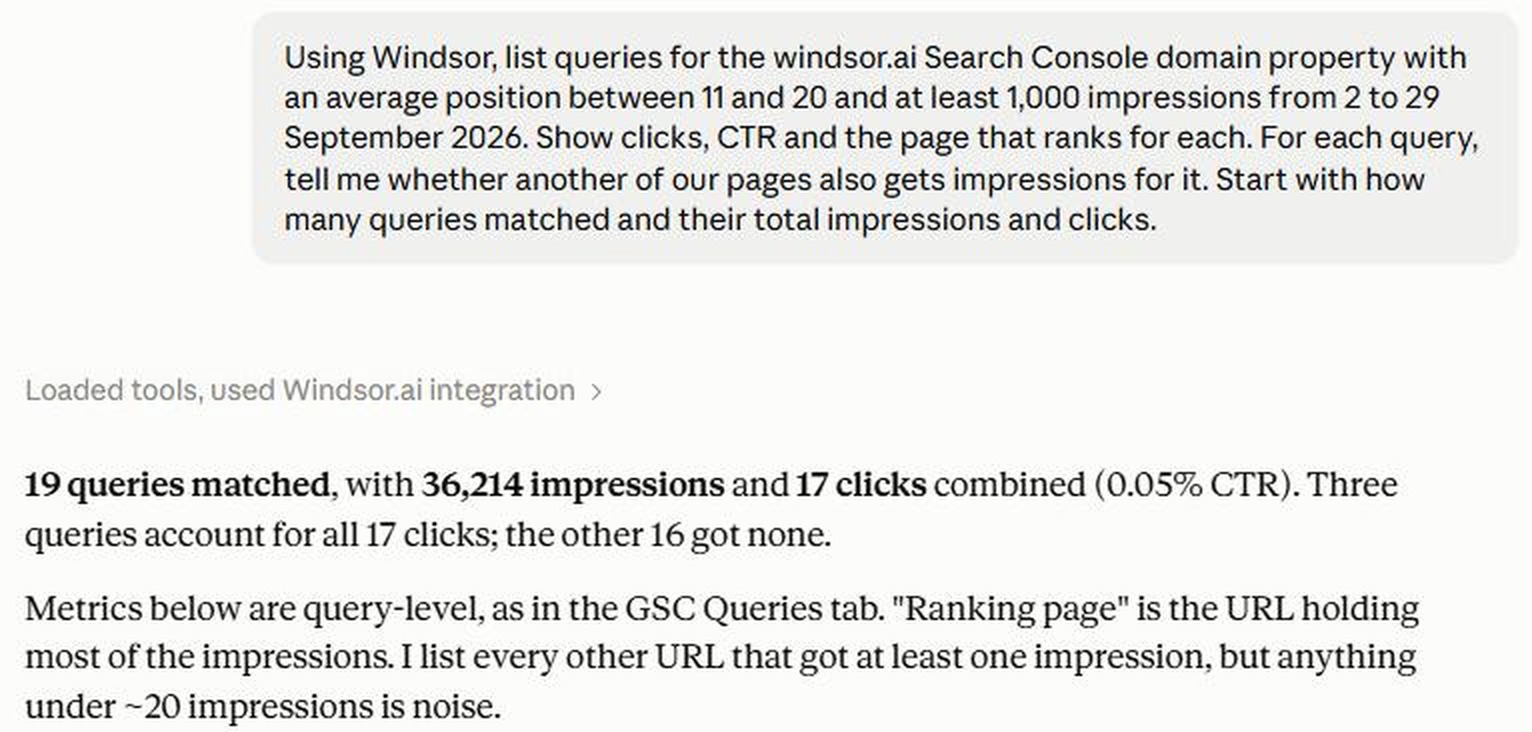
Claude’s answer on windsor.ai’s Search Console data, 1 October 2026. The query table below the summary is not shown.
Pages losing visibility
Show the pages that lost the most impressions in the last 7 days compared with the 7 days before. For each page, list the queries that lost position and the queries that lost the most impressions.
Titles that underperform their position
Show pages with more than 2,000 impressions in the last 28 days whose CTR is below the average for their position on our site. Suggest two new titles for each, based on the queries they rank for.
Sitemap problems
List our sitemaps with submitted URLs, errors, warnings and the last download date. Flag any sitemap Google has not downloaded in the last 7 days.
More prompts, including the ones I use every week, are in Google Search Console MCP.
Search Console data not showing in Claude?
- Property mismatch. The property selected in Windsor.ai (domain or URL-prefix) must be the one you want to analyze. A URL-prefix property only reports URLs under its prefix.
- Fresh data. The last 2 to 3 days are usually incomplete, so a new connection does not show today’s numbers.
- Permissions. The Google account you signed in with must have access to the property in Search Console.
- Totals that look low. Rows that carry a query add up to less than the site total, because Google hides rare queries. On windsor.ai in September, rows with a query covered 68% of clicks. Ask Claude whether a total is for all clicks or for clicks with a query.
Still stuck? See the troubleshooting guide.
Analyze Search Console next to GA4 and Google Ads
With more than one source connected in Windsor.ai, one prompt can join them:
- Search Console and GA4. Which pages get organic clicks but few engaged sessions. Check that both sources use the same form of the URL first; the GA4 to Claude guide covers the GA4 side.
- Search Console and Google Ads. Queries you pay for while you already rank in the top three organically.
The free forever plan covers one source. Using two or more sources after the first 30 days needs a paid plan, from $19 a month for three sources or $99 a month for seven. See pricing.
Conclusion
For daily work in Claude, add the Windsor.ai connector: sign in, pick the property, add Windsor in Claude, and check one number you know. Add an open-source server only if you need URL inspection, and limit who gets it. Use a CSV export for a single question. Before acting on an answer, ask for the latest date in the data and whether a total includes the hidden queries.
For the comparison of MCP options and the checks I run, read Google Search Console MCP. For the method I use on competing pages, read how I catch content cannibalization with Claude. If your team works in ChatGPT, the plugin setup is in how to connect Google Search Console to ChatGPT.
🚀 Connect Search Console to Claude with Windsor.ai. Free forever plan, no credit card. Try Windsor.ai.
FAQs
Do I need to write code to connect Search Console to Claude?
No. With the Windsor.ai connector you sign in and click Add. The open-source servers need a Google Cloud project, an OAuth client and a configuration file.
Does Search Console in Claude work in Claude Code?
Yes. Install the Windsor.ai plugin with claude plugin install windsor-ai@claude-plugins-official, or add the server with claude mcp add --transport http windsor https://mcp.windsor.ai.
Can Claude check whether a page is indexed?
Yes, with an open-source MCP server that has URL inspection, up to 2,000 inspections per property per day. Windsor.ai has no URL Inspection, so it cannot check a single URL’s index status.
How current is the Search Console data in Claude?
Usually 2 to 3 days behind, the same as Search Console itself. Ask Claude for the latest date in the data with every answer.
Can I analyze several Search Console properties in one chat?
Yes. Every property you connect in Windsor.ai is available in the same chat, so you can compare two sites or two clients in one prompt.


